If you have ever looked in the mirror and suddenly felt that your face looked more tired than before, you may have become interested in thread lifting at least once.
As nasolabial folds deepen, the cheeks appear to descend, and the entire face looks heavier, concerns about appearance can naturally grow.
As midface sagging worsens, the center of the face descends, deepening the nasolabial folds, reducing volume, and changing the overall impression to appear older.
In such cases, a midface thread lift may help restore a lively and youthful appearance.
One important point is that choosing a procedure based solely on price may not lead to satisfactory results.
The midface is one of the more technically challenging areas for thread lifting.
Each person has a different skin type and degree of sagging. In particular, because nerves and blood vessels are located in this anatomically complex area, it is important to receive treatment from a board-certified plastic surgeon with extensive experience in the procedure.
Today, I will explain in detail the topics that people considering a thread lift due to midface sagging are most curious about.

Why does midface sagging occur?
The midface refers to the area extending from below the eyes to the cheeks and the area around the nasolabial folds.
When we are young, volume is positioned higher, giving the face a three-dimensional appearance.
However, over time, as collagen and elastic fibers in the skin decrease and the effects of gravity take hold, the cheek tissue gradually descends.
This process can cause several characteristic changes.
The nasolabial folds may deepen, the medial cheek may sag, the facial contours may lose definition, and the area under the eyes may appear hollow or create a tired appearance.
The midface has a particularly significant effect on overall facial impression.
Even among people of the same age, those with less midface sagging often look much younger, while those with more pronounced sagging often appear older than their actual age.

How is a midface thread lift different from a general thread lift?
Many people think of thread lifting simply as a procedure that lifts the skin upward.
However, a midface thread lift is somewhat different.
Because the midface is a three-dimensional structure in which the cheekbones, cheeks, and nasolabial folds are all connected, simply pulling in one direction does not resolve the issue.
For this reason, it is best to understand that the procedure requires personalized design after analyzing the overall facial structure.
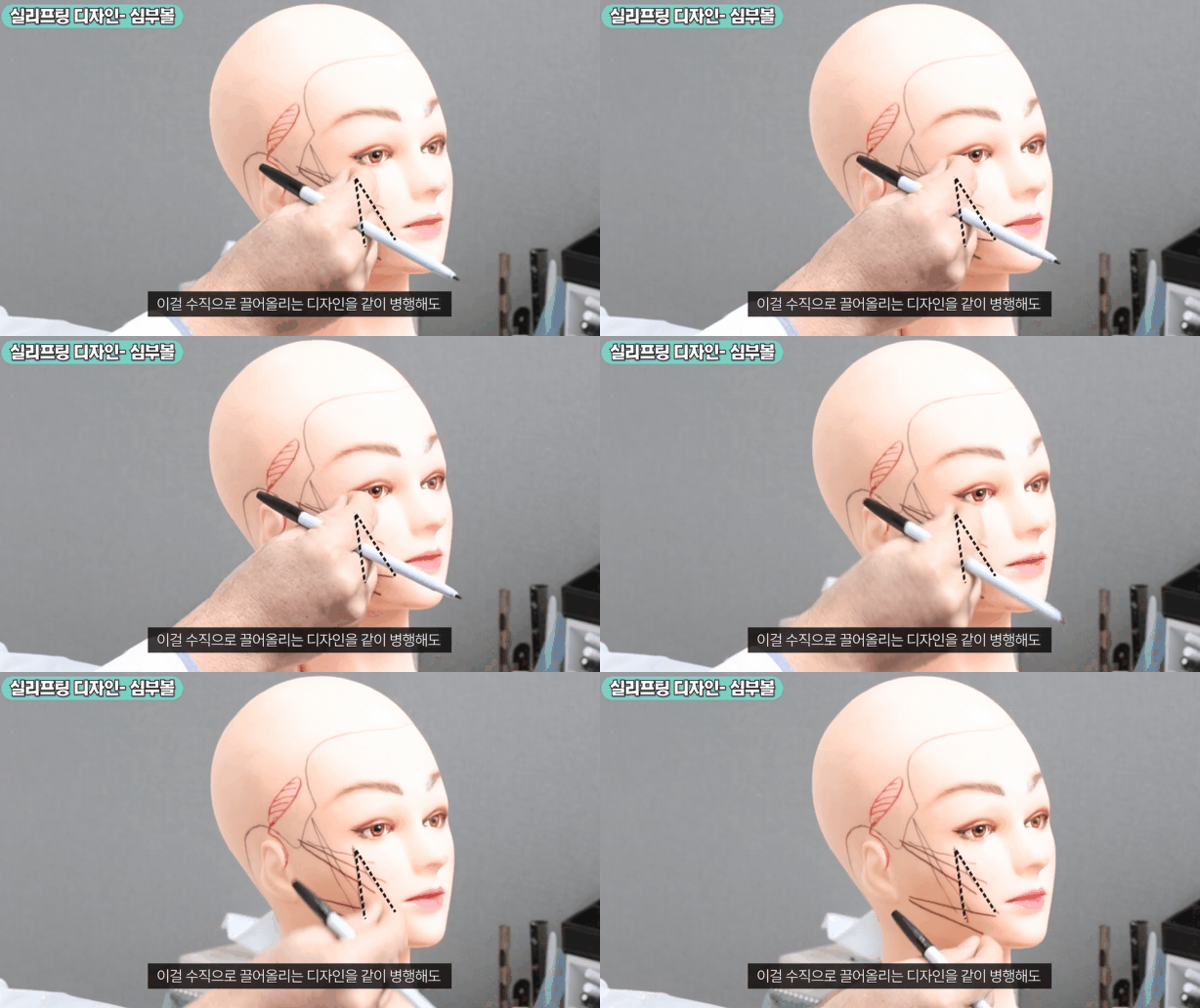
The most important factor in a midface thread lift is the design
One reason satisfaction can vary significantly after a thread lift is the design.
Simply inserting a large number of threads does not guarantee a good result.
What matters more is the direction in which the tissue will be pulled, the layer in which the threads will be placed, and the degree of tension to be applied.
Because the cheekbones and cheek tissue are complexly connected in the midface, an incorrect design can make the cheekbones appear more prominent or cause the cheeks to look hollow.
Therefore, before the procedure, it is necessary to thoroughly assess not only the condition of the skin but also the amount of fat and muscle, the direction of sagging, and the shape of the face.
With a midface thread lift, the key is ultimately not how much the tissue is pulled, but how naturally it is lifted.

Why is a tripod-shaped thread lift important?
Some thread lifts are performed by pulling the tissue in only one direction.
In such cases, force may become concentrated in a specific area, reducing durability or producing an unnatural result.
To address these limitations, a tripod-shaped thread lift may be applied.
A tripod refers to a structure that supports tissue from three directions, like a tripod stand.
Because the skin and tissue are secured from multiple directions rather than just one, a more three-dimensional lift is possible, and this can also help improve durability.
This approach is particularly important in areas such as the midface, which have many curves and a three-dimensional structure.
Areas such as the medial cheek, nasolabial folds, and sagging midface require a more three-dimensional approach.

How long do the effects of a midface thread lift last?
This is one of the questions most frequently asked by people considering a thread lift.
The threads used for thread lifting dissolve over time. However, the fact that the threads dissolve does not mean that the treated area immediately returns to its original state.
This is because collagen production is stimulated and skin elasticity may improve in the areas where the threads were placed.
The duration varies depending on factors such as skin condition, lifestyle, and degree of sagging, but it can generally be considered to last approximately 6 to 12 months.
However, more important than the duration is whether the procedure was performed using an approach suitable for you from the beginning.
If too few threads are used or the design is not appropriate, it may be difficult to experience the expected results.

Why is experience important for a midface thread lift?
The midface is one of the most challenging areas of the face to lift.
This is because the cheekbones, cheeks, nasolabial folds, and medial cheeks must all be considered together rather than simply pulling the skin.
Even when the degree of midface sagging is similar, one person may need volume restoration first, another may need correction of the nasolabial folds as a priority, and another may require stronger fixation.
In addition, the type and direction of the threads must be designed differently according to skin thickness, fat volume, facial shape, and the pattern of aging. Therefore, extensive experience and anatomical understanding are important.
Midface sagging is an aging-related change that can alter the overall impression and facial contours.
Therefore, if you are planning a thread lift, rather than simply comparing prices or the number of threads, first check whether a design suited to your face is possible, whether the provider has sufficient experience and expertise with the midface, and whether the cause of the sagging is being accurately analyzed.
A midface thread lift is not a procedure applied in exactly the same way to everyone.
By carefully analyzing each person’s facial structure and designing the direction and fixation method according to the cause of the sagging, it is possible to expect a more natural result with greater satisfaction.
Thank you.
| This post was written for the purpose of providing information in compliance with Article 56, Paragraphs 1–15 of the Medical Service Act. All treatments carry the risk of side effects and complications depending on the individual. Before undergoing treatment, please consult thoroughly with a medical professional who has extensive experience and make your decision afterward. |