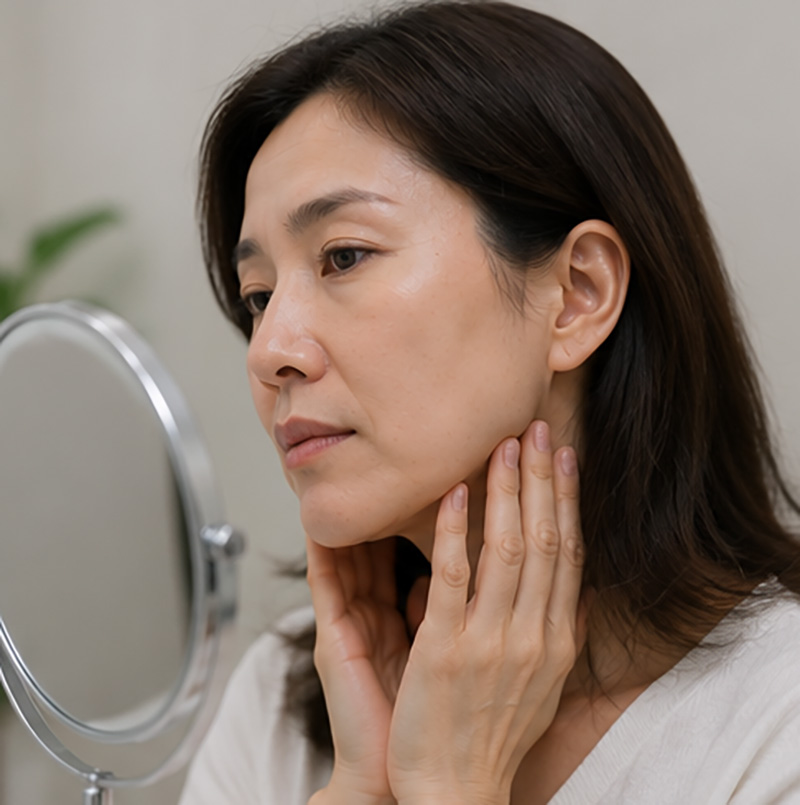
When discussing facial aging, people often mention reduced skin elasticity, wrinkles, and sagging cheeks separately. In reality, however, these changes begin simultaneously in one area: the midface, the region extending from below the eyes to around the mouth.
The midface is a key area that influences your first impression. When you are young, this area has ample volume, and the tissues sit high, creating dimension in the face. As you age, collagen and elastic fibers in the skin decrease, and gravity causes the cheek tissue to begin shifting downward. The upper cheeks then become hollow, while tissue accumulates in the lower area, deepening the nasolabial folds and creating shadows beneath the eyes. This is the source of a tired appearance, a heavier expression, and an overall older-looking appearance.
What Is Midface Thread Lifting?
Midface Lifting
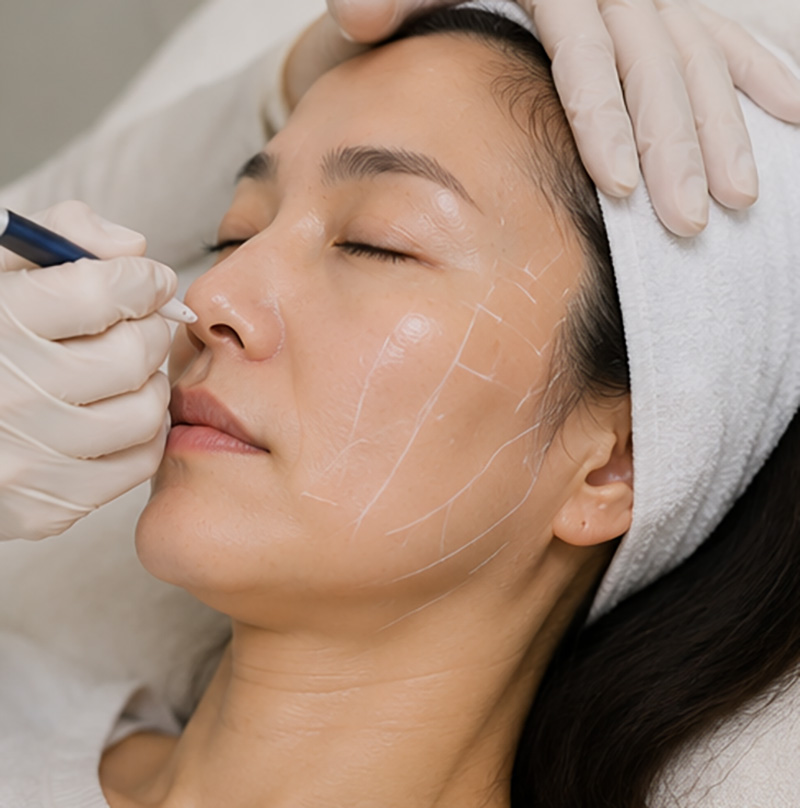
Midface lifting is a nonsurgical procedure designed to improve sagging in the midface. Medical-grade threads are inserted into the dermal layer beneath the skin to pull up and secure sagging tissue. Traditional facelift surgery is powerful because it directly dissects and lifts the skin and underlying tissue, but it requires incisions and a lengthy recovery period. In particular, the center of the face has many limitations for surgical approaches because scars may be easily visible. Midface thread lifting addresses this limitation by using threads, making it possible to improve midface sagging without concerns about visible scars.
The procedure is performed under local anesthesia and takes approximately 30 minutes. You can return to your daily activities on the day of the procedure, and you can wash your face and apply light makeup starting the following day, making it a manageable option even for people with busy schedules.
Why Is the Midface More Challenging—Why Does It Need to Be Treated Differently from Ordinary Thread Lifting?
Midface Lifting
The midface is more difficult to treat than other areas for two reasons. First, it moves frequently. The midface is constantly moving when you make facial expressions or speak. Second, the tissue is soft. Because the area contains a dense structure of fat and soft tissue, it is difficult for threads to remain in their intended position. With a conventional approach—inserting one thread in one direction, using a one- or two-dimensional technique—retention may be insufficient, which is why the effects can diminish quickly over time.
The Tripod structure is one way to address this issue. Like a tripod, it positions threads in three directions to secure the skin three-dimensionally. Rather than pulling in only one direction, it supports the tissue from three directions, so the threads are less likely to shift with facial expressions and the lifting effect can be maintained more evenly. This is also why the result can look natural. Instead of creating a forced or artificial appearance, the tissue is supported in multiple directions and follows facial movement naturally.

Customized Treatment According to the Pattern of Sagging?
Midface Lifting
Even with midface sagging, the treatment plan may vary depending on which area is the primary concern.
| Category | Main Symptoms | Treatment Focus |
|---|
| Primarily nasolabial folds | Deeper lines around the mouth, tissue gathering beneath the cheeks | Lift the tissue compressed above the nasolabial lines upward |
| Primarily deep cheek area | Hollowing in the upper cheeks, downward shift of the face’s overall center of gravity | Lift from the deep fat layer to restore the position of the cheeks |
The two patterns often occur together. In such cases, the treatment plan is designed by combining vectors suited to each concern. Because the result varies depending on where the thread insertion and fixation points are set, the preliminary assessment and planning stages are just as important as the procedure itself.
In addition, it can be effective to structure midface lifting in stages according to the degree of sagging and the condition of the skin. First, basic lifting is performed while restoring volume to hollow areas. Next, the subtle sagging around the nasolabial folds and beneath the cheekbones is fine-tuned. Finally, the procedure is completed by maximizing the fixation of the lifted tissue so that the effect can be maintained for longer. This sequence is important because simply pulling the tissue without first restoring volume can make the face look more artificial.
How Long Do the Effects Last After the Procedure?
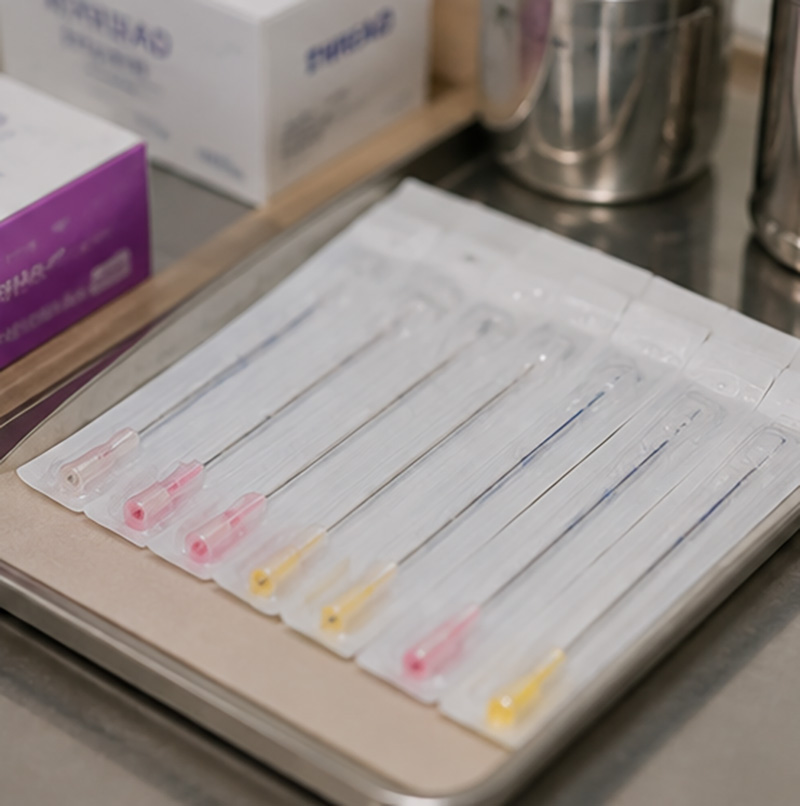
The PDO threads commonly used for midface lifting gradually break down in the body over a period of 6–8 months. During this process, collagen production in the tissue surrounding the threads is stimulated, so even after the threads dissolve, the collagen structure can continue to support the lifted tissue. The period during which the lifting effect remains pronounced is approximately 6 months to 1.5 years, while the period during which the condition remains better than before the procedure is approximately 2–3 years. However, this varies depending on each person’s skin condition, lifestyle, and rate of aging.
Rather than viewing thread lifting as a one-time procedure, approaching it as periodic care intended to slow the pace of aging may help you maintain skin elasticity for longer. Combining it with treatments such as laser lifting or skin boosters may also help extend the effects.
✅Who May Be a Good Candidate for Midface Thread Lifting?
✅People whose deepening nasolabial folds and sagging cheeks make their face look tired
✅People with hollowing in the upper cheeks that makes the middle of the face look flat
✅People who want natural-looking lifting without surgery
✅People who need to return to their daily routine immediately without a recovery period
✅People who have not noticed sufficient results from previous laser lifting
Conversely, when sagging has progressed significantly, it may be necessary to combine thread lifting with another method or consider facelift surgery first rather than relying on thread lifting alone. This decision can only be made accurately after directly examining the current degree of sagging and the condition of the skin.

How Do You Find a Good Plastic Surgery Clinic?
Midface thread lifting is a nonsurgical procedure, but the results can vary significantly. Check two things when choosing a provider.
Find out whether the provider specifically analyzes your pattern of sagging during the consultation. The direction of thread insertion and vector design vary depending on whether nasolabial folds are the main concern, whether deep cheek sagging is more prominent, or whether both are present. A clinic that recommends the procedure immediately without properly examining your face may be less likely to provide customized planning.
Also check whether the provider honestly explains other options besides midface lifting. Midface thread lifting is not suitable for everyone. A medical professional you can trust is one who honestly tells you when a method is not appropriate for your condition.
Midface sagging is not a problem limited to the skin’s surface; it is a structural change that begins in the deeper layers of the face. To respond effectively to this change, it is essential to plan not simply how to pull the tissue, but in which direction, at what depth, and how it should be supported. When a thorough assessment and precise planning come first, natural-looking and long-lasting results may be expected.
| This post was written for informational purposes in compliance with Article 56, Paragraphs 1–15 of the Medical Service Act. All treatments carry a risk of side effects and complications that may vary from person to person. Before treatment, please make a decision only after having a thorough consultation with a medical professional with extensive experience. |