Many people wonder, “Wouldn’t inserting more threads produce better results and make the effects last longer?” However, to state the conclusion first, a greater number of threads does not necessarily lead to better results.
If an excessive number of threads is inserted without considering the condition of the face, or if the procedure is performed uniformly, the expected lifting effect may be insufficient, or the face may look unnatural. In some cases, this may lead to lower satisfaction, such as the cheekbones appearing more prominent or the cheeks looking hollow.
What matters in thread lifting is not “how many threads are inserted,” but “where they are placed, in which direction, and how many are actually needed.” Since everyone has different skin thickness and elasticity, fat volume, locations where sagging has begun, and facial bone structure, the number of threads required must also vary from person to person.

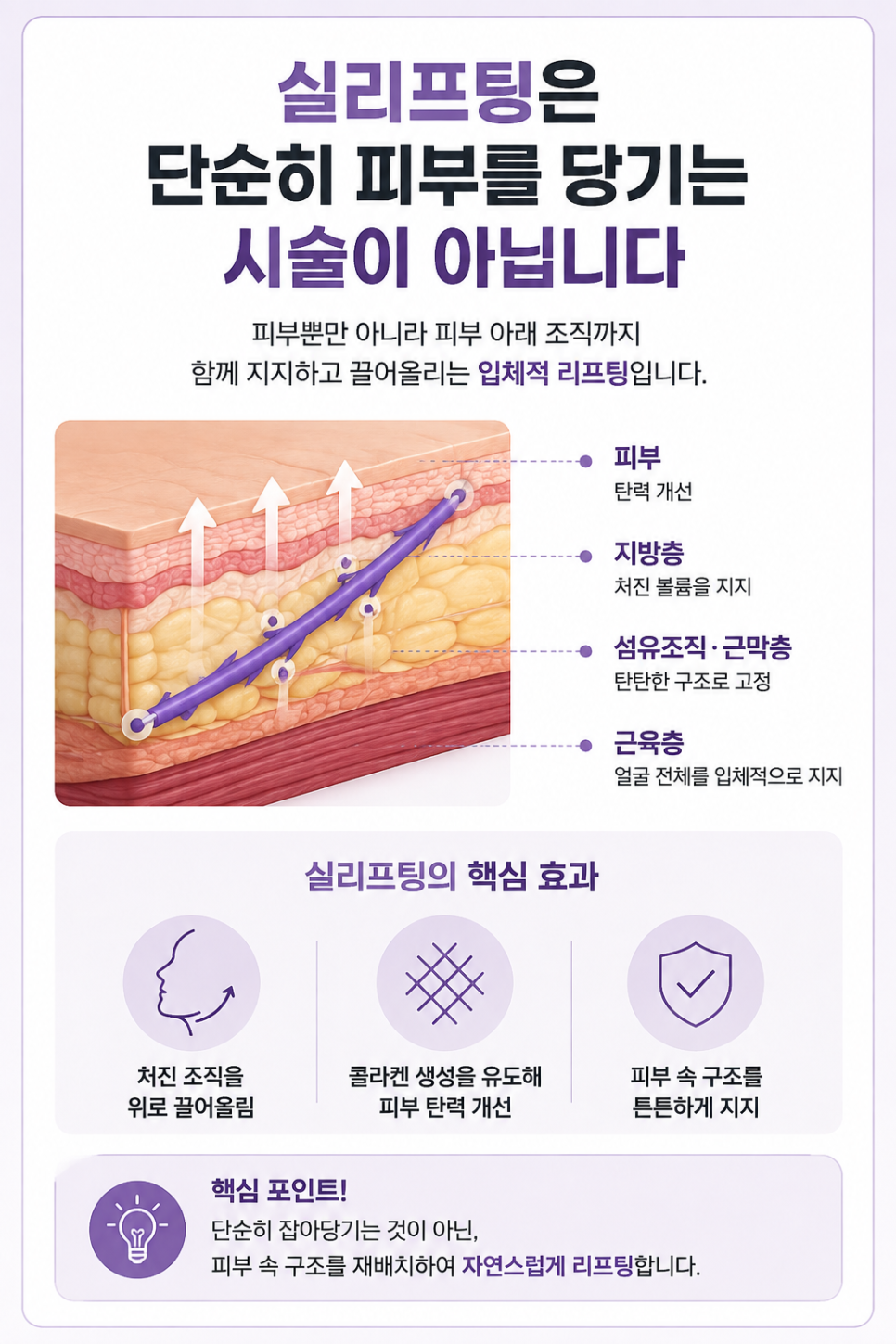
Thread lifting is not simply a procedure that pulls the skin
Thread lifting is a procedure in which medical threads are inserted beneath the skin to lift sagging tissue upward. The procedure must take into account the position of the fat layer, fibrous tissue, and fascia beneath the outer skin. In particular, skin thickness and fat volume vary by area of the face. Because nerves and blood vessels also run densely through the midface, it is important to identify the appropriate insertion layer.
| Evaluation item | Impact on the treatment plan |
|---|
| Skin thickness | Determines the type of thread and insertion depth. |
| Fat volume | Changes the required traction force and number of threads. |
| Direction of sagging | Changes the direction in which the threads are placed. |
| Facial bone structure and left-right asymmetry | Helps reduce prominence of the cheekbones or hollowing of the cheeks. |
| Left-right asymmetry | Requires adjusting the pulling strength differently on each side. |
If the same number of threads is inserted at predetermined locations without assessing these factors, it is difficult to expect a natural result.
The location and cause of sagging may differ
A deepening nasolabial fold does not necessarily mean that only the nasolabial fold area needs to be pulled. In reality, the fold may look deeper because fat beneath the cheekbone has descended, or the corners of the mouth and jawline may appear to sag together because of the weight of the deep cheek fat.
Common types of sagging include the following.
■A type in which the nasolabial folds deepen as the midface descends
■A type in which the corners of the mouth look heavy as the deep cheek fat sags
■A type in which the jawline becomes less defined and a double chin also appears
■A type in which the skin is thin, elasticity is reduced, and fine lines are numerous
■A type in which a large amount of fat requires strong support
Although the visible concerns may look similar, their actual causes may differ. Therefore, before the procedure, it is important not only to examine the area where wrinkles are visible, but first to determine which tissue has descended and from where.
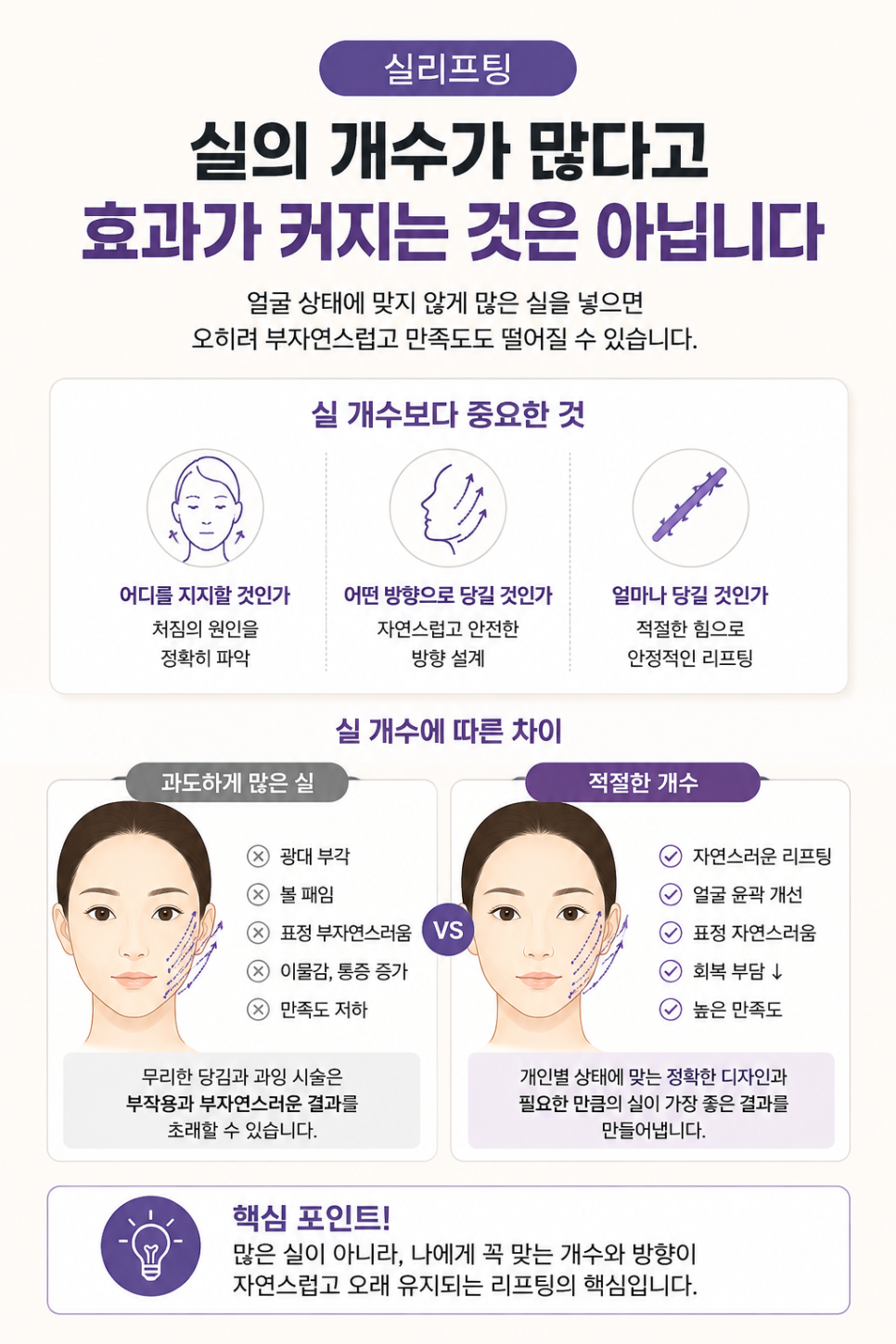
Thread count does not necessarily increase the effect
Many people consider “how many threads are inserted” important when receiving a consultation for thread lifting. However, a higher number of threads does not automatically lift the face more effectively. Inserting an excessive number of threads into an area with little sagging, or pulling too forcefully, may instead make the facial contours look unnatural. Conversely, if the amount of fat and degree of sagging are substantial but only a small number of threads are used without sufficient support, the desired effect may be insufficient.
There are three key points.
1.Which area will be supported
2.In which direction it will be moved
3.How much force will be used to pull it
In particular, pulling the midface strongly and unconditionally upward can cause tissue to gather around the cheekbones, making the face appear wider. The force should be distributed while also considering the sides of the face and the jawline to create a more natural appearance.
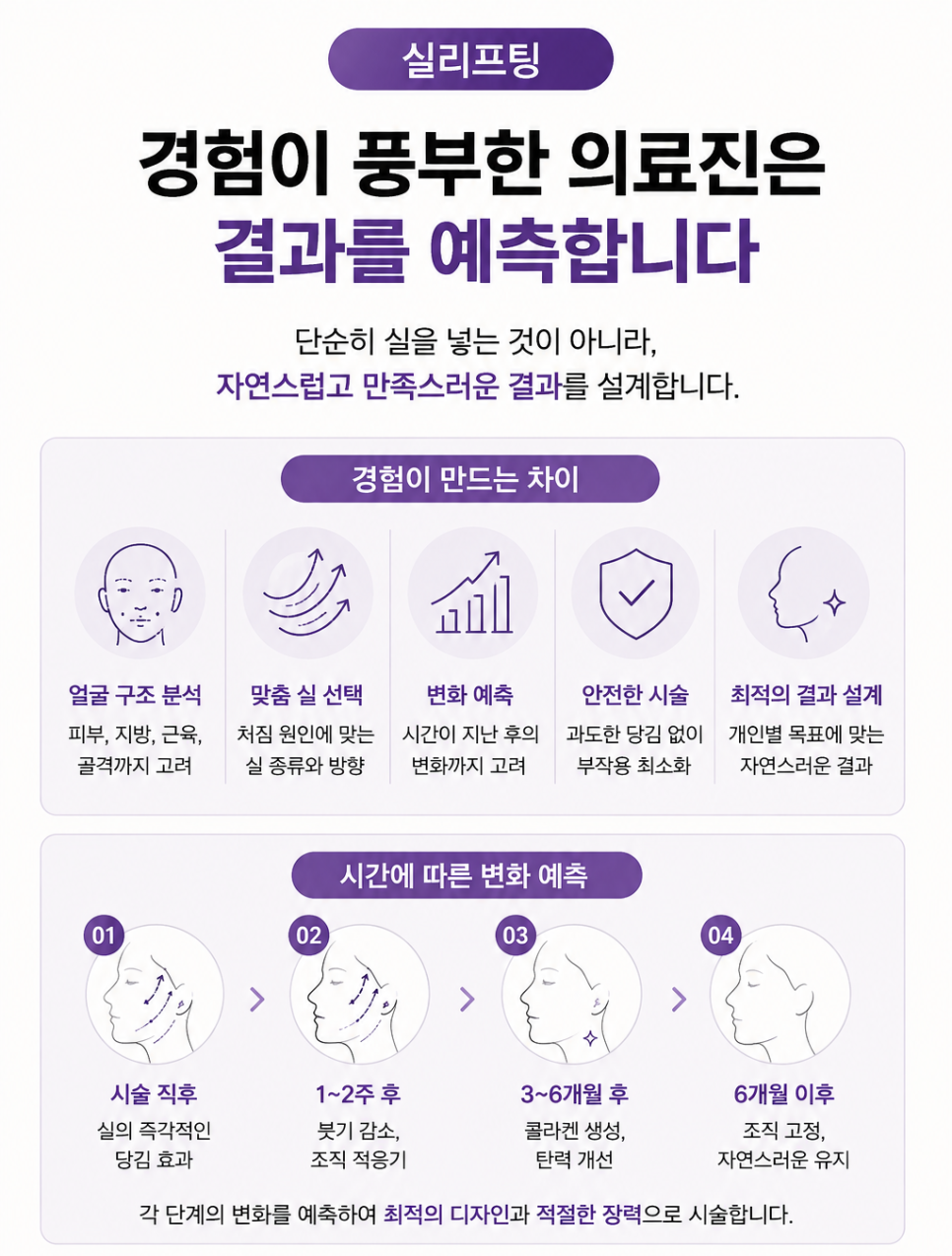
Experienced medical professionals anticipate the results
Thread lifting is difficult to evaluate based solely on the appearance immediately after the procedure. Initially, swelling and tissue tension remain, and over time the threads and surrounding tissue settle into place.
Experienced medical professionals consider not only the changes immediately after the procedure but also the following processes.
✅ Changes in the facial contours after the swelling subsides
✅ The process by which the tissue settles while the threads are absorbed
✅ How long the results last according to skin elasticity and fat weight
✅ Discomfort that may occur when making facial expressions
✅ The possibility that left-right asymmetry may become apparent
Although one might think that pulling strongly at the beginning will produce better results, excessive traction can make facial expressions look awkward or cause the skin to appear uneven. Appropriate tension should be set by anticipating both the current condition and the changes that may occur over time.
Potential problems should also be considered in advance
Swelling, bruising, and temporary tightness may occur after thread lifting. However, if the insertion layer or pulling direction is inappropriate, the following problems may also arise.
■Dimples in which the skin appears indented
■Pain and a foreign-body sensation when making facial expressions
■Asymmetry in which one side appears more lifted
■Prominent cheekbones or hollowing of the cheeks
■A lifting effect that is less than expected
■Threads showing through the surface of the skin
To reduce these possibilities, the appropriate layer should be selected according to the skin thickness, and the threads should be positioned so that force is not concentrated in one area. If sagging has already progressed considerably or there is substantial excess skin, you should also be clearly informed that thread lifting alone may not provide sufficient improvement.
Criteria to check before considering the price
Before deciding on thread lifting, it is advisable to check the following.
□ Are the skin, fat, and bone structure analyzed together?
□ Are the causes of sagging in each area of the face explained?
□ Are the direction and reasons for thread placement explained rather than just the number of threads?
□ Are both the changes that can be expected and the limitations explained?
□ Are possible problems and precautions explained?
□ Is there a management system for monitoring the progress after the procedure?
Price may be one of the criteria for choosing a procedure. However, if an excessively low cost or a large number of threads is emphasized, it is worth taking another look at whether the procedure is actually necessary for your face.

Thread lifting has the advantage of involving relatively little burden from incisions, but it is not a procedure that can be applied in the same way to everyone. The plan should vary according to skin thickness, fat volume, the location where sagging began, facial bone structure, and left-right balance.
Therefore, rather than comparing only prices and promotional terms, it is important to check whether the provider has experience with various facial types and can design an individualized approach based on anatomical structure. After carefully reviewing the changes that can be expected and the limitations of the procedure through a sufficient consultation, please make your decision carefully.
| This post was written for informational purposes in compliance with Article 56, Paragraphs 1–15 of the Medical Service Act. All treatments carry the risk of side effects and complications that may vary from person to person. Before treatment, be sure to have a thorough consultation with a medical professional with extensive experience before making a decision. |