There is one area that can make you feel that you look particularly older when you look in the mirror: the area around the eyes. At first, fine lines around the outer corners of the eyes may appear only when you smile, but over time, the lines may remain even when you are not making an expression. If the outer corners of the eyes and the surrounding skin also begin to sag, your appearance may look more tired and heavy than before.
For this reason, many people who look into cosmetics, Botox, and other options for improving eye-area wrinkles also become interested in thread lifting. However, not all wrinkles around the eyes develop for the same reason. Some are fine lines caused by thinning skin, some are caused by repeated facial expressions, and others become deeper as the area around the eyes sags downward.
Therefore, if you are considering lifting for eye-area wrinkles, it is important to first examine why the area around your eyes has changed rather than simply pulling the skin upward.
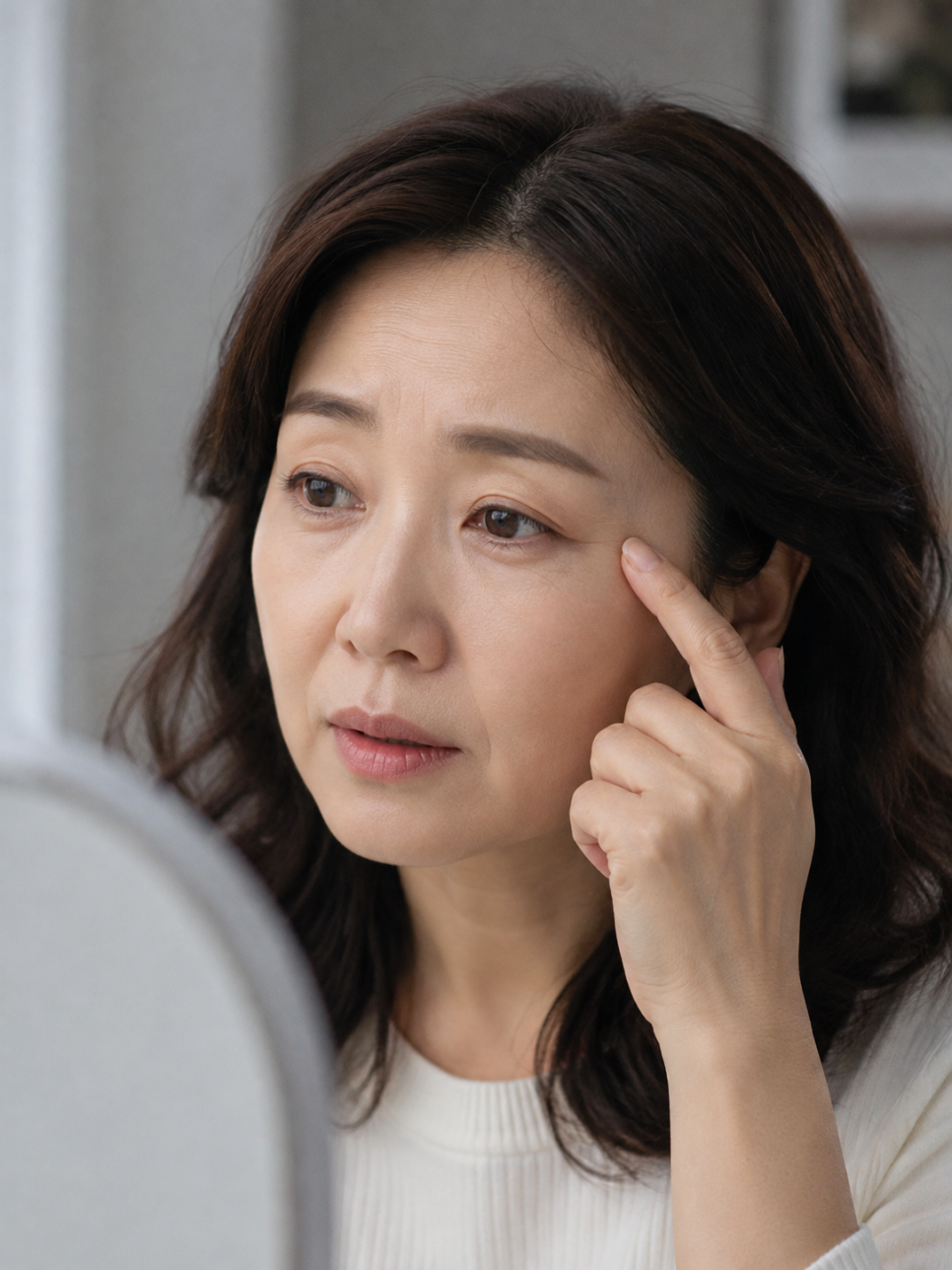
Why do eye-area wrinkles gradually become deeper?
The skin around the eyes is quite thin and moves frequently, even compared with other areas of the face. We blink countless times a day and move the skin around our eyes when we smile or frown. When we are young, the skin has sufficient ability to return to its original state, but as elasticity decreases with age, lines may gradually remain even after making facial expressions.
In addition, when the areas around the eyebrows and temples also begin to sag downward, the skin around the outer corners of the eyes can overlap, making the wrinkles appear deeper.
The causes that affect eye-area wrinkles can be summarized as follows.
| Cause | Changes that may appear |
|---|
| Reduced skin elasticity | Thin, fine lines |
| Repeated facial expressions | Wrinkles at the outer corners become more prominent when smiling |
| Sagging around the eyes | The outer corners of the eyes descend and wrinkles deepen |
| Sagging around the temples and cheekbones | The entire eye area looks heavy and tired |
Ultimately, even for the same eye-area wrinkles, the appropriate approach may differ depending on which causes have the greatest influence.

Is simply smoothing out eye-area wrinkles always the right answer?
When eye-area wrinkles are a concern, it is natural to focus on eliminating the wrinkles themselves. However, if the wrinkles have deepened because the area around the eyes has sagged downward, managing the wrinkles alone may not produce the desired change. Thread lifting is one of the options that may be considered in this situation.
Thread lifting is a method in which medical threads are inserted beneath the skin to move sagging tissue in the desired direction. Compared with surgery involving incisions, it generally involves less burden and has a relatively shorter recovery period. That does not mean the area around the eyes should always be pulled strongly.
The skin around the eyes is thin and moves whenever you make a facial expression. Applying excessive force may make the eyes look unnaturally elevated or cause the skin to appear uneven.
Therefore, in eye-area lifting, the key consideration is not how strongly to pull, but which areas to move and in what direction.
The surrounding areas should also be examined, not just the eye area
Sagging around the eyes is often not an issue limited to the immediate eye area. The skin around the outer corners of the eyes may look heavier when the temples and upper cheekbones also descend. If only the outer corners of the eyes are pulled strongly upward in this situation, the result may not harmonize with the overall facial contour.
Therefore, when planning lifting for eye-area wrinkles, it is important to examine the position of the eyebrows, the direction of the outer corners of the eyes, sagging around the temples and cheekbones, and the thickness and elasticity of the skin together.
This is because the appropriate lifting direction may differ between someone with thin skin and many fine lines and someone with noticeable sagging around the outer corners of the eyes, even if they are the same age. In particular, with thread lifting, the placement and pulling direction of the threads are just as important as the number of threads.
Will using more threads produce a greater effect?
When researching thread lifting, the number of threads used may seem like an important criterion. Of course, using as many threads as necessary is important. However, a greater number of threads does not necessarily mean that the area will be lifted more naturally or that satisfaction will be higher.
Special care is needed when using more threads than necessary or applying strong force around the eyes, where the skin is thin. Conversely, if sufficient support is not provided when sagging has progressed to a certain degree, it may be difficult to achieve the change you expected.
For this reason, rather than deciding on the number of threads from the outset, the first step should be to assess the current degree and direction of sagging and then determine the necessary extent of treatment.

3 things to check before eye-area thread lifting
If you are researching eye-area lifting, it is better to examine the following points rather than compare only prices or the number of threads.
① Do they distinguish the cause of my eye-area wrinkles?
You should determine whether they are fine lines, wrinkles caused by facial expressions, or wrinkles that have deepened because of sagging.
② Do they examine the surrounding facial contours as well as the eye area?
The sagging around the eyebrows, temples, and cheekbones should also be examined to plan a natural direction.
③ Do they avoid automatically recommending strong pulling or a large number of threads?
The purpose of thread lifting is not to pull as much as possible, but to create a change that suits your current facial features.

How should the area be managed after the procedure?
Immediately after the procedure, the threads need time to settle securely within the surrounding tissue. During the initial period, avoid rubbing or massaging the area around the eyes forcefully, and avoid applying too much pressure when washing your face or applying makeup.
It is also advisable to be cautious for a certain period about actions such as opening your mouth wide or moving your face excessively, as well as strenuous exercise or using a sauna. For the specific period, follow the medical staff’s instructions based on the condition of the treated area.
Swelling, bruising, and a pulling sensation may vary from person to person. If discomfort persists or an unexpected change appears, do not touch or massage the area on your own; instead, have the condition checked at the medical institution where you received the procedure.
Eye-area wrinkles are a visible result, but their causes differ from person to person. It is difficult to improve in exactly the same way wrinkles caused by thinning skin, wrinkles created by repeated facial expressions, and wrinkles that have deepened as surrounding tissue has descended.
If eye-area wrinkles and sagging are concerns, rather than deciding first what type of thread to use or how many threads to insert, please begin by properly determining why the area around your eyes is currently sagging.
| This post was written for informational purposes in compliance with Article 56, Paragraphs 1–15 of the Medical Service Act. All treatments carry the risk of side effects and complications, depending on the individual. Before undergoing treatment, be sure to have a thorough consultation with an experienced medical professional and make your decision afterward. |