If you are planning double-eyelid surgery, you may at some point wonder, “I want a natural look without an incision, but won’t the buried-suture method come undone easily?”
Unlike the incisional method, the buried-suture method does not require a long skin incision, so it can create a relatively natural crease with less burden during recovery. However, this does not mean that every person has sutures placed in the same position and tied with the same amount of tension. This is because every person’s eyes have different conditions.
Factors to Check When Planning the Buried-Suture Method
-
Eyelid skin thickness
-
Amount of fat in the upper eyelids
-
Skin elasticity and degree of sagging
-
Current condition of the double-eyelid crease
-
Strength of the muscles that open the eyes
-
Desired height and shape of the double-eyelid crease
-
Differences in the size and shape of the two eyes
If surgery is performed uniformly without considering these differences, the crease may initially appear fine but later become lower or come undone, resulting in unexpected changes over time.
This is also why our clinic has continued to revise and develop the buried-suture method over the past 30 years.

The Buried-Suture Method I First Learned Was Not the Right Answer for Every Eye
I first began performing the buried-suture method about 30 years ago, during my second year of residency. At the time, I started by faithfully reproducing the standard surgical technique I had learned from my mentor. However, as I gained more surgical experience, I was able to confirm one fact more clearly.
If there are 100 pairs of eyes, there are 100 different sets of conditions. Some people have thin eyelids, while others have fuller eyelids because they contain more fat. Even when the crease is created at the same height, its appearance can vary depending on skin elasticity and the strength of the muscles that open the eyes.
Ultimately, it became necessary to move beyond simply repeating a fixed surgical method and instead modify the technique to address the various issues found in each patient’s eyes one by one.
That process has continued for 30 years.
What Are the Main Concerns with the Buried-Suture Method?
The buried-suture method is known as a relatively simple type of double-eyelid surgery, but consultations reveal a range of concerns.
Common examples include the following.
① When the crease comes undone over time
In some cases, a double-eyelid crease that was distinct immediately after surgery gradually becomes less defined, or the crease on one side comes undone. The important point is not simply to tie the sutures as tightly as possible. The fixation position and depth must be suited to the structure of the eyes, and the tension must be adjusted carefully to take both a natural crease and its durability into consideration.
② When the double-eyelid crease gradually becomes lower
A crease that initially looked satisfactory may gradually become lower over time and begin to resemble a hidden double eyelid. In particular, if the crease does not extend sufficiently from the inner to the outer corner, the result may differ from the desired in-out or semi-out crease. Therefore, it is important to consider not only the appearance immediately after surgery but also how the crease may settle over time.
③ When the upper eyelids look full
It is easy to assume that an incisional method is always necessary when the eyelids look full. However, the first important step is to identify the cause of the fullness. If eyelid fat is the main cause and the skin is not significantly sagging, one option may be to create the crease while removing some of the necessary fat through the small openings made during the buried-suture procedure. Conversely, if the skin itself is thick or significantly sagging, removing fat alone may not produce the desired change.
④ When the eyes still look sleepy after creating a double-eyelid crease
Making the eyes look more defined is not solely a matter of the double-eyelid crease. If you normally have difficulty opening your eyes fully or your eyes have a sleepy appearance, the strength of the muscles that open the eyes should also be assessed. If there is no severe true ptosis, combining the buried-suture method with non-incisional eyelid-correction surgery may be considered depending on the condition.
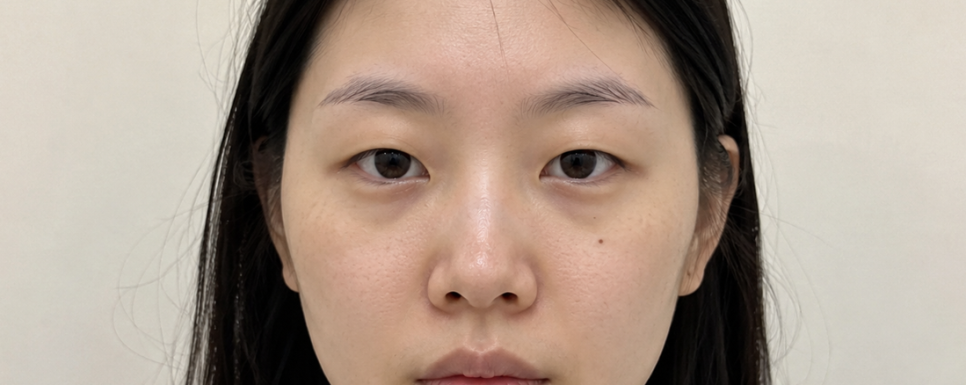
Situations in Which the Buried-Suture Method May Also Be Considered
The buried-suture method is often thought to be applicable only to younger people receiving double-eyelid surgery for the first time. However, depending on the condition of the eyes, its applications may be somewhat broader.
-
When an existing double-eyelid crease has become too low
-
When an existing crease has come undone or become less defined
-
When a change from an in-line crease to a semi-out crease, for example, is desired
-
When the double-eyelid creases differ between the two eyes
-
When a double-eyelid crease has come undone after incisional surgery
-
When fat in full eyelids also needs to be reduced
-
When the strength of the muscles that open the eyes also needs to be supplemented
Revision surgery does not necessarily require another incision. After examining the condition of the previous surgery, the amount of available skin, and the degree of scarring and adhesions, it is possible to determine whether correction with the buried-suture method is feasible.
Incisional Surgery Is Not Always the Right Answer for Middle-Aged Eyelid Surgery
As the eyelids sag with age, it is easy to first think of skin-excision procedures such as upper blepharoplasty. However, in middle-aged eyelid surgery, it is important not to look only at the double-eyelid crease but also to determine where the sagging of the eyebrows and eyelids begins.
If the upper tissues have descended together with the eyebrows, one option may be to improve the sagging tissues from above through a brow lift or forehead lift rather than removing a large amount of eyelid skin, and, when necessary, to naturally refine the double-eyelid crease using the buried-suture method.
What We Have Considered Important While Refining the Buried-Suture Method for 30 Years
The areas on which our clinic has focused while gaining experience with numerous cases and developing the buried-suture method can be summarized as follows.
-
Ligation techniques to reduce the likelihood of the crease coming undone
-
Fixation points and tension adjustment that take the possibility of the crease becoming hidden into consideration
-
Individualized crease designs, including in-out and semi-out creases
-
Minor fat removal for full eyelids
-
Combining non-incisional eyelid correction when necessary
-
Buried-suture revision surgery for existing double-eyelid creases
-
Combined application of a brow lift and the buried-suture method in middle-aged eyelid surgery
These methods are not necessary for everyone. What matters is distinguishing which of the various methods is needed for your current eye condition.

The Buried-Suture Method Is Not Determined Solely by “How Many Points Are Used”
When researching the buried-suture method, many people begin by comparing the number of fixation points and the type of suture used. The surgical technique is certainly important, but it is difficult to judge the result based on those factors alone. The thickness of the eyelids, the amount of fat, skin sagging, the strength of the muscles that open the eyes, the existing crease, and the desired crease must all be considered together, after which the fixation position, depth, and tension must each be adjusted.
Over approximately 30 years of performing the buried-suture method, we have examined issues that patients actually experience, including the crease coming undone or changing over time, full eyelids, and sleepy-looking eyes, and have supplemented the surgical technique one issue at a time. More important than continually adding new methods is accurately applying the method needed for each individual’s eyes.
If you are considering double-eyelid surgery, rather than deciding first between an incision and the buried-suture method, we hope you will carefully examine the current structure of your eyes and the changes you want before making a decision.
| This post was written for informational purposes in compliance with Article 56, Paragraphs 1–15 of the Medical Service Act. All treatments carry the risk of side effects and complications that may vary from person to person. Before undergoing treatment, be sure to have a thorough consultation with a medical professional with extensive experience before making a decision. |