
As more people seek a clearer facial line, interest in “contour surgery” has also been increasing.
Contour surgery is not simply about “shrinking the face”; it is a surgery that changes the overall balance and impression.
Therefore, it is most important to make the decision based on sufficient information and careful judgment.
However, many people still undergo consultations without fully understanding what it actually means or what results they can expect.
Today, we will briefly summarize the key points about contour surgery.

Many people considering facial contour surgery first think of one thing.
They want to make their face as small as possible.
But in reality, highly satisfying results are not created by simply removing a lot; they are created when the right amount is left in place.
Today, let’s talk about why “leaving some volume” is more important in contour surgery.

Will removing as much as possible always lead to a good result?
The answer is no.
✅ The face may look too flat
✅ Sagging of the cheeks may become more severe
✅ The overall impression may become unnatural or artificial
A face is not naturally attractive simply because it is “small”; it needs to maintain dimension and balance.

The essence of contour surgery is not reducing size, but “creating harmony.”
Because the cheekbones, jaw, and chin are connected to one another, reducing only one area too much can disrupt the overall balance.
In fact, leaving the right amount of volume can make the face look smaller and complete a more natural contour.
Precisely refining only the necessary areas and preserving the volume that should remain
This process ultimately creates a natural and refined result.
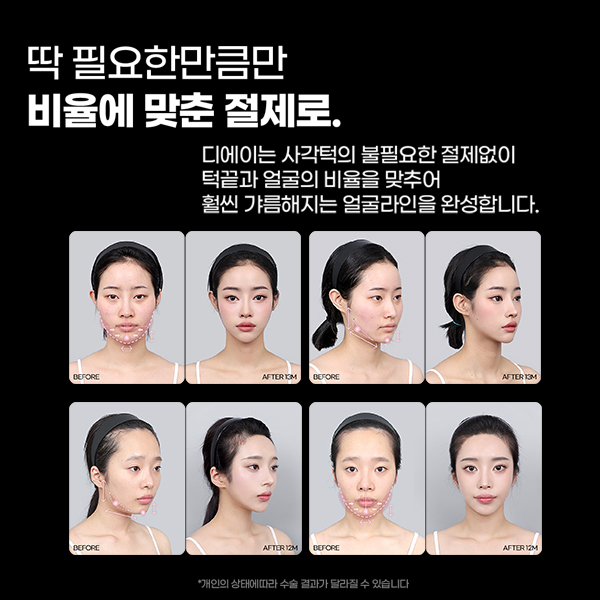
Not everyone needs to have the same V-line standard.
The jawline that suits you depends on your face shape, features, and proportions.
The goal is not to make the face smaller at all costs,
but to find the balance that suits your own face.
In the process of achieving that balance, the key is to reduce the square jaw only as much as needed and adjust its proportion with the chin.
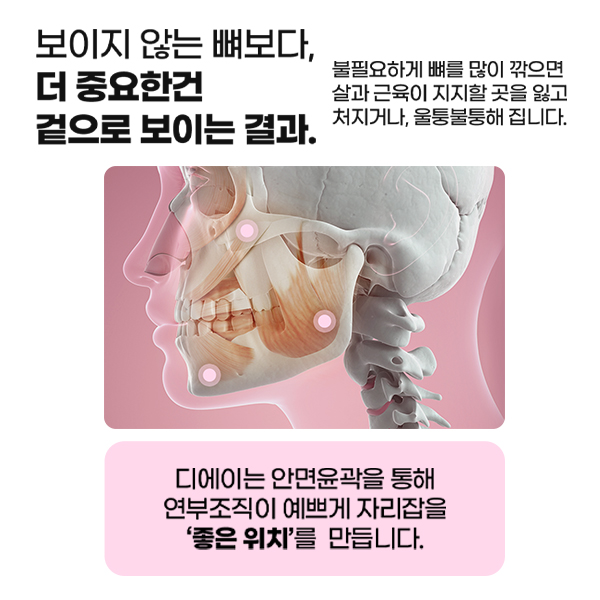
Contour surgery is not simply “reduction” but “design.”
Removing as much as possible does not make it a better surgery;
real skill lies in reducing only what is necessary and leaving exactly what should remain.
A face that has been over-reduced often becomes noticeable over time,
but a contour that has been appropriately preserved stays stable and natural as time passes.
Rather than asking, “How much can be reduced?”
it is better to ask, “What kind of balance can be created?”
If you want a harmonious change that suits your face, we hope you approach it carefully and look forward to a satisfying result.
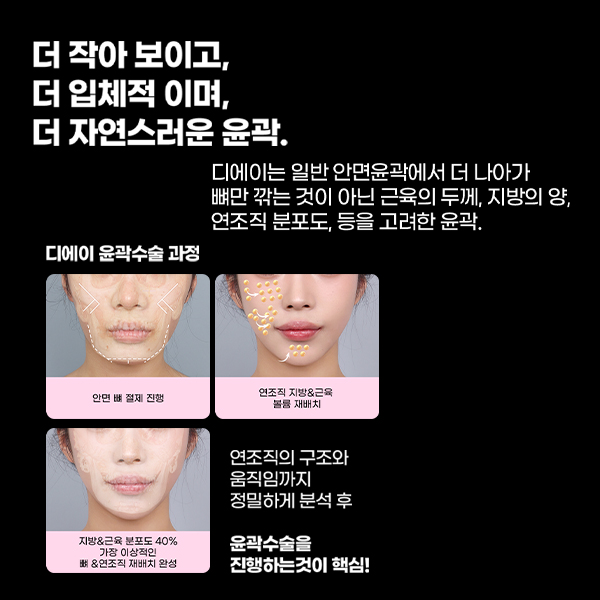
Contour surgery is not simply an operation that shaves bone.
Only when the structure and movement of the soft tissue covering it are designed together is it truly complete.
A face that looks natural not only when still but also when expressions change,
and a contour that remains stable over time—
if that is what you want,
accurately understanding the characteristics of your own soft tissue is
the key to creating a natural and balanced result.
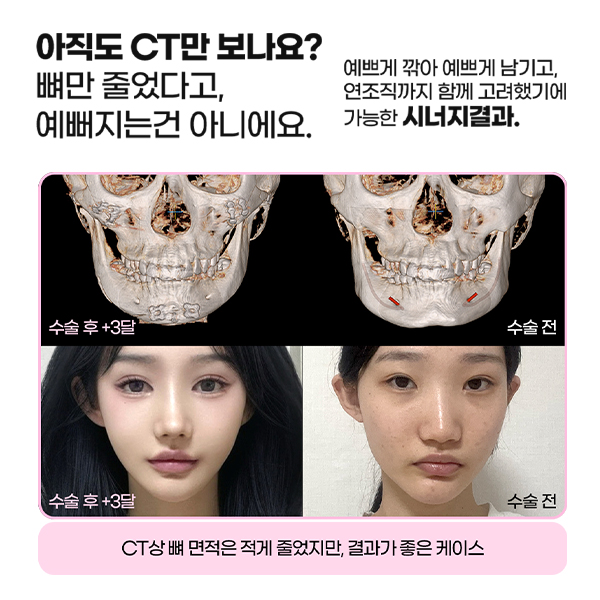
Even with the same contour surgery, one person may need enough resection,
while another may be better suited to only minimal adjustment.
If necessary, reducing the amount of bone removed and encouraging a natural redistribution of the soft tissue
may actually lead to a more complete result.
The core of contour surgery is not simple resection, but “balance design.”
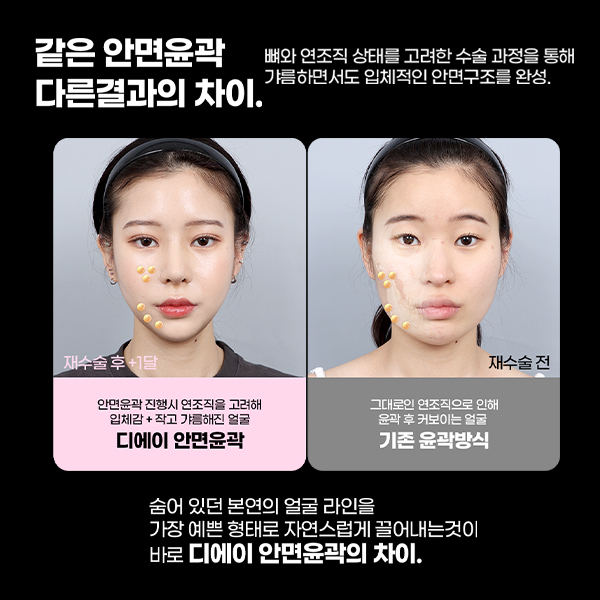
■ Dimension is created by the “volume that is left behind”
Contour surgery that takes soft tissue into account focuses on cleaning up unnecessary areas while preserving the volume that is needed to maintain dimension.
By considering the thickness, elasticity, and movement of the soft tissue, you can create a much slimmer and more refined contour without needing to remove too much.
The goal of contour surgery is not simple reduction.
It is to create a face that looks smaller and more slender while preserving dimension and balance.
If you are considering surgery, rather than asking “How much can be reduced?”
it is better to approach it by asking, “How can dimension and balance be preserved?”


This post complies with the standards of the law regarding the display of medical advertisements.
https://youtu.be/dBD9UfEdeSI?si=PW1Yzh6R4ui9a6dW