Headache, vomiting, pain, nausea after forehead lifting... are those side effects?
For those who are worried, here’s an explanation.
Headache, vomiting, pain, nausea...
Are these symptoms complications of forehead lifting?
Recovery Process After Endoscopic Forehead Lift _ Director Kim Jun-hyun
Hello, this is Director Kim Jun-hyun. ^^
One of the surgeries I perform frequently is
the endoscopic forehead lift.
Today, I’d like to talk about
"symptoms that may cause concern after surgery and the reasons behind them."

First, let me explain the midline forehead lift.
The forehead lift surgery is performed while viewing a clear image
by using FULL HD endoscopy.
While preserving the nerves and blood vessels,
we dissect the retaining ligaments and muscles.
Once the dissection is complete,
the entire forehead, including the eyebrows, is lifted
and the periosteum is fixed with dissolvable sutures through bone tunneling.
This smooths out the wrinkles and compressed areas
of the forehead, glabella, bridge of the nose, and eye area,
and improves heavy eyes, reduced double eyelids, and drooping eyes.
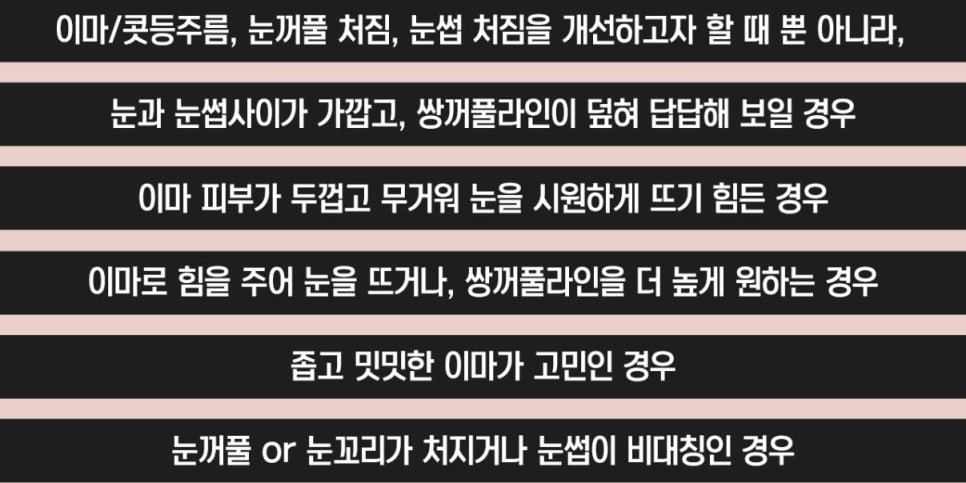 Forehead lift effect
Forehead lift surgery is not only for patients in their 40s, 50s, and 60s;
a lot of patients in their 20s and 30s also undergo it.
The issues they want to address differ depending on age. ^-^
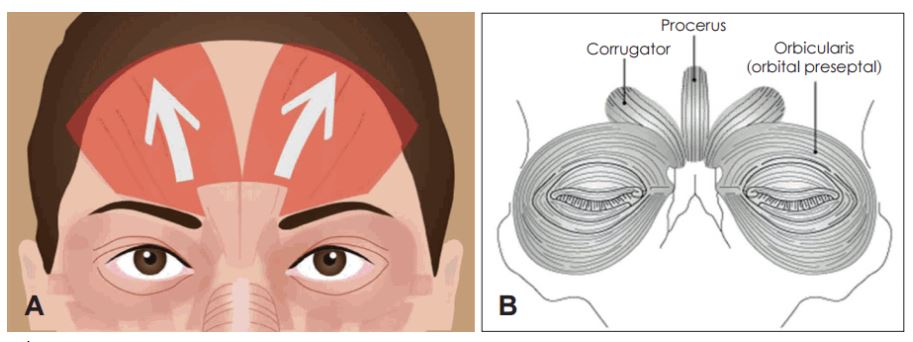 Source: kjorl.org/journal/view.php?number=7771
For the effects of forehead lift surgery to last a long time,
it is important to dissect the muscles that pull the eyebrows downward
(the depressor supercilii, corrugator supercilii, and procerus muscles).
At this time, focus should be placed on preserving the sensory nerves,
which is one reason this procedure should be performed by an experienced doctor.
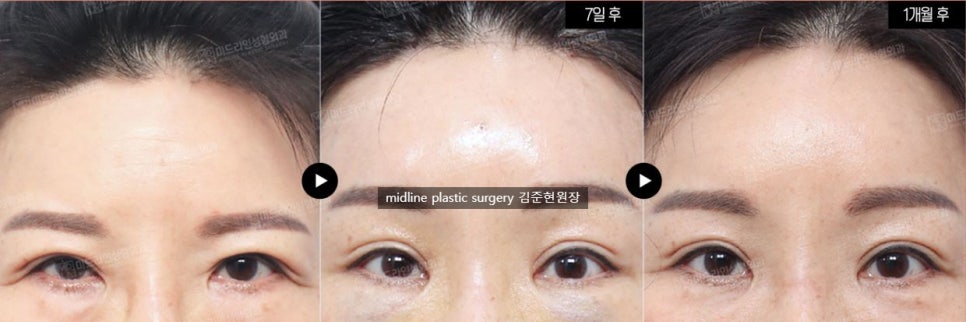 7 days after forehead lift
Let’s talk about symptoms that may occur after surgery.
Many people ask whether headaches and nausea after surgery are okay,
or whether they are a side effect.
These symptoms are observed in about half of patients who undergo surgery.
When general anesthesia is used, temporary nausea can occur because of the anesthetic gas.
However, forehead lift is a procedure that does not require general anesthesia,
and is usually performed under sedation, so the nausea is not caused by anesthetic gas.
One hypothesis is that during forehead lift,
while the supraorbital nerve is preserved during the dissection below the eyebrows,
this area is pulled during the dissection process.
The idea is that this may be a cause of nausea.
Rather than being a side effect, I explain it as an uncomfortable recovery process.
There is no problem with the surgical site,
and headaches and nausea improve after about one or two days.
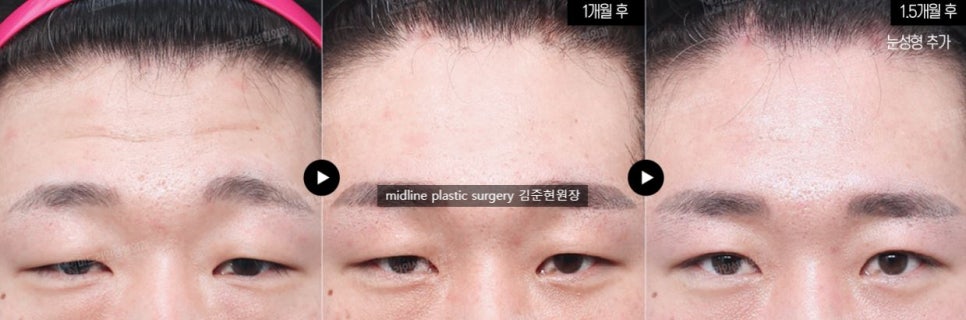 Forehead lift surgery for men
Next, one of the most common questions is about pain.
Many people worry that if tingling or prickling sensations continue, it may be a side effect.
After forehead lift surgery,
the forehead initially becomes numb,
and a tight, helmet-like feeling may occur.
The reason these symptoms happen is that the sensory nerves responsible for the forehead and crown are stressed during surgery.
Because the supraorbital nerve supplies sensation from the forehead to the crown,
these symptoms can be felt all the way past the hairline to the crown.
As the supraorbital nerve is pulled during dissection below the eyebrows, temporary paralysis-like symptoms appear.
In our body, nerves are the slowest to begin recovery and take the longest.
This numb sensation begins to recover after about one month,
and may change into tingling or prickling sensations, which some people find uncomfortable.
In some cases it takes as little as 3 months, and in others 6 months to 1 year.
This is not a side effect of forehead lift, but rather an unavoidable and uncomfortable recovery process.
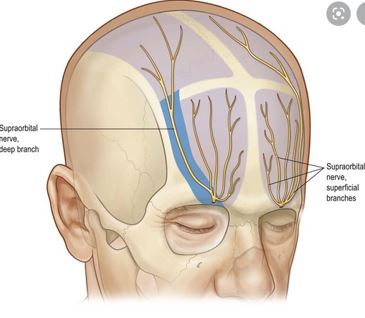
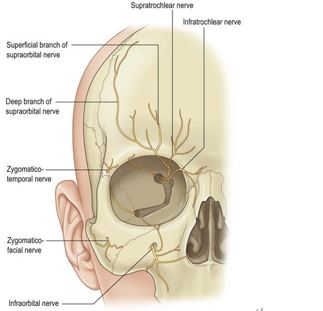 Source: plasticsurgerykey.com/forehead-rejuvenation/
These symptoms improve over time and do not cause major problems in daily life.
Many people do not feel much discomfort at all.
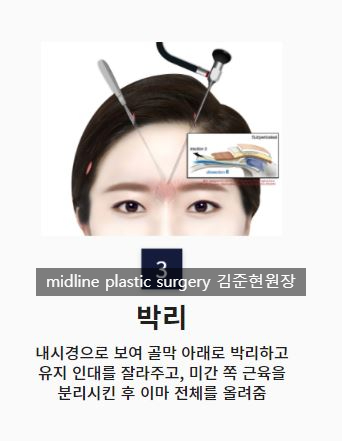 Forehead lift dissection
As shown in the image above, forehead lift is a procedure in which the periosteum is dissected beneath the periosteum,
then the periosteum is pulled and fixed to create a lift,
so there are no side effects such as damage to the bone or brain.
But still, I’m worried!
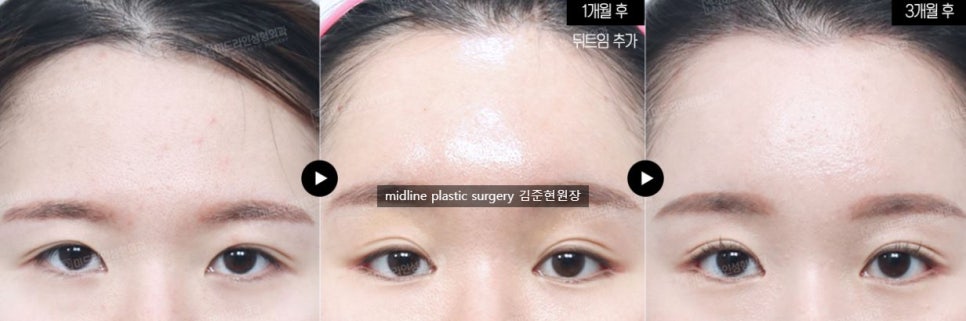 Endoscopic forehead lift for people in their 20s and 30s
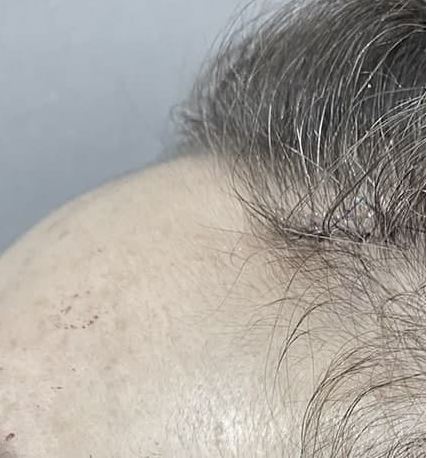
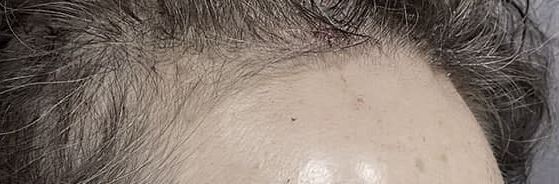 Immediately after forehead lift surgery
(The photo above shows the condition before discharge on the day of surgery.)
If you are worried,
I recommend making follow-up appointments with the hospital where you had surgery
and receiving postoperative observation.
Unless I am in surgery, I personally monitor the progress of my postoperative patients.
Also, even if the difference is slight,
I use dissolvable sutures with less pain and foreign-body sensation
and perform the surgery with a bone-tunneling multi-fixation method.
Let me explain the advantages of the multi-fixation method.
If the standard bone-tunneling fixation method is similar to a simple buried suture method in eye surgery, which has a high chance of loosening,
the multi-fixation method can be explained as a natural adhesion method with a lower chance of loosening than buried sutures.
In other words, by making the fixing force act over a wider and stronger area,
it becomes a method that maintains a definite lifting effect for a longer time.
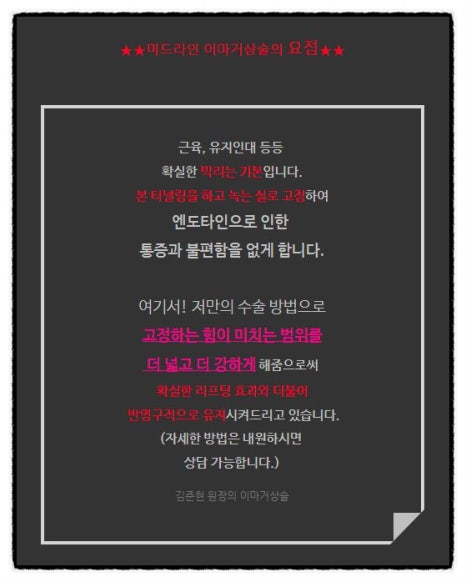
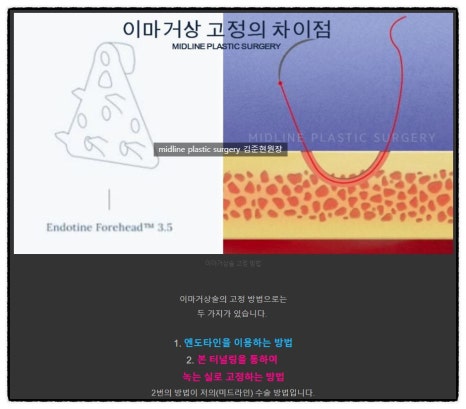
For details about the fixation method, please refer to ★Anti-aging → Forehead/Eyebrow Endoscopy → 'Differences in Forehead Lift Fixation'.
This is my promise to patients.
It will also be posted on the website in the near future.
- Honest treatment -
If a procedure is not necessary for the patient’s current condition
or the expected effect after surgery would be minimal,
we make it a rule not to proceed.
- Safe surgery -
We do not apply unverified procedures to patients.
- Attitude toward surgery, results -
Through customized care, we identify the patient’s needs,
then combine the surgeon’s aesthetic sense and delicacy
to further enhance the result.
<If you have additional questions, please leave a private comment,
and I will kindly answer them. Thank you.>