
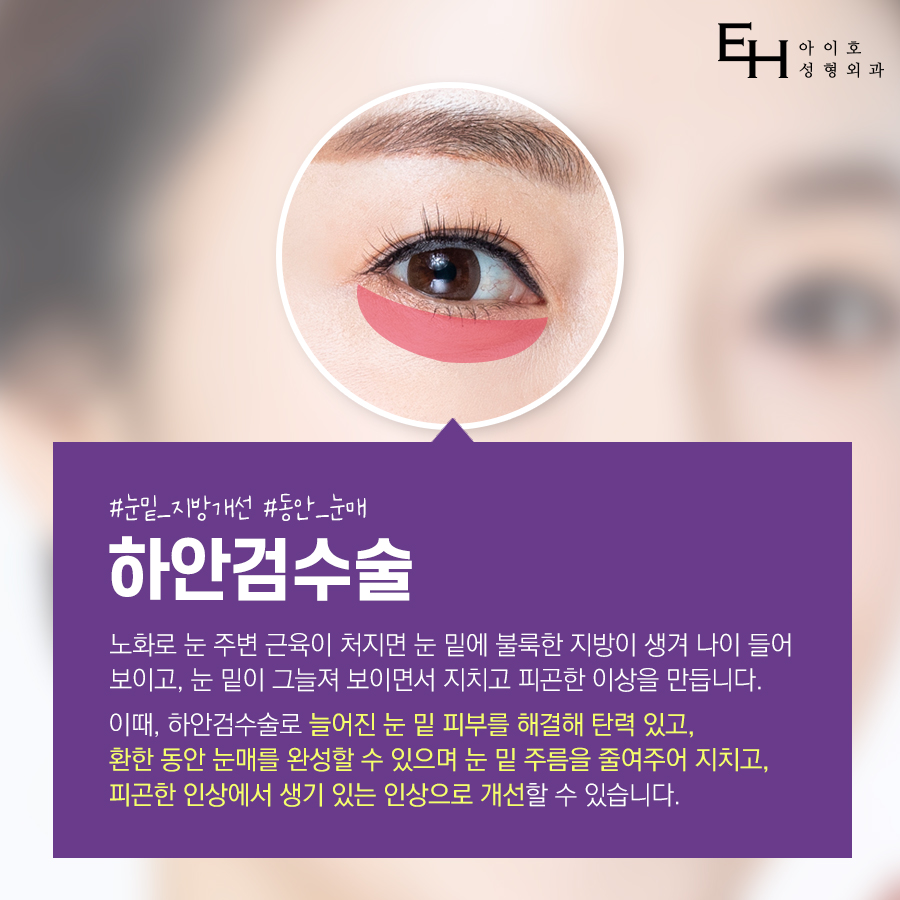
Because the skin around the eyes is thin and does not have sebaceous glands, signs of aging appear quickly, which can be a burden. As elasticity decreases and wrinkles become more noticeable in this area, skin firmness naturally begins to decline with age. If the lower eyelids are sagging, fat around the orbit that surrounds the eyes has also begun to droop. In that case, under-eye bags and a dark appearance may develop, and tear troughs can form as well. Over time, severe under-eye wrinkles can pull the lower eyelid downward, exposing the conjunctiva and causing side effects such as ectropion. Lower blepharoplasty is a surgical method that improves under-eye bags and tear troughs by making an incision along the lash line and lower area to access the orbital fat. After removing part of the sagging skin, the procedure is directed so that the end of the orbicularis muscle is fixed to the edge of the orbital bone, and it can also be described as a method of lifting the lower eyelid together.
It can be said to be an appropriate surgical method for middle-aged and older adults who want to improve sagging skin in both the under-eye bags and tear trough area at the same time. For this reason, many people worry about whether side effects such as ectropion, which can appear in reviews of lower blepharoplasty for under-eye sagging, can be managed. That is why I want to take some time to look into lower blepharoplasty pain, cost, and side effects.
I will explain lower blepharoplasty in more detail.
In most cases, lower blepharoplasty is a method that makes an incision in a way that keeps the scar from standing out around the eye, while enhancing the original aegyo-sal and lifting the lower part of the eye at the same time. Through this, it can be said to be a surgical method that meets enough conditions to improve toward a softer, more youthful facial impression. As people age, sagging around the eyes may appear more severely in the lower part than in the upper eyelid. The fat under the eyes can appear bulging, and dark circles may look relatively deeper. In addition, as aging progresses, the likelihood of side effects that make the face look older increases. Here, by looking into lower blepharoplasty, which can improve the bulging fat under the eyes, one can plan for lower blepharoplasty pain, cost, and side effect prevention.

I will explain the criteria for choosing a lower blepharoplasty method.
In cases where lower blepharoplasty is appropriate, each person has a different facial structure, shape, and under-eye form, so a customized lower blepharoplasty is planned accordingly. In general, ectropion, a side effect of lower blepharoplasty, can be prevented through the process described below.
-
The procedure is performed by making an incision so that no scar is visible below the eyelashes.
-
After dissecting the skin and muscle tissue, some of the fat layer is removed and some is repositioned.
-
After fixing the orbicularis muscle under the eyes to the periosteum, external canthopexy should be performed to prevent ectropion, since eyelid elasticity is reduced and the eyelid is more likely to droop.
-
Excision is attempted so that the under-eye sagging problem and any remaining skin can be addressed at the same time without strain.
-
The operated area is carefully sutured.
-
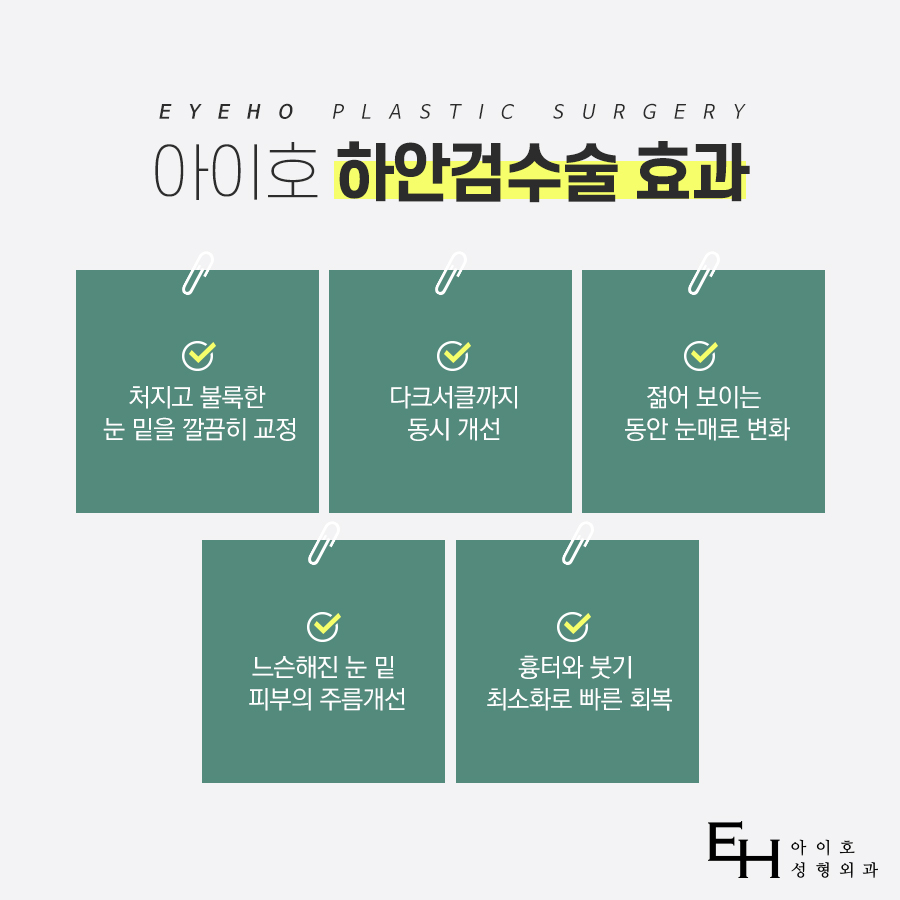
The original aegyo-sal is further emphasized, dark circles can also be improved, and this can help refine the eyes into a more youthful look, leading to a positive prognosis.
What types of cases are well-suited for lower blepharoplasty?
-
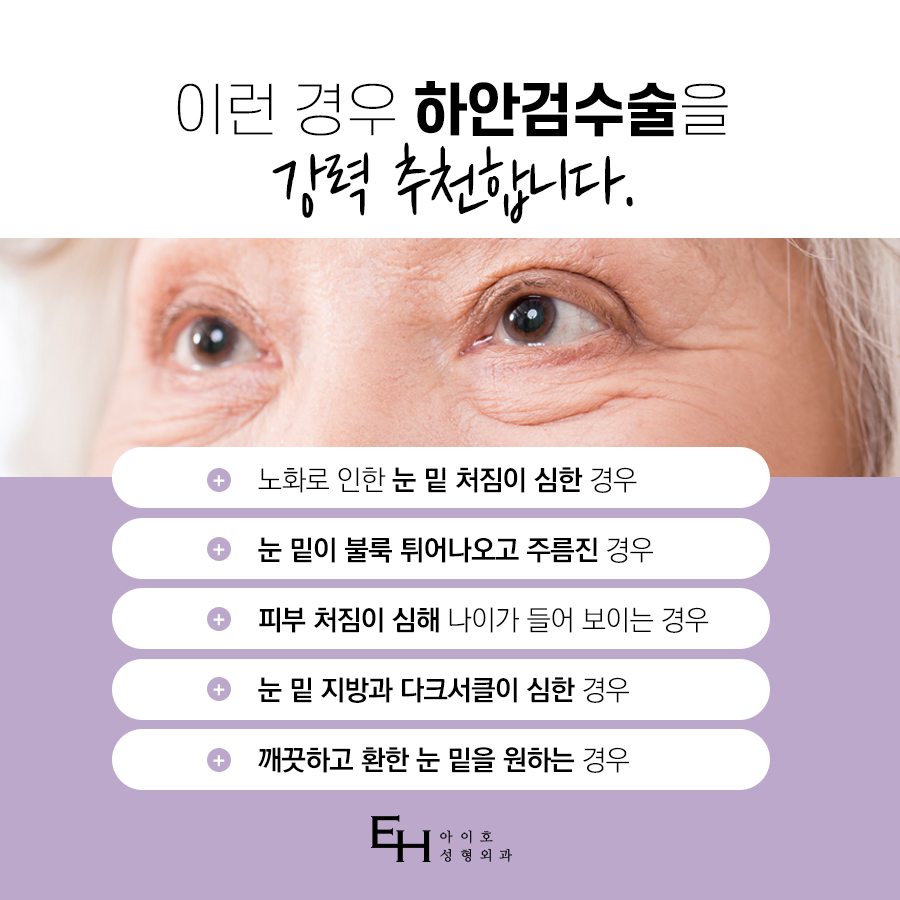
When wrinkles are numerous and the skin sagging is severe, making the face look older
-
When the under-eye area looks hollow and dark because of the groove under the eyes
-
When the eyelashes under the eyes constantly irritate the eye due to entropion or ectropion
-
When the fat under the eyes bulges out and dark circles appear very prominent
-
When volume is lacking in the under-eye area and the upper cheek, causing hollowness and under-eye sagging
I will show how to reduce side effects from lower blepharoplasty and what the results look like.
The most representative side effect of lower blepharoplasty is ectropion. Ectropion refers to a condition in which the eyelid turns outward and the inner conjunctiva is exposed. It can usually be identified by the eye appearing red and inflamed. It can also be divided into cicatricial ectropion and spastic ectropion. Cicatricial ectropion refers to scarring caused by external skin trauma, lacerations, ulcers, burns, and similar injuries, and contraction can occur. It may also be a major cause of skin spasm problems, along with disease-related adhesions such as periostitis and osteomyelitis of the orbital surface. Because the eye does not fully close when shut, it often leads to exposure keratitis. Spastic ectropion is a phenomenon in which, when the anterior segment protrudes due to conditions such as suppurative ophthalmic disease or orbital cellulitis and the volume within the orbit increases, causing the eyelid margin to be pushed outward, orbicularis muscle spasm occurs at the same time and outward turning takes place.
To prevent ectropion, a side effect of lower blepharoplasty, under-eye sagging surgery must be carefully reviewed and performed. At this time, if the elevated skin tissue is firmly fixed to the periosteum in multiple areas, the eyelid should be prevented from becoming heavy and dropping. If too much skin tissue is removed during surgery, the skin may contract and the eyelid may droop downward, so an appropriate amount of skin excision should be determined and then removed accordingly. The eyes have a sensitive and complex structure, and even small differences can lead to significant changes, so the choice must be made carefully.
What about lower blepharoplasty pain?
In the case of lower blepharoplasty pain, you should apply cold compresses until the third day after surgery, and warm compresses from the fourth day onward. Sutures are removed about a week later, and light face washing is possible starting the day after suture removal. Since under-eye sagging surgery involves making an incision below the eyelashes, dissecting the tear trough, repositioning under-eye fat, performing external canthopexy, or suturing after removing sagging skin, tearing, sensitivity to light, dryness, and a foreign-body sensation may occur. Therefore, care must be taken to avoid irritating the eyes, and the prescribed ophthalmic ointment should also be applied. As a result, a pulling sensation or a cold, stinging pain may continue for 6 months to over 1 year, and then gradually improve.

When performing lower blepharoplasty for under-eye sagging, ectropion, a side effect of lower blepharoplasty, requires a personalized solution, so a precise preoperative examination should be carried out to analyze the individual’s condition, degree of sagging, and signs of aging. Therefore, the condition of the lower eyelid muscles, the amount of fat, and the depth of the bone should be carefully assessed so that the design can be planned. The surgical method and amount of excision must then be determined and carried out in a way that helps prevent ectropion. However, because the eyelids are thin and the sebaceous glands are underdeveloped, elasticity gradually decreases, sagging becomes visible, and the eyelashes can begin to irritate the eyes. In particular, as people get older, the skin around the eyes can become irritated and, due to drooping eyelids, may look tired and stuffy. On top of that, unevenness under the eyes can create tear troughs, making the area look even more sagging and causing dark circles to appear. As these changes continue over time and happen more quickly, it is said that lower blepharoplasty should be used to improve them promptly, so please keep that in mind.















Previous image
Next image