Hello.
This is Again EH Clinic Plastic Surgery.
As aging begins, the skin layer around the eyes is thin, so aging appears quickly. In particular, if sagging under the eyes or dark circles become noticeable, they can only be a source of stress. When looking for ways to address these concerns, many people wonder what the difference is between under-eye fat repositioning and lower blepharoplasty, and which surgery is right for them. Today, let’s take a look at under-eye fat repositioning and lower blepharoplasty, procedures people try in order to look younger.

Lower blepharoplasty, under-eye fat repositioning
For those considering these procedures
Looking at people considering lower blepharoplasty and under-eye fat repositioning, they often expect a positive change if the under-eye area looks hollow, if they frequently hear that they look tired, or if severe dark circles make them look dark and panda-like.


Are lower blepharoplasty and under-eye fat repositioning
different surgeries?

Lower blepharoplasty and under-eye fat repositioning can be seen as the same surgery in the sense that they both operate on the under-eye area, but they differ in the parts they can change. In broad terms, lower blepharoplasty can be said to be a procedure that includes under-eye fat repositioning as well.

First, let me explain the lower blepharoplasty method.
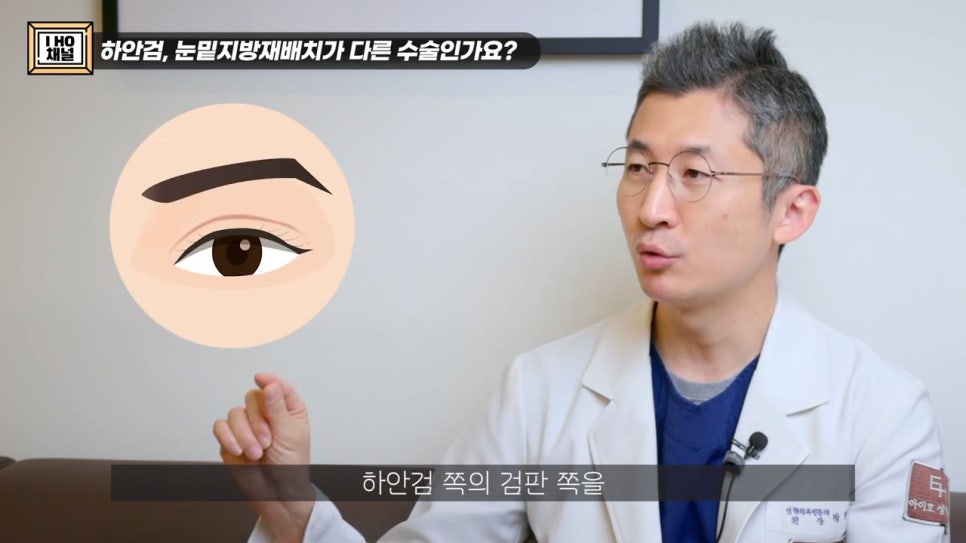
Lower blepharoplasty is a surgical method intended to prevent sagging by incising the loose skin on the outside and, if necessary, fixing the canthus so that the sagging area is secured upward. Therefore, lower blepharoplasty is performed through an external skin incision.





What is canthal fixation?
Canthal fixation refers to a method of attaching the lower muscle and the tarsal plate on the lower eyelid side to the periosteum so that the lower eyelid does not droop further and the eye does not turn outward.




Previous image
Next image
Unlike lower blepharoplasty, under-eye fat repositioning does not involve an external incision. It is performed by entering through the conjunctiva and repositioning the under-eye fat.


As such, although both are procedures for the under-eye area, the method chosen inevitably depends on the patient’s eye condition. After thoroughly checking various factors such as the degree of skin laxity, how much the skin recoils, and how much wrinkling is present, a proper plan must be established with the appropriate method to achieve the desired result. Therefore, choosing medical staff with extensive experience is the wise choice.

Types that may need under-eye fat repositioning or lower blepharoplasty
- Under-eye fat repositioning
People in their 20s and 30s
When the skin is elastic
When fat repositioning alone is sufficient
- Lower blepharoplasty
When the skin is sagging
When fat repositioning alone cannot solve the problem
When removal of loose skin is necessary


The results of lower blepharoplasty and fat repositioning can be considered similar. This is because the purpose itself is to reposition the fat under the eyes and make the area look younger, so the outcomes achievable through both procedures can be similar.

Lower blepharoplasty, under-eye fat repositioning
Are there cases where they are performed additionally?

Based on what I explained earlier, under-eye fat repositioning is a surgical method for people in their 20s and 30s, while lower blepharoplasty can be a surgical method for middle-aged people. However, there are exceptional cases where young people in their 20s and 30s need lower blepharoplasty, or middle-aged people can achieve the desired result with fat repositioning alone.

If the lower eyelashes irritate the eyeball and affect vision, the problem can be addressed through lower blepharoplasty regardless of age. So even at a young age, there can be cases where lower blepharoplasty is performed.


Even in people in their 50s or 60s, if the skin still has elasticity and the amount of sagging is not significant, then if the condition can be addressed with under-eye fat repositioning alone, there is no need to undergo lower blepharoplasty. Therefore, since the skill of the medical staff can affect the outcome, it is important to check whether they have experience with various cases in this field.





Previous image
Next image
Lower blepharoplasty, under-eye fat repositioning
What are the characteristics?

Characteristics of lower blepharoplasty
Because lower blepharoplasty involves an external incision, the scar requires a recovery period of about 1 to 2 months, so the recovery time is longer than that of under-eye fat repositioning.

Characteristics of under-eye fat repositioning
A characteristic of under-eye fat repositioning is that, because there is no external incision, recovery can be faster.

Are there side effects as well?

Both lower blepharoplasty and under-eye fat repositioning are procedures in which side effects rarely occur, but bleeding is something to be careful about.


If bleeding from the inner fat near the nose is severe, it can compress the eyeball and cause vision problems, so bleeding is the main issue to watch for.

Bleeding can be considered a side effect associated with both lower blepharoplasty and under-eye fat repositioning. In the case of lower blepharoplasty, because it removes loose skin through an incision, a side effect called ectropion can occur.


Ectropion refers to what is commonly called the eye turning outward. When the eye turns outward and the red inner tissue becomes visible, it can be said to be because too much skin was removed during surgery. However, there are cases where the eye appears to turn outward even without excessive removal of tissue; in such cases, it may be due to severe swelling, so it is better to wait and see with time.





Previous image
Next image
If the eye turns outward because too much skin has been removed, it is almost impossible to return to normal. Therefore, it is important not to remove too much skin.



Another thing I would like to mention is that many people who come in for lower blepharoplasty ask us to remove the fine wrinkles under their eyes too, to tighten everything so they can go back to looking 20 again, and to cut away a lot of loose skin. But if the surgery is performed exactly as the patient wants, the likelihood of ectropion, where the eye turns outward, increases, so appropriate skin removal is more important than anything else.
Please remember that lower blepharoplasty is not a surgery to remove the fine wrinkles under the eyes, but rather a procedure intended to make the contour look younger by repositioning the fat under the eyes.


What precautions should be taken after surgery?

Precautions after lower blepharoplasty include avoiding actions that put strong pressure on the still-fragile skin, such as opening the mouth wide when yawning or eating, because pressure may be applied to the under-eye area and the sutured part may open. You should also be careful not to put pressure on the eyes, and because the procedure involves an incision, sunlight exposure may lead to pigmentation, so it is important to apply sunscreen properly.

For both under-eye fat repositioning and lower blepharoplasty, it is best to avoid excessive pressure, not to put pressure on the eyes, and not to bend the head down too much so that blood does not rush to the area.