Among cosmetic surgeries, nose surgery
involves delicate internal soft tissue,
has a complex structure, and is highly difficult.
Because implants are inserted during surgery,
problems such as side effects after surgery
may follow,
so extra careful attention is needed.
If, after nose surgery, it is not simply a matter of
diminished satisfaction with the shape,
but a problem arises with the function of the nose itself,
prompt improvement is necessary.

In particular, a contracted nose is one of the
typical side effects of rhinoplasty.
It is characterized by the tip of the nose becoming hard,
red, and shrunken due to an inflammatory reaction
caused by the implant.
If left untreated, the nose becomes shorter and the shape deforms,
making revision surgery for a contracted nose unavoidable.

A contracted nose occurs when the body recognizes
the implant inserted during rhinoplasty as a foreign substance,
forms a thin capsule,
and triggers an immune response.
As the capsule surrounding the implant hardens,
the nose becomes shortened and lifted upward.
So, if you want to resolve a nose that has contracted,
let’s look at what surgical method is used
for revision surgery for a contracted nose.
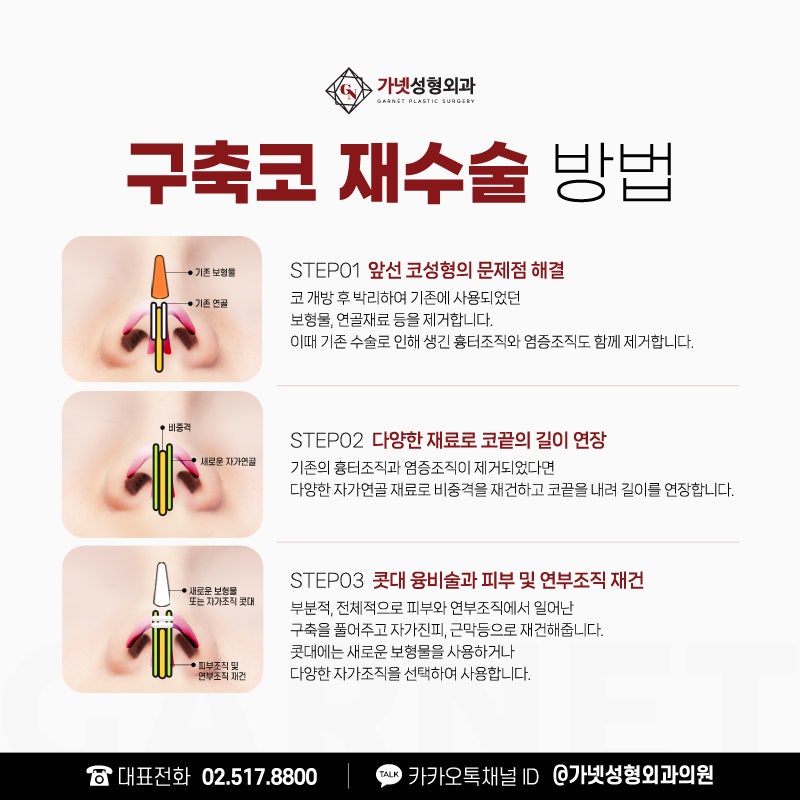
First, the implant that caused the contracture
can be removed first.
At this time, the nose is opened to remove the materials that were used,
and scar tissue or inflammatory tissue
caused by the surgery must also be removed.
After that, the septum can be reconstructed with various autologous cartilage materials,
and the length of the nasal tip can be lowered
to extend the length and redesign it.
After that, the contracture that occurred in the soft tissue is released,
and then the tissue is reconstructed using autologous dermis and fascia.
For the bridge of the nose, a new implant can be used,
or autologous tissue can be used.
When performing revision surgery for a contracted nose,
a wise choice of implant is necessary
to prevent experiencing the same side effects again.
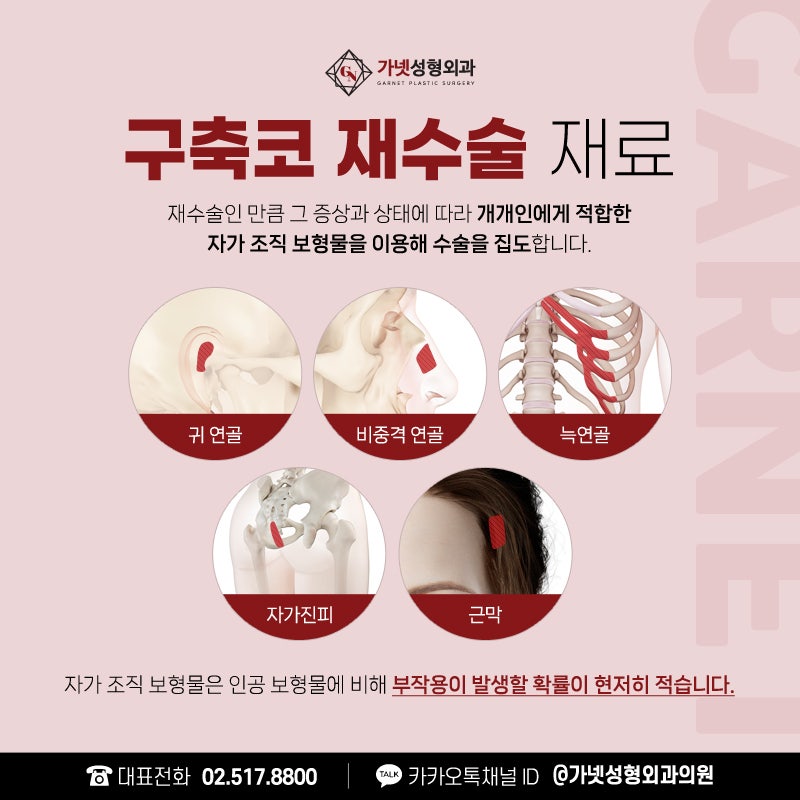
Compared with artificial implants such as silicone,
autologous tissue implants have a significantly lower probability
of side effects,
so the appropriate implant for the individual,
such as ear cartilage, septal cartilage,
costal cartilage, or autologous dermis,
must be selected properly.

Revision surgery for a contracted nose
not only reconstructs the shortened nose and its shape,
but also resolves functional problems and improves it to
a normal length and a natural nasal line,
so it can be considered a necessary procedure.
Compared with the first surgery, revision surgery
comes with greater psychological anxiety
and is also more difficult than the initial operation,
because the damaged internal function must be improved as well.
However, because the already damaged shape and function of the nose
make normal daily life difficult,
it is better to decide on revision surgery
as soon as possible after consultation.
If you are curious about the timing for revision rhinoplasty
and the revision methods,
please check through the video!
The key to revision rhinoplasty is clearly analyzing
the cause of the first surgery’s failure and identifying the problems,
so that revision surgery does not have to be repeated again.
Through treatment by experienced medical staff,
and sufficient consultation,
it is best to design the materials and line that suit me
so that the nose is no longer burdened.

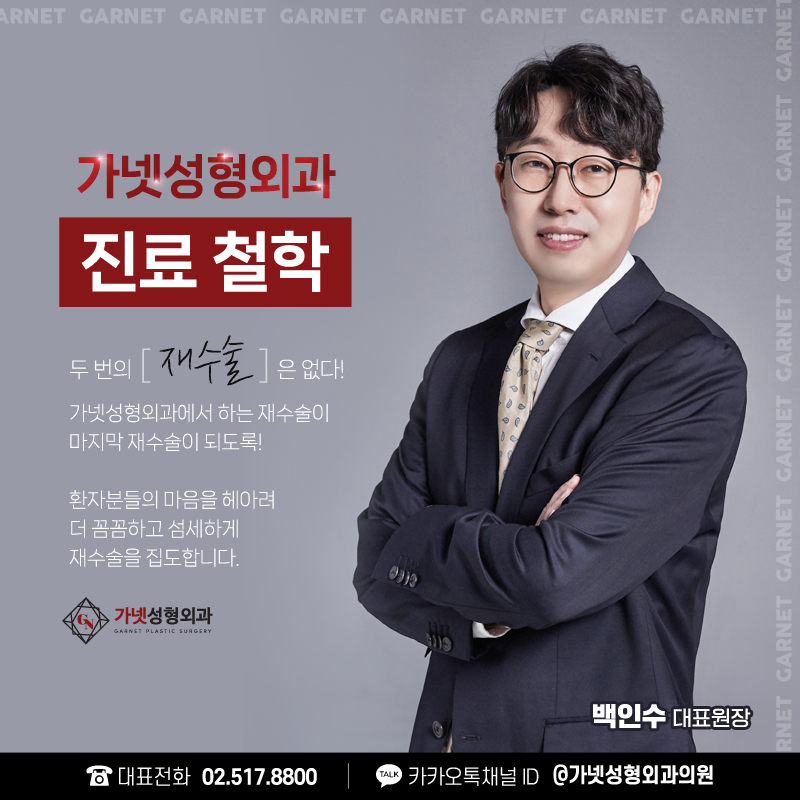
Director Baek In-su of Garnet Plastic Surgery
understands the concerns of patients undergoing revision surgery
and provides careful one-on-one care
from consultation to surgery.
With the mindset of helping those receiving revision rhinoplasty
avoid having to undergo the same surgery again,
he performs meticulous and delicate procedures.
If you have concerns due to a contracted nose,
please consider deciding on revision surgery through consultation!