When you reach your 30s and 40s, you may suddenly start wanting
to look younger than your actual age.
At times like this, many people look into
what they can do with youthful facial plastic surgery.
In particular, the eyes are one of the areas where
aging appears the fastest, so if the eyelids sag
or fat under the eyes bulges and makes you look tired,
you may especially hope to improve it effectively through
midlife eye surgery.
As the new year of 2023 approaches,
if you are hoping that, instead of simply getting a year older,
you can make your appearance look even younger,
please take a look today at the types and methods of
youthful facial plastic surgery introduced by
Apgujeong Station Plastic Surgery! :)

First, youthful facial plastic surgery refers to operations that improve a face that looks aged and lacks elasticity by improving forehead wrinkles, crow’s feet, sagging eyelids, sagging facial skin, hollow areas without volume, and neck wrinkles.
Through this, many people are interested because they can have a lively and youthful impression.
Representative procedures include upper blepharoplasty/lower blepharoplasty, fat grafting, and facelifts.
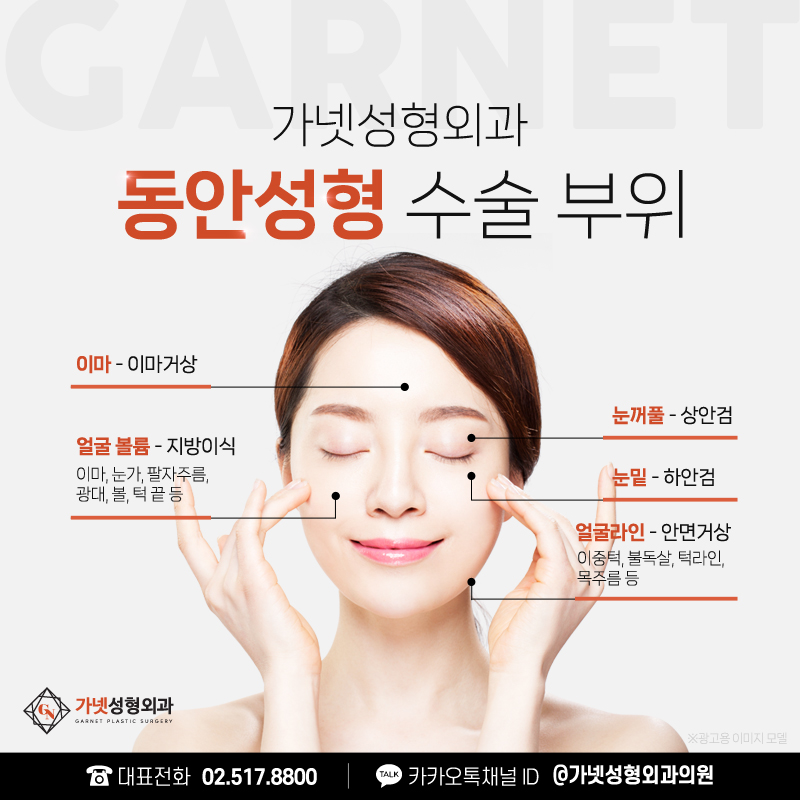
If the forehead tissue starts to sag,
wrinkles increase and the eyelids feel heavy,
a forehead lift can be used to improve it.
If there is a loss of volume in the forehead, eye area, cheekbones, cheeks, chin tip, and other areas,
making you look tired and older,
autologous fat grafting can restore volume.
In addition, if wrinkles increase across the face,
such as a double chin, jowls, or marionette lines,
and the skin sags so the facial line loses definition,
a facelift can be considered.
Along with that, upper and lower blepharoplasty can help create brighter,
more refreshed-looking eyes.
So, let’s take a closer look one by one at what these youthful facial plastic surgery procedures are,
as explained by Apgujeong Station Plastic Surgery.
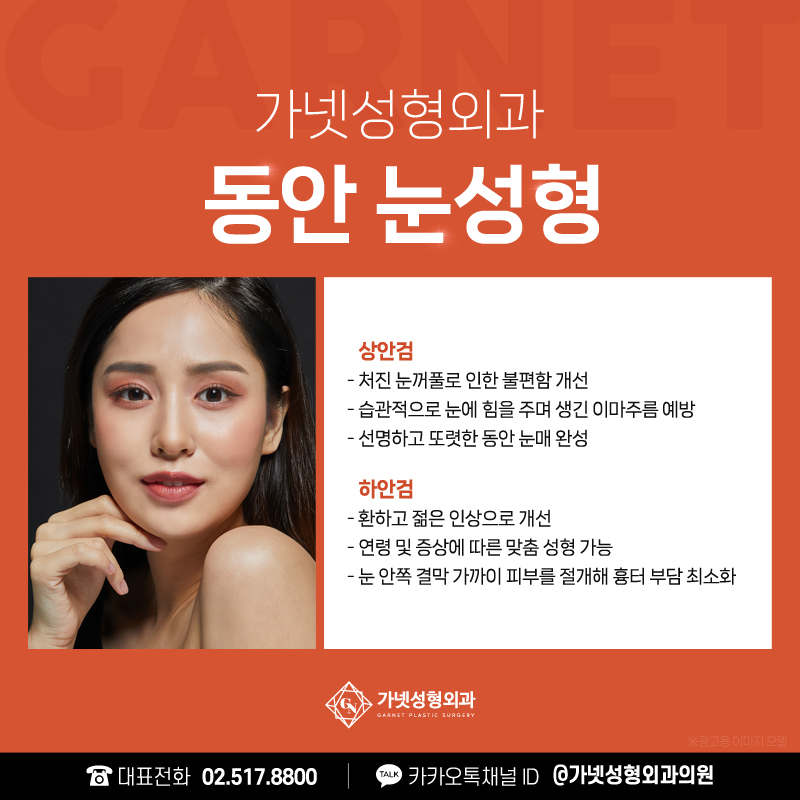
First, upper blepharoplasty and lower blepharoplasty are well-known as common midlife eye surgeries.
Upper blepharoplasty improves sagging eyelids,
creating a clearer eye shape.
At the same time, if you have had the habit of opening your eyes by using your forehead muscles,
upper blepharoplasty makes the eyelids lighter,
which can also help prevent forehead wrinkles from becoming deeper.
Lower blepharoplasty is performed when, with age,
fat under the eyes becomes prominent and dark circles
appear severe, and its defining feature is that it can change a tired impression into a clear and lively one.
Let’s look at the procedure method and recovery process
through an actual lower blepharoplasty case.
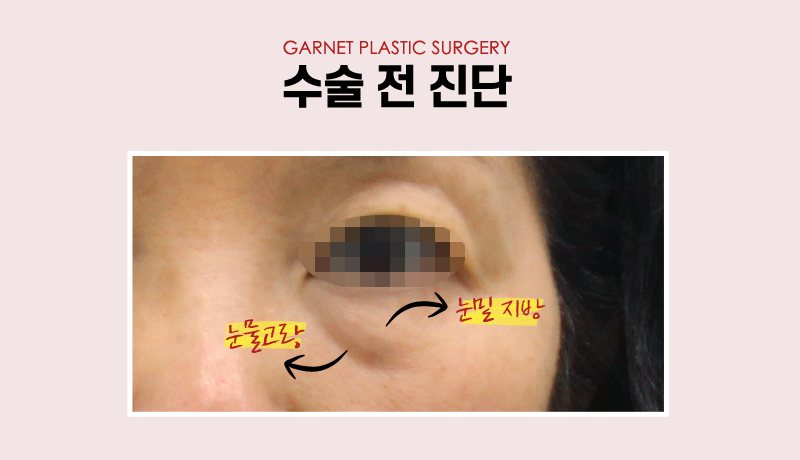
Looking at the pre-surgery photo,
the elasticity of the skin and muscles under the eyes has decreased,
and the fat pockets are bulging out,
with the tear trough beneath them appearing sunken.
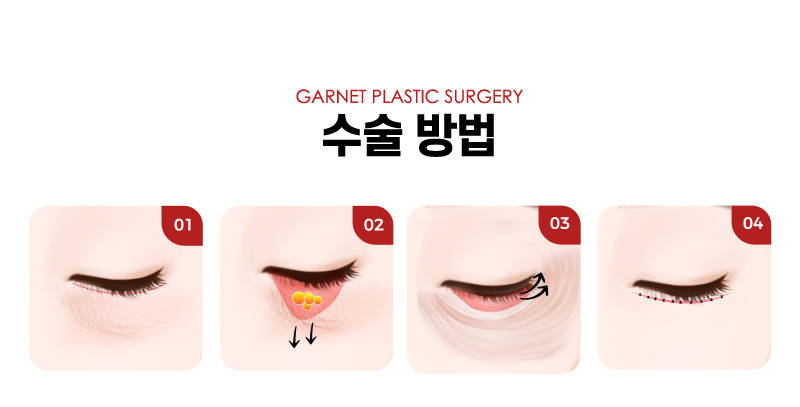
During lower blepharoplasty, an incision is made below the lower lash line.
The protruding fat pockets are separated and moved downward
to fill the hollow tear trough area.
This process is called “under-eye fat repositioning.”
After repositioning the under-eye fat
and securing the lower eye muscle to restore firmness,
the excess skin is removed
and the procedure is completed with delicate suturing.
Lower blepharoplasty is performed comfortably under sleep anesthesia,
and the surgery takes about 30 to 40 minutes.
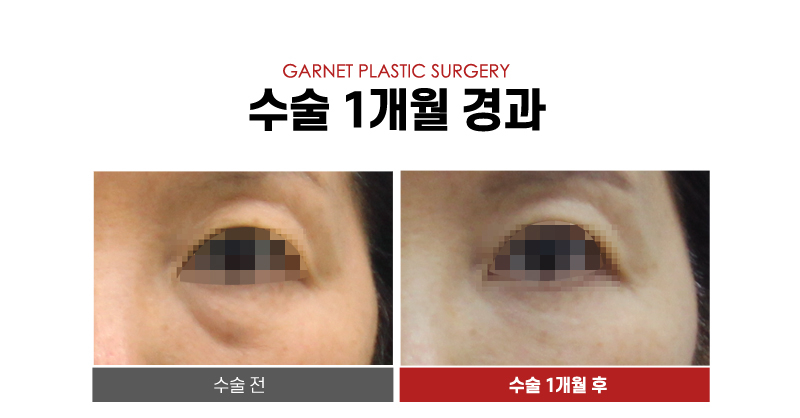
This is what it looks like one month after surgery.
The under-eye area is much brighter,
and it is said that people around them often comment that they look younger.
At this stage, there is not much discomfort,
but the area where the under-eye fat was repositioned may feel somewhat firm.
This is a normal part of the recovery process as scar tissue matures,
and over time the under-eye scar becomes barely visible
and later is almost unnoticeable.
Next, at Apgujeong Station Plastic Surgery,
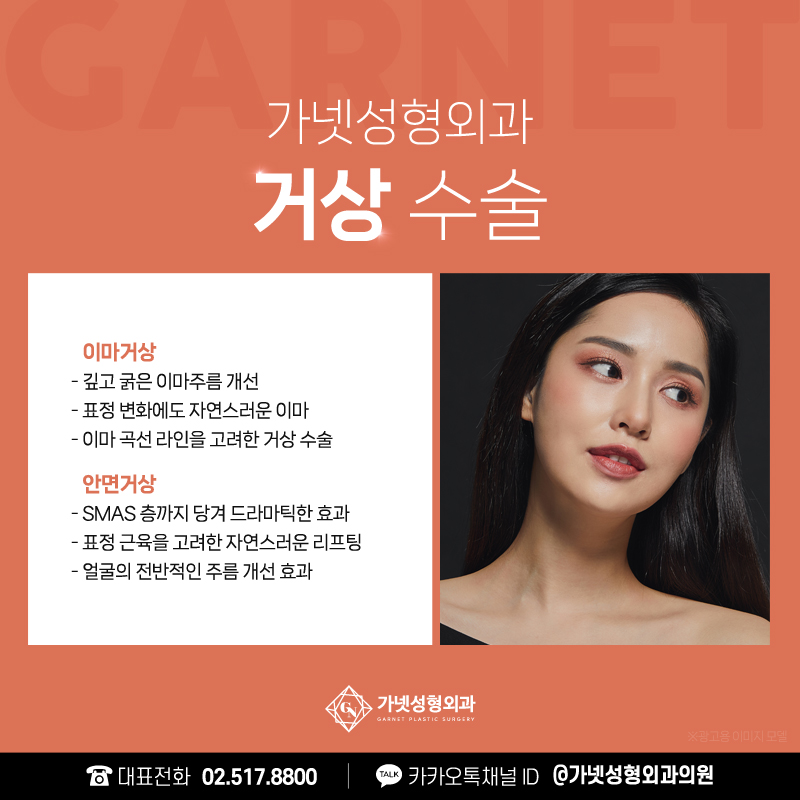
a facelift and forehead lift can be performed.
A facelift is a surgery that makes an incision at the temple, behind the ear,
or along the hairline and pulls the skin and SMAS layer.
Because it removes and lifts sagging tissue,
it can improve areas such as the jowls and double chin and create a sharper facial contour,
which is why it is considered a representative anti-aging procedure.
In addition, a forehead lift makes an incision along the hairline and pulls the forehead upward,
aiding in the improvement of forehead wrinkles.
If the forehead tissue has sagged significantly and affected the eyelids as well,
a forehead lift alone may also improve the upper eyelids.
Let’s also look at the recovery process of a forehead lift through an actual case.
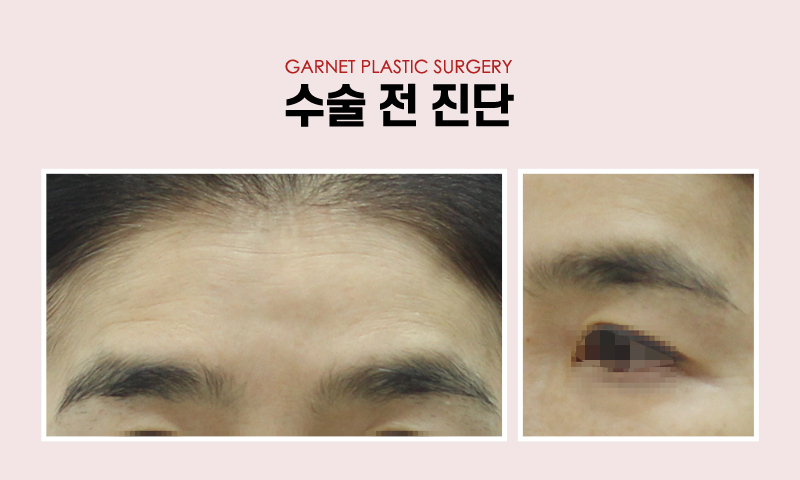
First, it is helpful to understand why forehead wrinkles form.
Forehead wrinkles often occur because when the eyelid skin sags and covers the eyes,
people develop the habit of opening their eyes using their forehead muscles,
and this cannot be solved with Botox alone.
Botox can help improve forehead wrinkles,
but it may make opening the eyes even more uncomfortable.
In such cases, a forehead lift can address crow’s feet and forehead sagging at the same time.
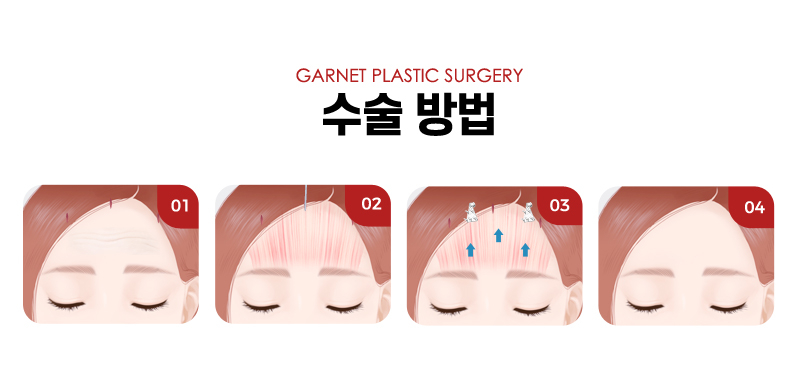
Because of the name “lift,” many people worry that a forehead lift must be a major operation.
However, the surgery is performed entirely inside the scalp,
and the incision is made within about 2 cm, just large enough for an endoscope,
so there is little concern about scarring.
In addition, the forehead, temples, brows, and eye area are delicately dissected using an endoscope,
then securely fixed with sutures or Endotine,
and the surgery is completed by closing the incision,
so there is no need for excessive concern.
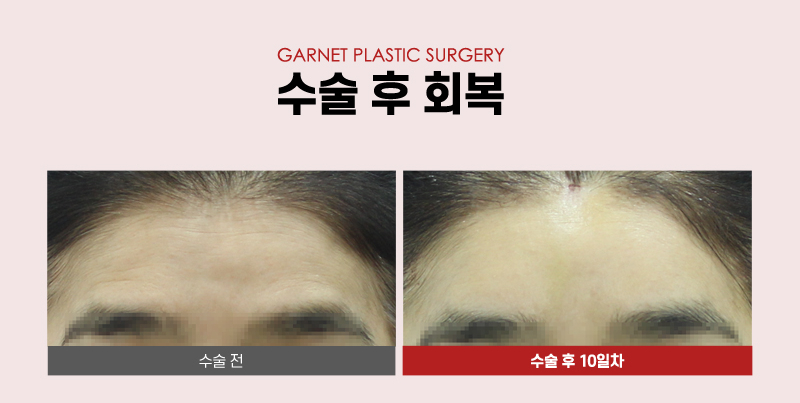
The biggest advantage of a forehead lift is that there are no stitches visible on the face!
Even by day 10 after surgery, there is little major swelling or bruising,
and the scar is not visible from the outside.
As the sagging skin is improved, opening the eyes becomes easier,
and forehead wrinkles are also seen to improve.
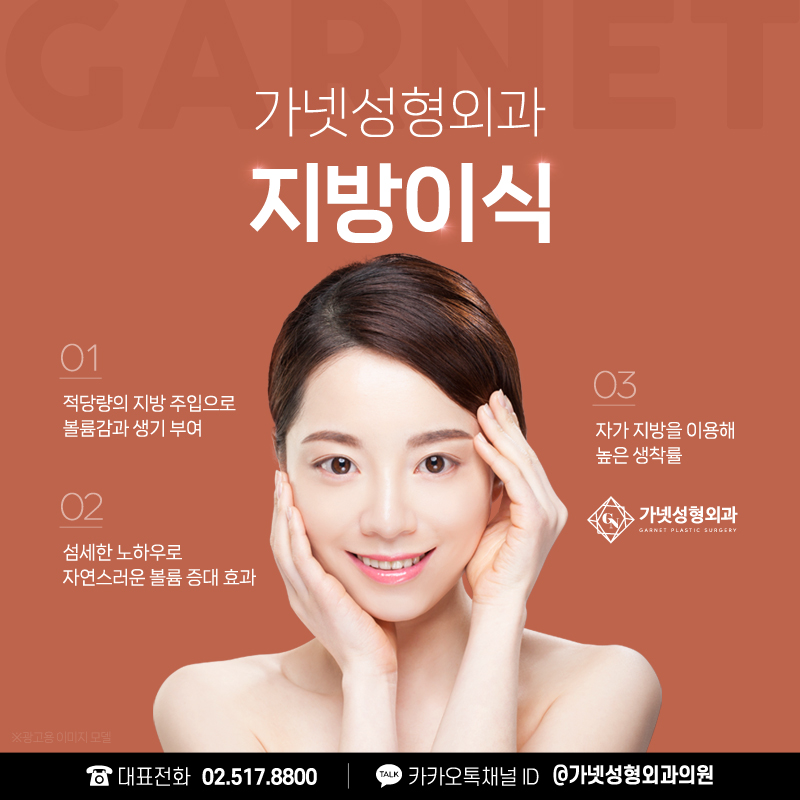
If a face has some volume, it can appear youthful and younger than its age,
but on the other hand, as aging begins and facial fat decreases,
the face can start to look older than the actual age.
Therefore, if volume is restored through autologous fat grafting in areas that have become hollow,
such as the cheeks, cheekbones, chin, eye area, and nasolabial folds,
you can achieve a natural-looking volume effect without appearing unnatural.
In particular, by transplanting an appropriate amount of fat while considering the characteristics of the entire face,
the result looks natural,
and because your own fat is used, the survival rate is high,
which means there is less concern about side effects.
In this way, Apgujeong Station Plastic Surgery can help you regain a youthful and lively image
through a variety of youthful facial plastic surgery procedures.
If you would like to learn what kind of philosophy and treatment approach our clinic has when caring for patients,
it would be good to find out through the video. :)
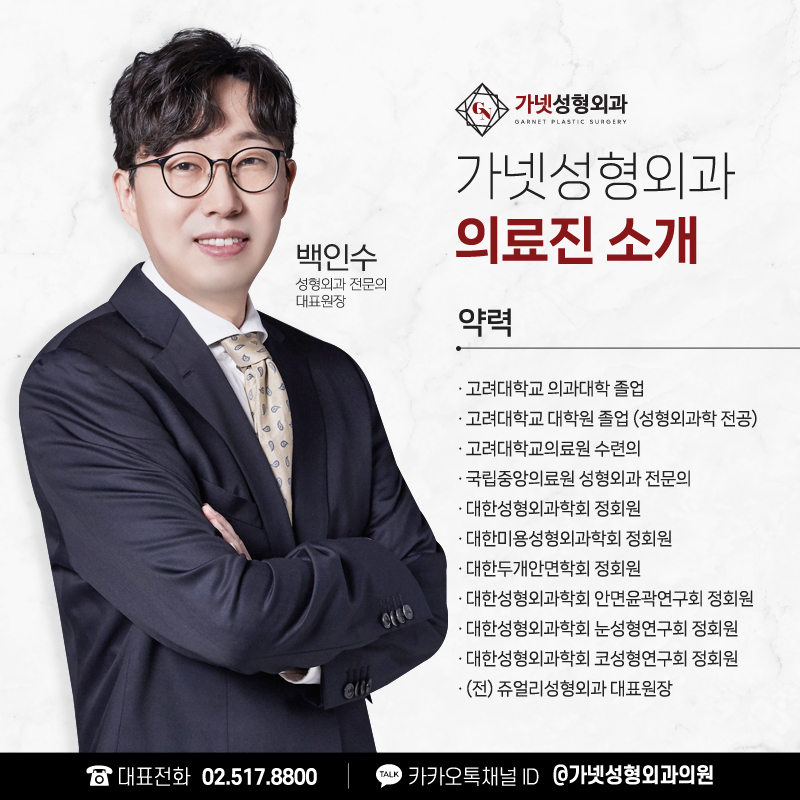
At Ganet Plastic Surgery, the Apgujeong Station Plastic Surgery clinic,
Director Baek In-su, a board-certified plastic surgeon,
has long experience meeting patients as the chief director of a large plastic surgery clinic.
Based on that experience, he strives to create beautiful designs and natural-looking results
that match each individual’s facial proportions and harmony,
using skilled techniques and extensive know-how.
If you want to reverse the changes that come with aging and have a younger-looking impression,
please decide through a consultation what youthful facial plastic surgery is right for you
and which procedures would be good to do together.