As aesthetic standards for anti-aging have risen, more people have become interested in forehead lifts.
Recently, with advances in endoscopic technology, surgery has become possible through small incisions, so the recovery period for a forehead lift has also become very short.
A forehead lift is usually performed through five incisions inside the scalp while using an endoscope to examine various structures.
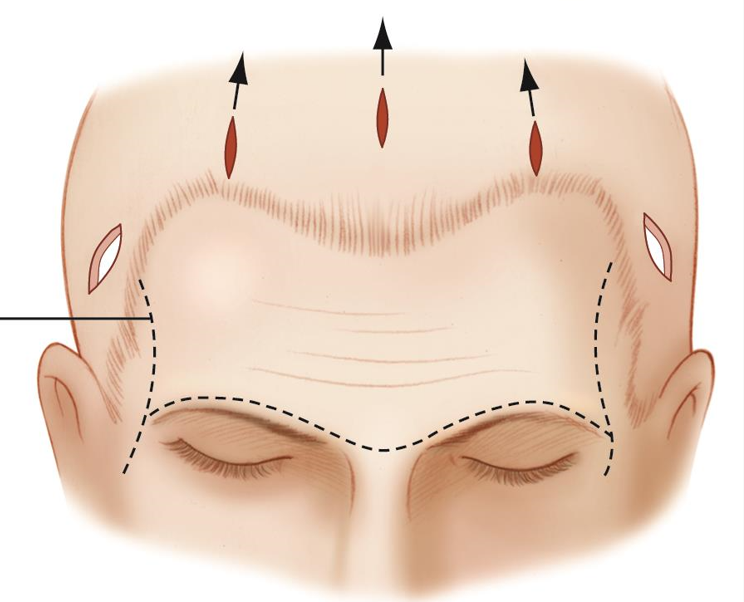
Incisions for the Pentafix forehead lift
Using a surgical endoscope has the advantage of making it easier to identify important structures during surgery, which makes dissection safer.
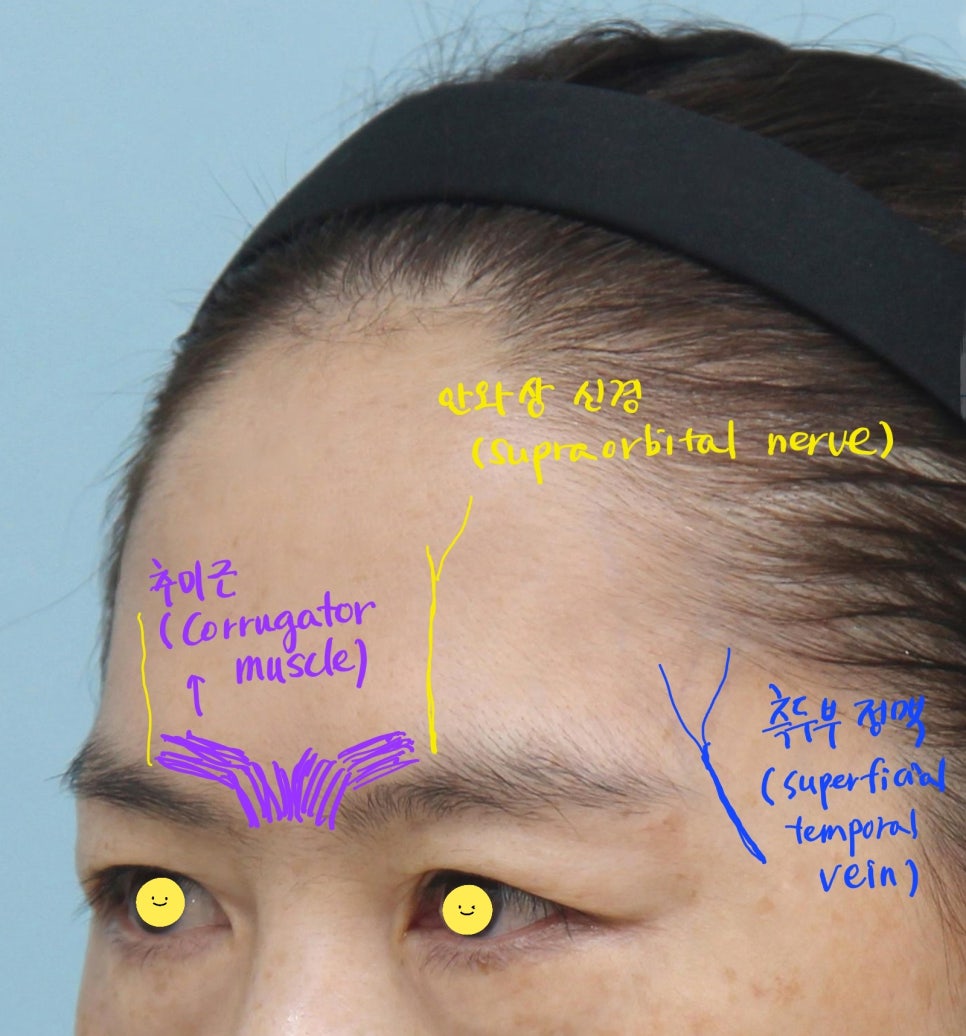
Key structures encountered in forehead lift surgery
Among the nerves encountered during a forehead lift, the supraorbital nerve is the most important. Dissection must be performed so that the supraorbital nerve is not damaged, in order to prevent loss of sensation in the forehead and scalp. In addition, the corrugator muscle is located medial to the supraorbital nerve. This muscle is used to frown at the glabella, and it is partially removed during forehead lift surgery.
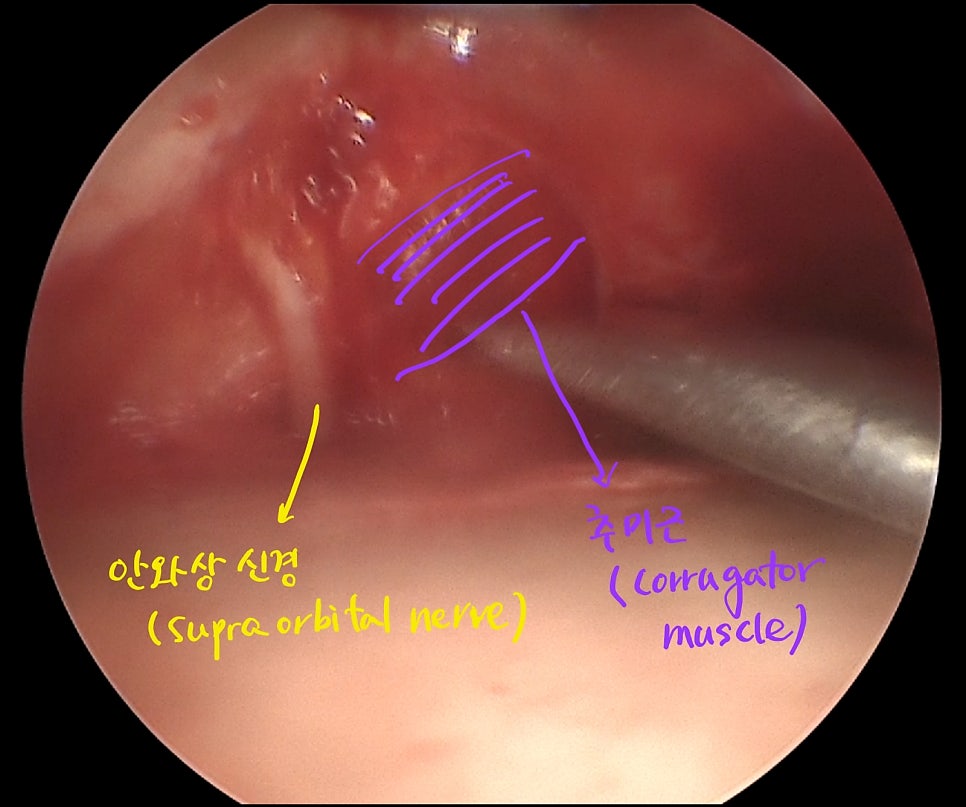
The supraorbital nerve and corrugator muscle seen with an endoscope
And on the temple side, there are branches of the temporal vein, called the sentinel vein, and care must be taken not to damage these vessels.
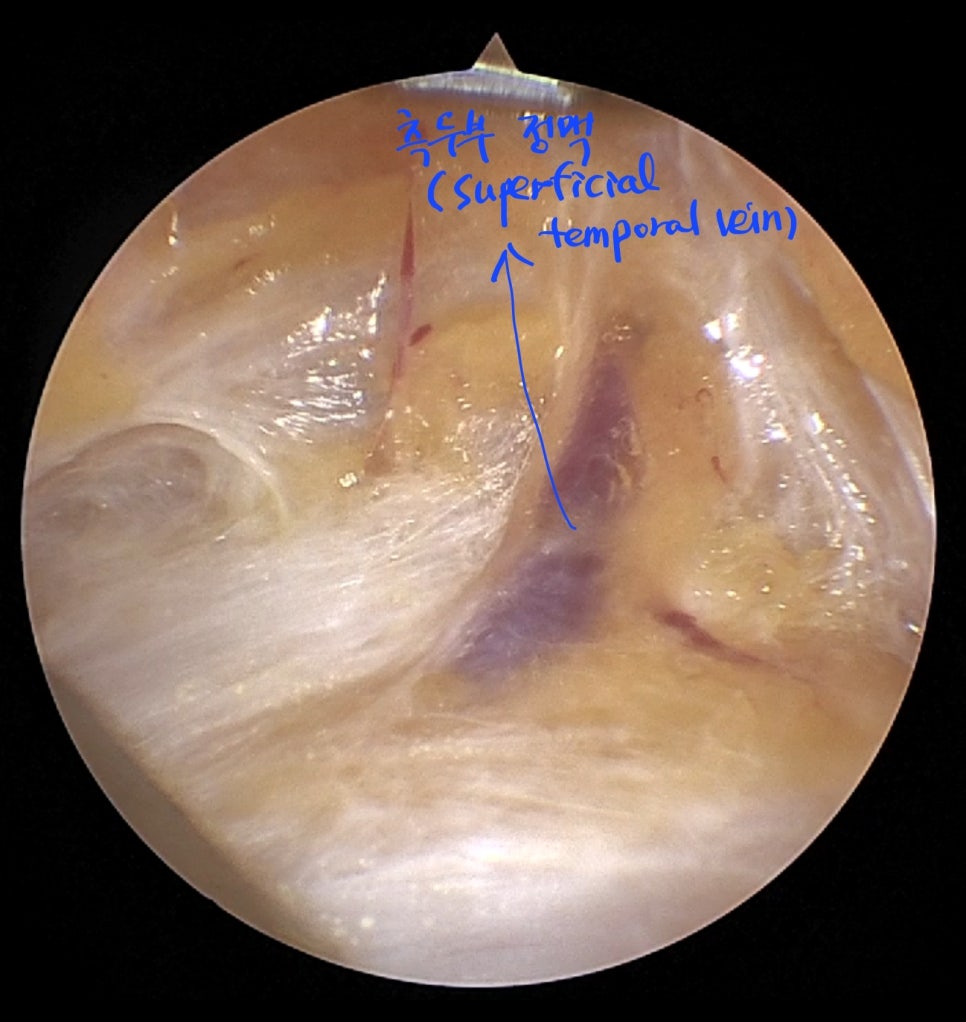
Veins of the temporal region
By safely dissecting these important structures without damaging them, the forehead and temple areas can be separated safely. This is the advantage of endoscopic forehead lift surgery.
As in a facelift, it is important in a forehead lift to properly release the retaining ligaments, and the effect of the forehead lift is improved when the periosteum is properly released around the border between the forehead and the eyebrows.
These retaining ligaments are located on the forehead bone, above the orbit, and in the temple area, and they are also carefully separated while being checked through the endoscope.
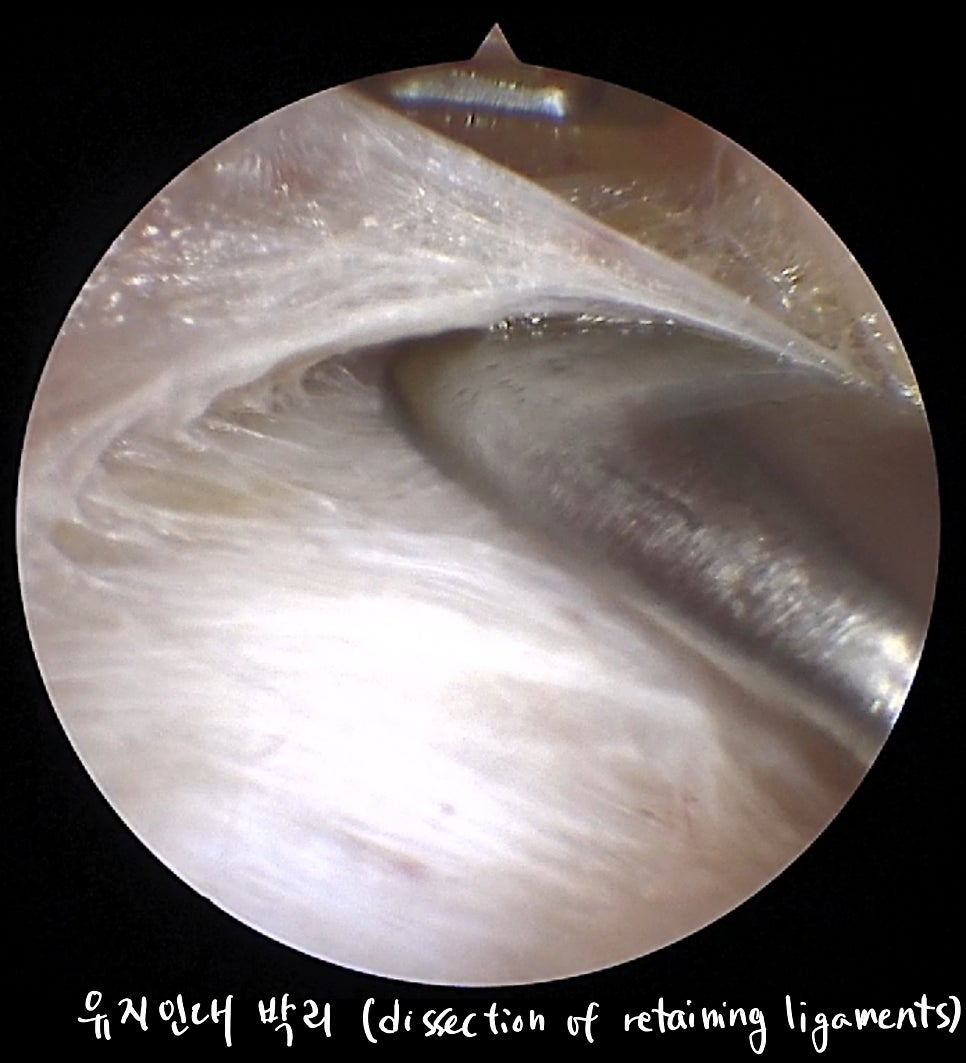
The process of releasing the retaining ligaments
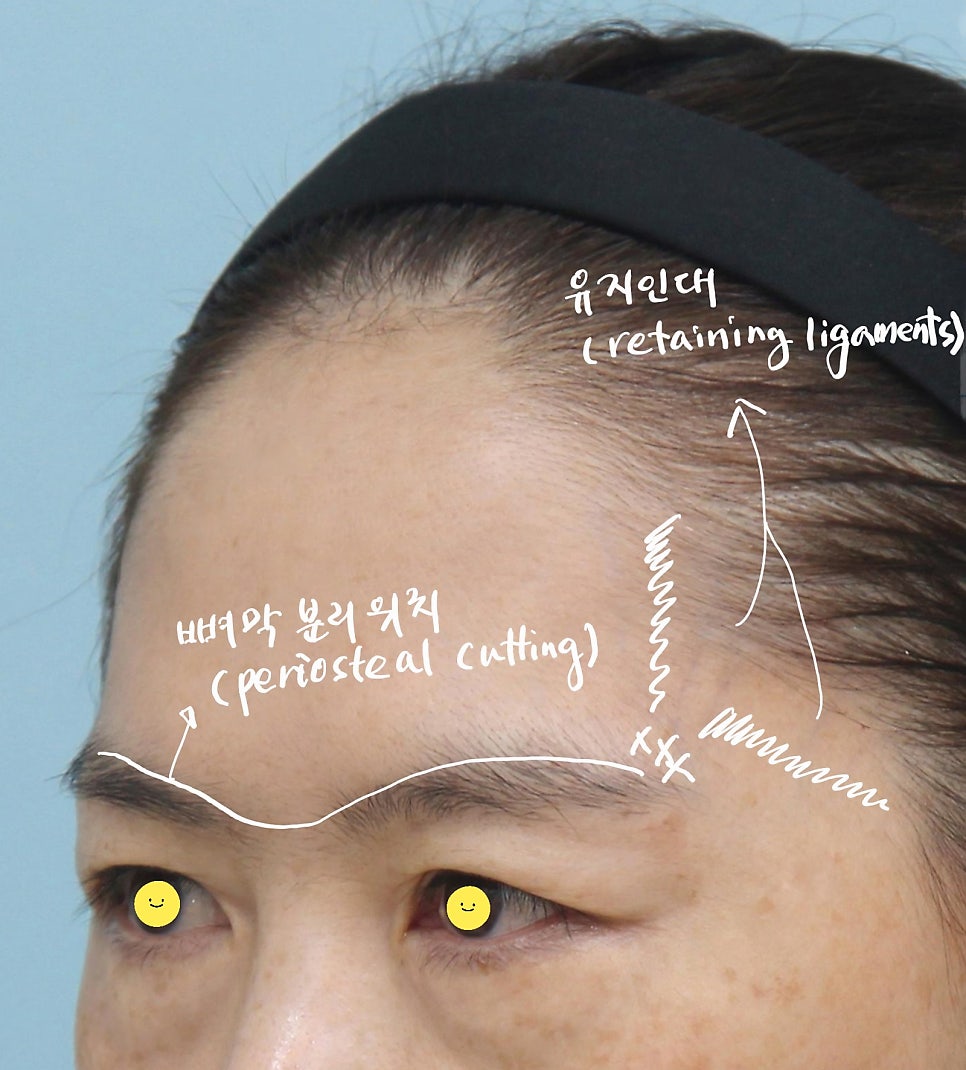
The periosteum of the forehead bone and the retaining ligaments of the temple area
Once the periosteum and retaining ligaments have been properly separated, the dissected forehead must be fixed in place.
The fixation methods include using absorbable fixation pins called Endotine, and a bone tunnelling fixation method, in which holes are drilled in the bone and fixed with sutures.
Because the Endotine method and the bone tunnelling method each have their own advantages and disadvantages, Garnet Plastic Surgery uses both methods and performs surgery according to the patient's characteristics.
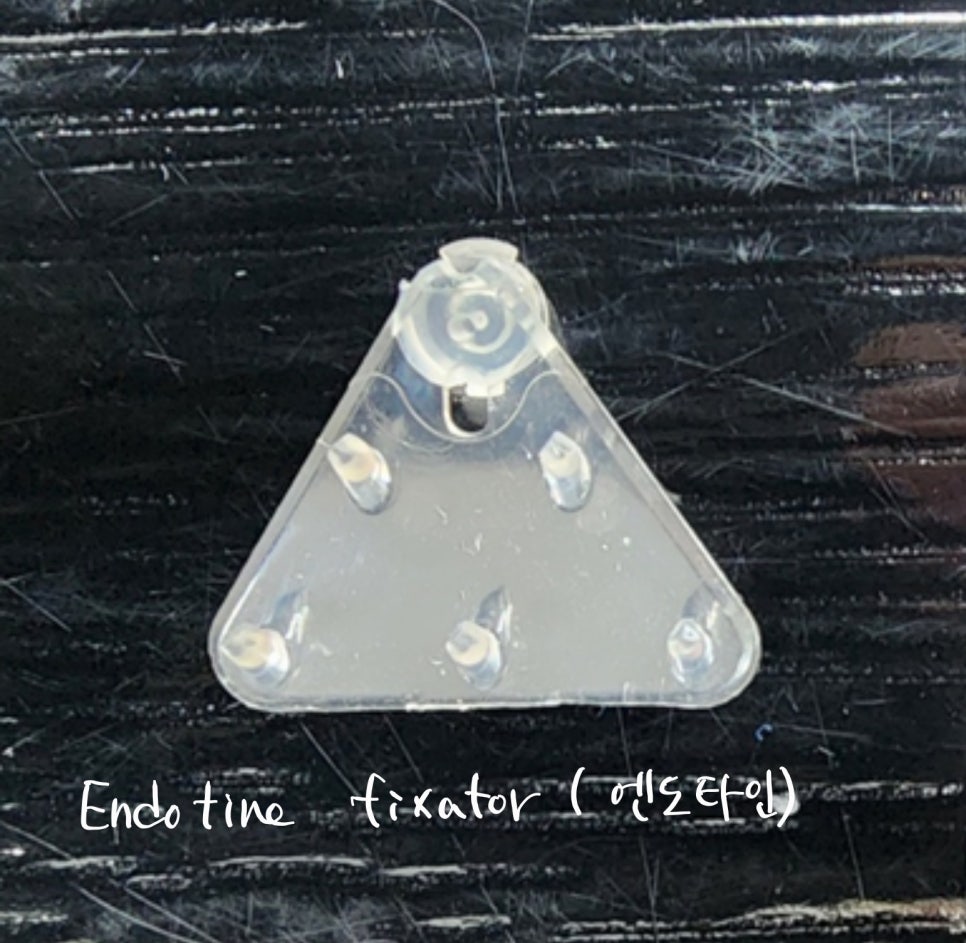
Endotine fixation pin
And along with fixation of the forehead bone area, fixation of the temple area is also important.
Fixation of the temple area is performed by suturing to a strong fascia called the temporal fascia, and this fixation can improve sagging skin on the outer side of the eyes.

Before-and-after comparison (front view)

Before-and-after comparison (45 degrees)
If you compare before and after surgery, you can see that the eyebrows have been lifted well, resolving sagging skin around the eyes.
Of course, there is also the advantage that partial removal of the corrugator muscle improves the frown lines between the eyebrows.
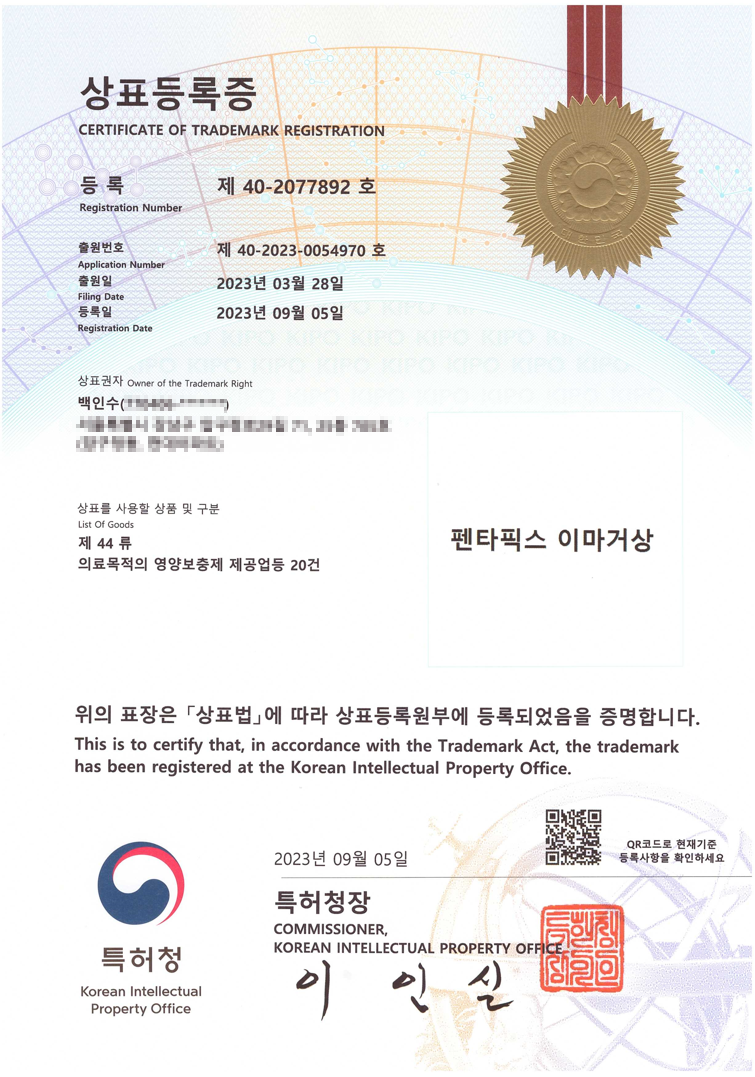
Patented Pentafix forehead lift by the Korean Intellectual Property Office
Garnet Plastic Surgery's unique Pentafix forehead lift is a surgical method that safely and securely dissects the forehead and temple areas through an endoscope, improves sagging skin in the forehead, temples, and around the eyes using five fixation points, and is also effective for glabellar wrinkles and similar concerns.