Lower blepharoplasty, performed to correct under-eye sagging, is a procedure that addresses the fat, muscle, and skin under the eyes and has continued to develop through the efforts of many plastic surgery specialists.
The history of lower blepharoplasty can be roughly divided into surgical advances across stages 1 through 4.
Since lower blepharoplasty is a procedure that corrects under-eye aging, let’s first look at the anatomical structure under the eyes.
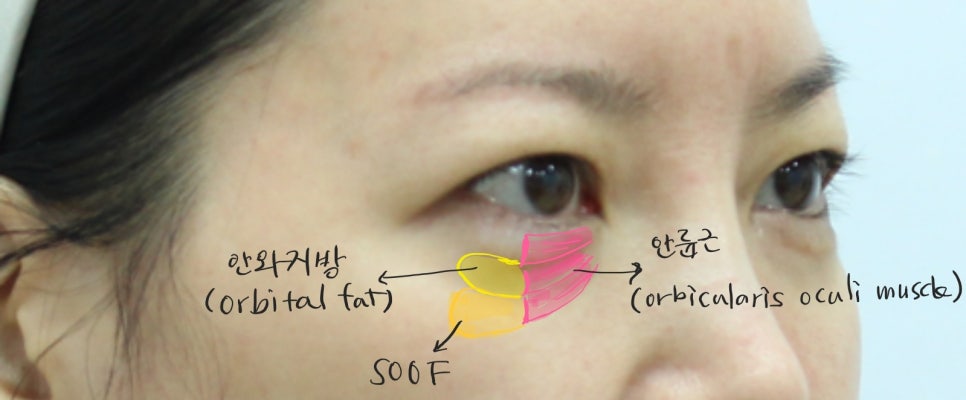
There are several factors that create aging under the eyes.
The skin and muscle under the eyes (orbicularis oculi muscle) sag, the orbital fat (under-eye fat) pads become loosened, and there is a factor in which the sub-orbicularis oculi fat, called SOOF, sags downward.
To correct these factors, lower blepharoplasty has evolved from the simple methods of the past into approaches that increasingly correct each aging factor.
If we explain lower blepharoplasty by stage, it is as follows.
1st-stage lower blepharoplasty: Under-eye fat repositioning + under-eye skin excision
2nd-stage lower blepharoplasty: Under-eye fat repositioning + orbicularis oculi suspension fixation + under-eye skin excision
3rd-stage lower blepharoplasty: Under-eye fat repositioning + orbicularis oculi suspension fixation + lateral canthopexy + under-eye skin excision
4th-stage lower blepharoplasty: Under-eye fat repositioning + SOOF lift + orbicularis oculi suspension fixation + lateral canthopexy + under-eye skin excision
These methods have continued to evolve, and plastic surgery specialists are still working now to correct each factor of aging more precisely and help results last longer.
Let me explain the currently used 4th-stage lower blepharoplasty method.
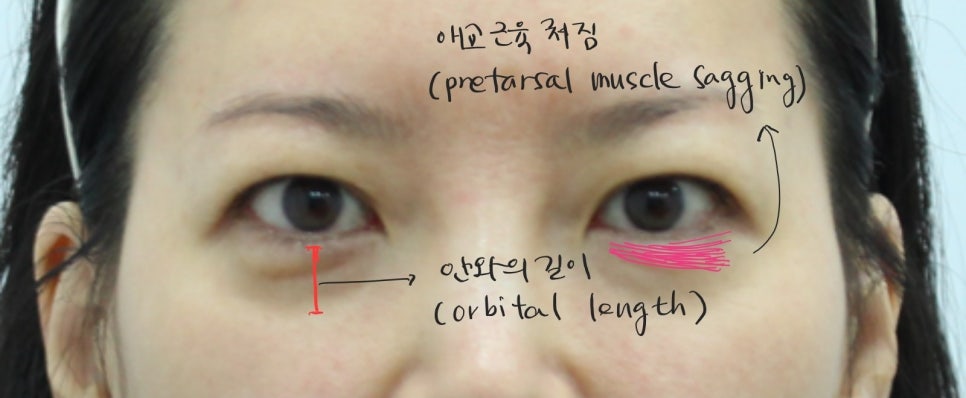
Aging under the eyes
When aging occurs under the eyes, the skin sags, and the orbicularis oculi muscle that creates the under-eye fullness also droops, making the tear trough more prominent.
In addition, the under-eye fat (orbital fat) pads also become loosened, and the overall length of the orbit becomes longer.
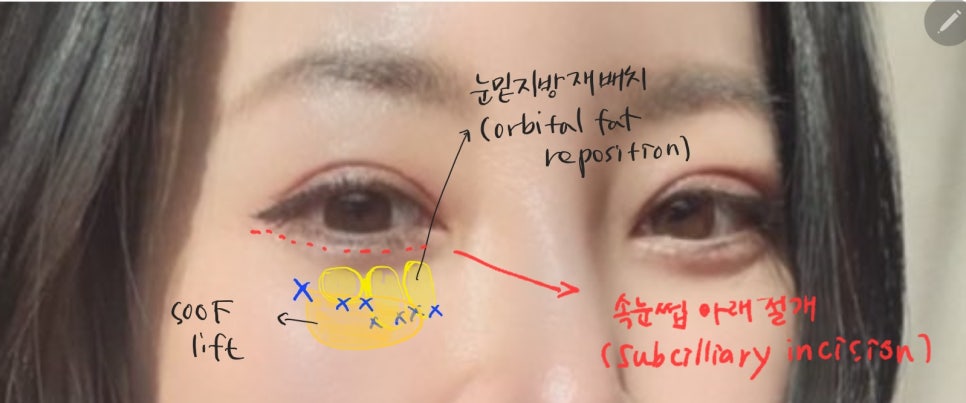
Lower blepharoplasty is performed through an incision below the eyelashes of the lower eyelid. First, after dissecting the tear trough, the under-eye fat (orbital fat) is moved downward and fixed in place to reposition it. Through this process, the protruding under-eye fat pad is smoothed out, and the sunken tear trough is filled.
Next, the sub-orbicularis oculi fat called SOOF is lifted upward and fixed. Through this process, the length of the orbit becomes shorter, and the midface gains more elasticity, creating a more youthful effect.
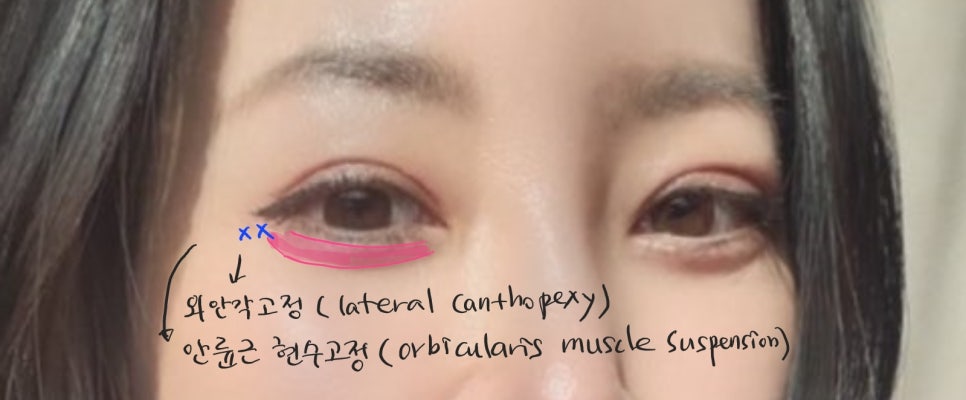
Lateral canthopexy and orbicularis oculi suspension fixation
Next, to lift the sagging muscle, the orbicularis oculi muscle that creates the under-eye fullness is fixed to the outer corner of the eye. This is called orbicularis oculi suspension fixation, and through this, the fullness under the eyes can be well maintained.
In addition, lateral canthopexy is performed to prevent lower eyelid ectropion and to provide elasticity to the under-eye area.
Finally, the surgery is completed by removing the skin appropriately.
Let’s compare the results before and after surgery.
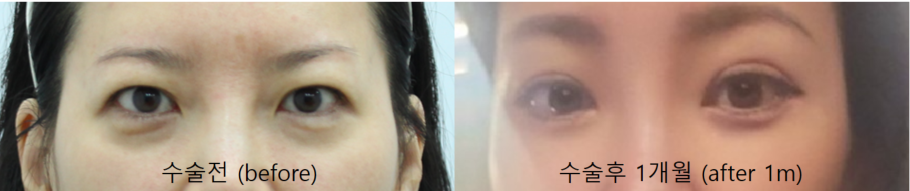
Before-and-after comparison of Quad Plus lower blepharoplasty
The hollow under-eye area before surgery has been well restored, and through the SOOF lift, you can see that the length of the orbit has become shorter.
Through the SOOF lift, you can also see that the elasticity of the midface has improved.
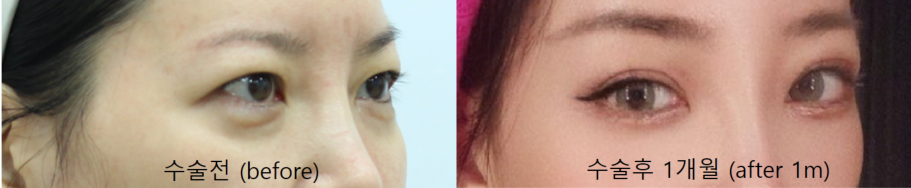
Before-and-after comparison of Quad Plus lower blepharoplasty
Before surgery, the skin and the muscles that create the under-eye fullness were sagging, but through orbicularis oculi suspension fixation and lateral canthopexy, the elasticity under the eyes has improved and the under-eye fullness has been lifted upward.

This is a real model who has agreed to disclosure.
Garnet Plastic Surgery’s Quad Plus lower blepharoplasty is a 4th-stage lower blepharoplasty that corrects each factor of under-eye aging, and the details of each procedure are as follows.
Quad Plus lower blepharoplasty: Under-eye fat repositioning + SOOF lift + orbicularis oculi suspension fixation + lateral canthopexy + under-eye skin excision

Quad Plus lower blepharoplasty, patent office