Many people think only about wrinkles appearing on the face as they get older.
However, facial aging appears in various forms, and facial shape also changes due to aging.
'Facial Shape in Youth'
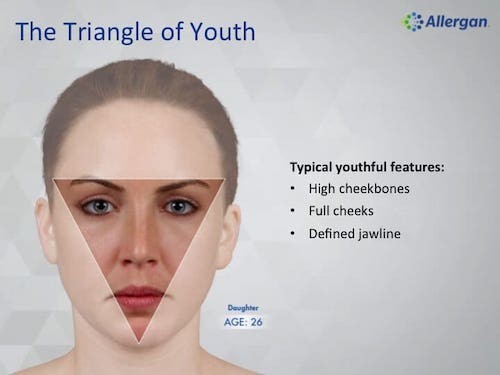
Facial shape in your 20s (Source: Allergan website)
The youthful facial shape in your 20s is often expressed using a triangle, and the three elements of a youthful face are as follows.
High cheek bones: The cheekbones are positioned high on the face, creating an upward-lifted facial shape.
Full cheeks: The cheeks, especially the front cheeks, retain good volume, creating a firm and full-looking face.
Defined jawline: There is no sagging of the skin or soft tissue, so the jawline appears slim.
A youthful face that has these three elements can be described as the Triangle of Youth.
'Changes in Facial Shape Due to Aging'
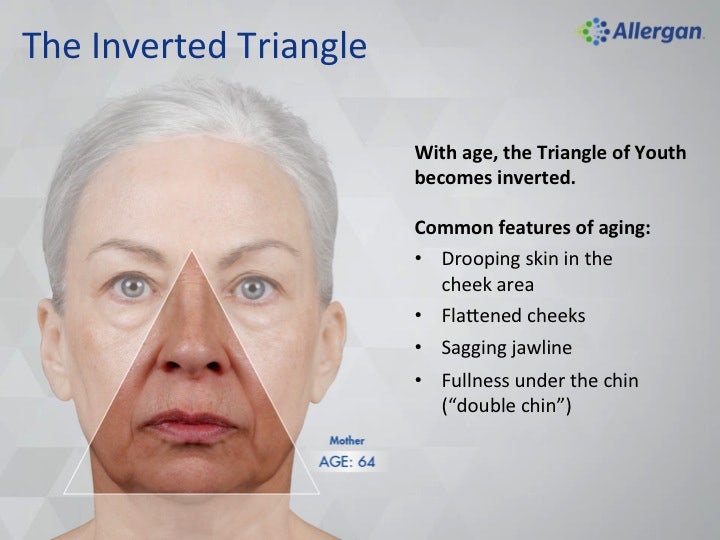
In contrast, as aging progresses, volume in the upper part of the face decreases and the soft tissues sag downward, causing the lower part of the face to become more prominent and creating an inverted triangle shape.
When listening to people who visit for lifting consultations, many say:
'My face has become longer than it was when I was younger.'
'As I’ve gotten older, it feels like my square jaw has become bigger.'
They also often ask whether facial contouring surgery is necessary because the face seems longer and the lower face has become larger.
In the case of facial bones, bone resorption actually occurs with age, causing them to become smaller, and if dental health is poor, bone resorption tends to progress more quickly.
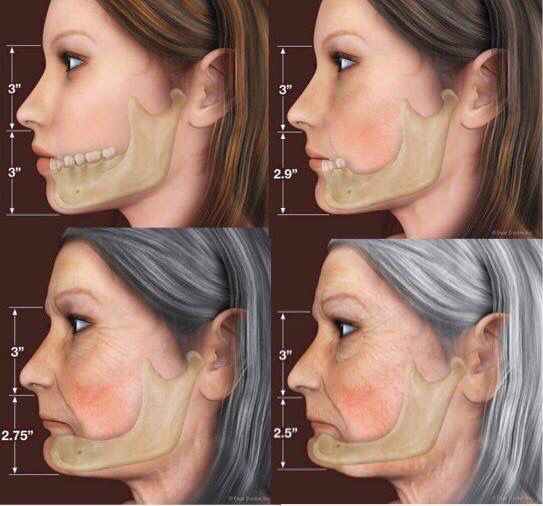
Changes in the mandible due to aging
Therefore, the changes in which the face becomes longer and the lower face becomes more heavy due to aging are not caused by changes in the facial bones, but by sagging skin and soft tissue.
'Facelift Surgery Process'
To lift the sagging skin and soft tissue in the lower face, appropriate subcutaneous dissection and sufficient dissection of the SMAS layer are necessary.
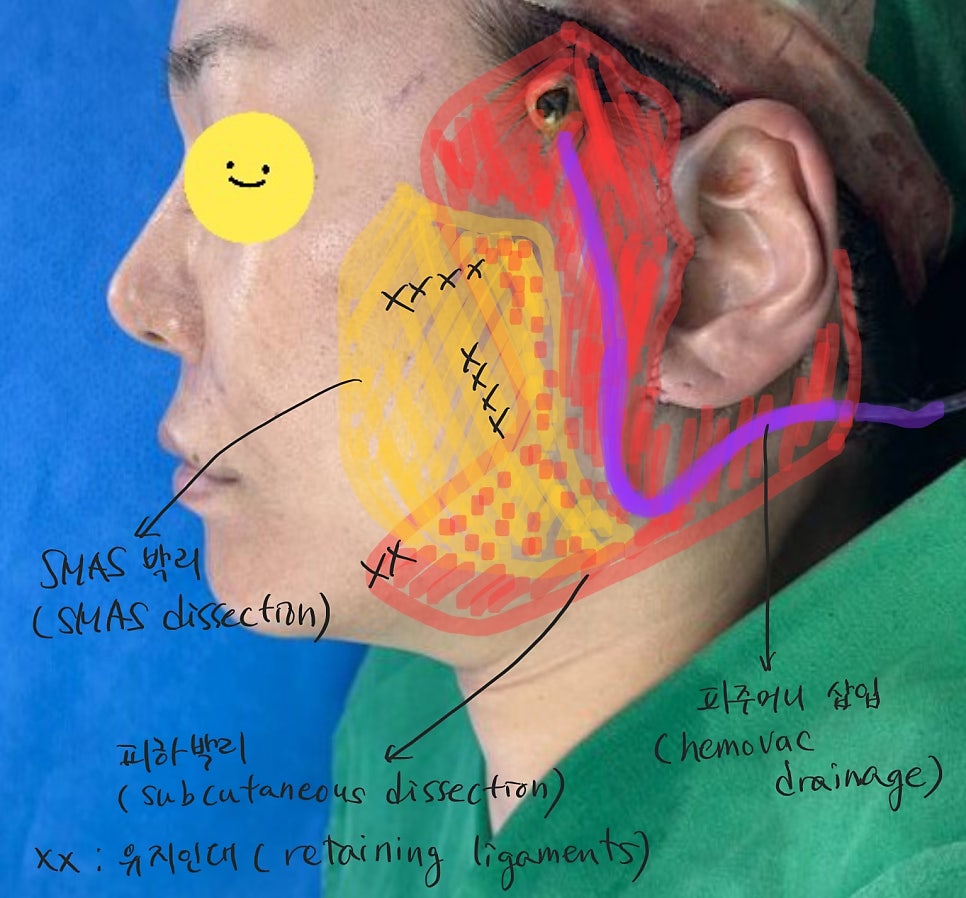
Dissection range in a facelift. Dissection of the SMAS layer and retaining ligaments
The retaining ligaments that are important in a facelift can largely be divided into three areas.
Zygomatic retaining ligament
Parotid-masseteric retaining ligament
Mandibular retaining ligament
In a facelift, proper dissection of the above retaining ligaments together with dissection of the SMAS layer is very important, and especially to lift the lower part of the face well, dissection of the mandibular retaining ligament is particularly important.
'Changes in Facial Shape One Month After a Facelift'
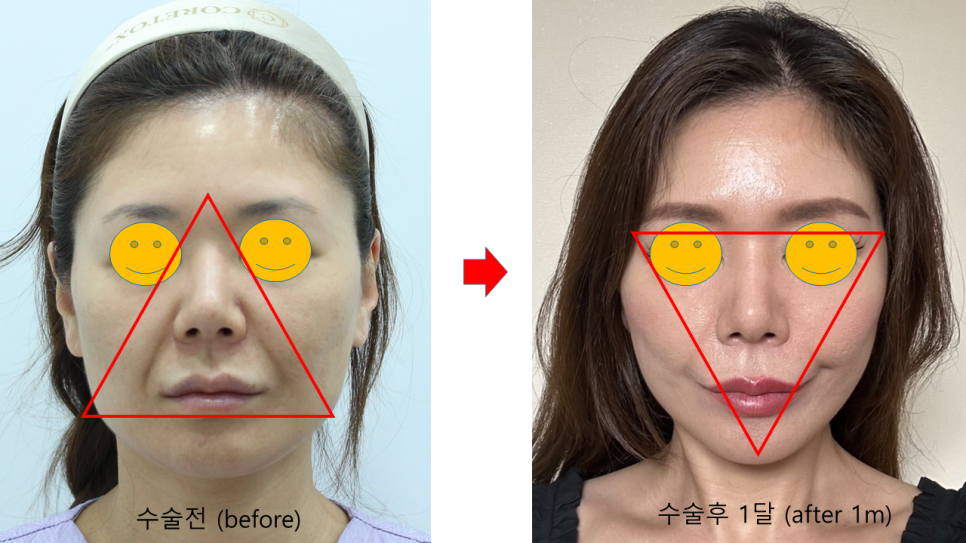
Changes in facial shape after facelift surgery
Before surgery, the sagging skin and soft tissue made the lower face stand out, showing an inverted triangle face shape of aging.
If facelift surgery is performed well, the skin and soft tissue that had been gathered in the lower face are lifted upward, and the face is nicely changed into a youthful triangle face shape.
Facelift surgery changes the shape of the face into a more youthful form and also makes the overall face appear shorter.
As people age, some consider facial contouring surgery or get jaw Botox because their face seems longer and the lower face becomes larger and heavier.
However, if facial contouring surgery or jaw Botox is performed after middle age, skin sagging may become more noticeable, so caution is advised.
Therefore, through an accurate consultation, it is important to determine what factors are causing the change in facial shape, and selecting the appropriate surgery accordingly can be a way to achieve a younger and more youthful-looking face.

This is a partial model who has consented to public release.