The best way to address aging under the eyes is lower blepharoplasty.
Sometimes, during lower blepharoplasty consultations, many people ask whether aegyosal will disappear after surgery.
The reason this question is asked so often is probably because the incision site for lower blepharoplasty is similar to the area where aegyosal appears.
And in fact, among some people who had lower blepharoplasty a very long time ago, there were cases where aegyosal really did disappear after surgery.
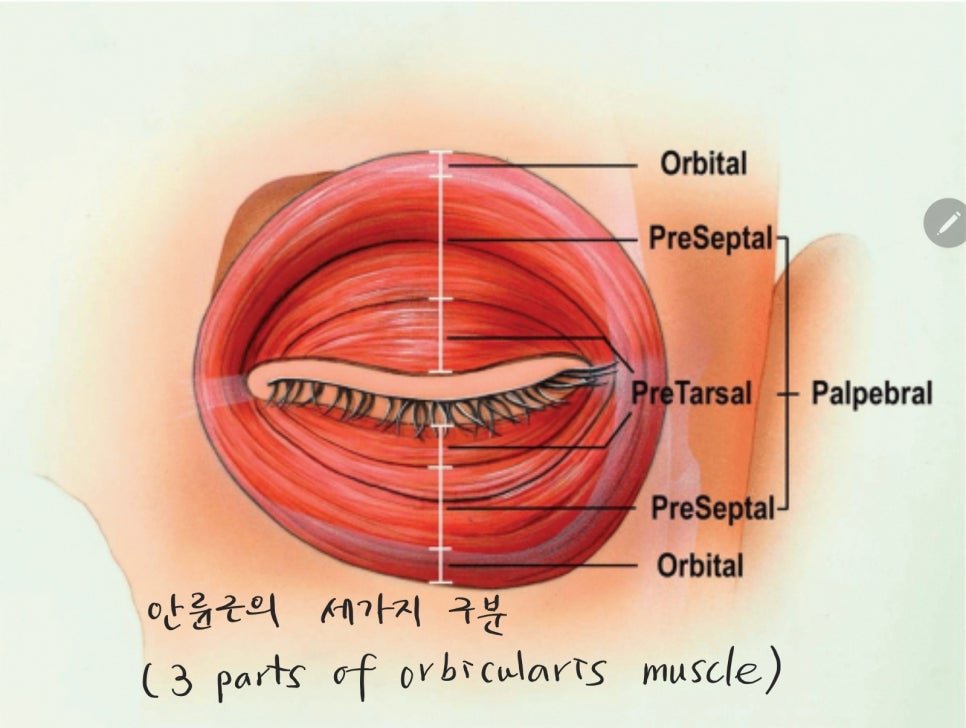
The three divisions of the orbicularis oculi muscle. The pretarsal orbicularis oculi muscle that creates aegyosal
Aegyosal is created by the pretarsal orbicularis oculi muscle (pretarsal OOM), one of the three compartments of the orbicularis oculi muscle that surrounds the eyes.
That is why, in lower blepharoplasty, if the orbicularis oculi muscle is damaged or if work to fix the orbicularis oculi muscle to the outside is not performed, aegyosal may disappear, so caution is needed.
'Past lower blepharoplasty'
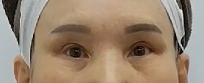
Loss of aegyosal in a person who had lower blepharoplasty at another hospital about 20 years ago
In the past, lower blepharoplasty was a relatively simple surgical method that partially removed bulging fat under the eyes and excised sagging skin.
However, current lower blepharoplasty has gradually improved into a method that corrects even the detailed causes of aging under the eyes.
'Under-eye aging'
Aging under the eyes is not simply sagging skin under the eyes; it occurs due to a combination of factors.
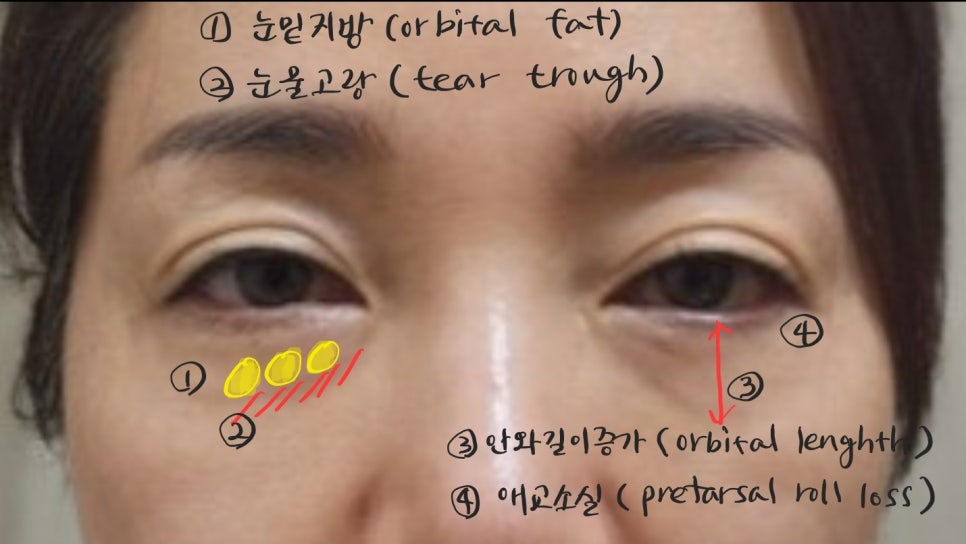
Causes of under-eye aging
First, the fat pads under the eyes lose elasticity and become lax. As a result, the contour of the attachment site of the tear trough ligament becomes more pronounced.
In addition, the distance from the lower eyelid to the orbital bone boundary, called the orbital length, becomes longer, which is also something that needs correction.
And as the elasticity of the skin and muscles under the eyes decreases, aegyosal becomes flatter or the outer part of the aegyosal begins to sag.
'Quad Plus lower blepharoplasty'
If the lower blepharoplasty of the past addressed only some of the aging factors mentioned above, current lower blepharoplasty can be described as a procedure that comprehensively corrects the various factors of under-eye aging.
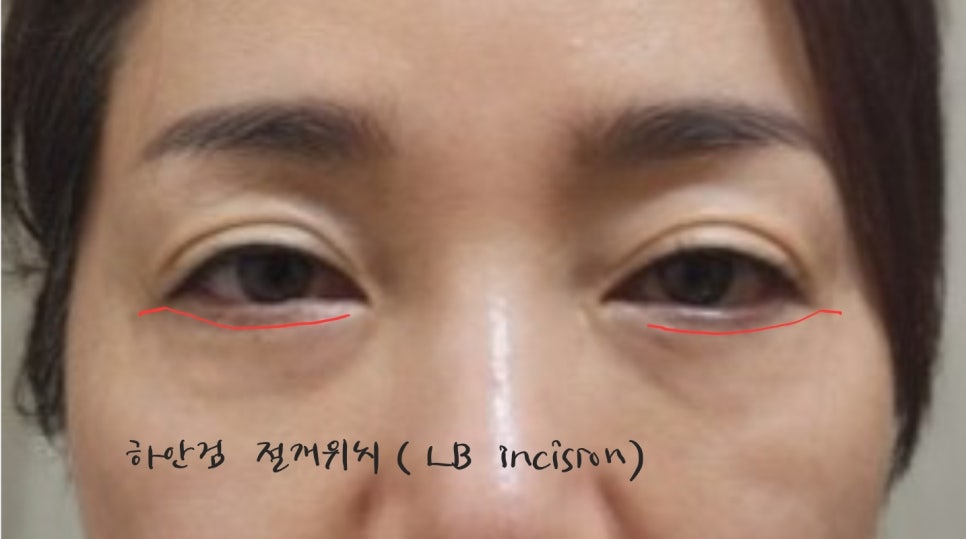
Incision site for lower blepharoplasty
The skin incision for lower blepharoplasty is made 2 to 3 mm below the lash line. In this area, the orbicularis oculi muscle that creates aegyosal lies beneath the skin, so it is important to reach the fat pads under the eyes without damaging the orbicularis oculi muscle.
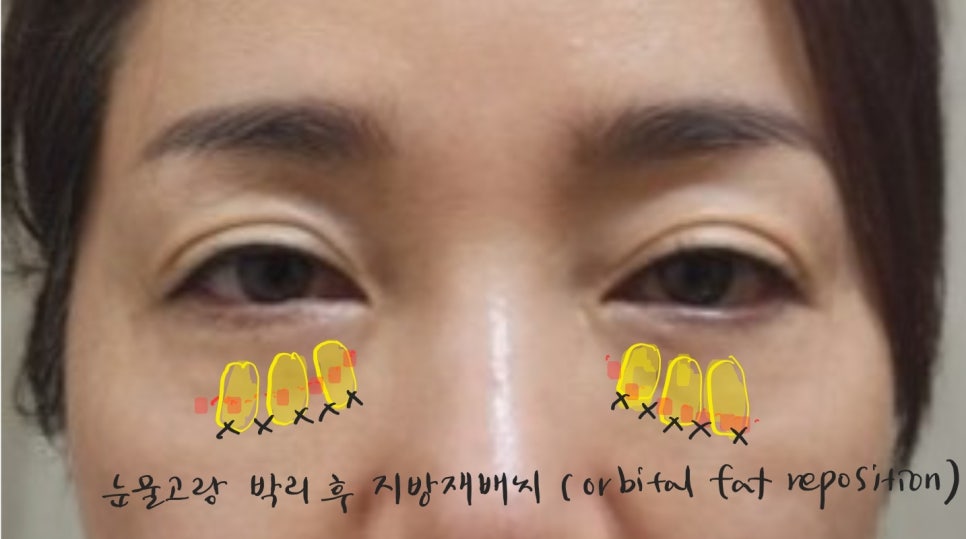
Under-eye fat repositioning performed after releasing the tear trough ligament in lower blepharoplasty
By carefully dissecting the orbicularis oculi muscle under the eyes, the tear trough ligament and fat pads under the eyes can be reached. After properly releasing the tear trough ligament, the under-eye fat pads are sufficiently dissected and moved downward to fill in the hollowed area under the eyes. This procedure is called under-eye fat repositioning.
If only the fat under the eyes is removed during lower blepharoplasty, hollowing under the eyes may occur, or the under-eye fat may bulge out again over the long term, so caution is needed.
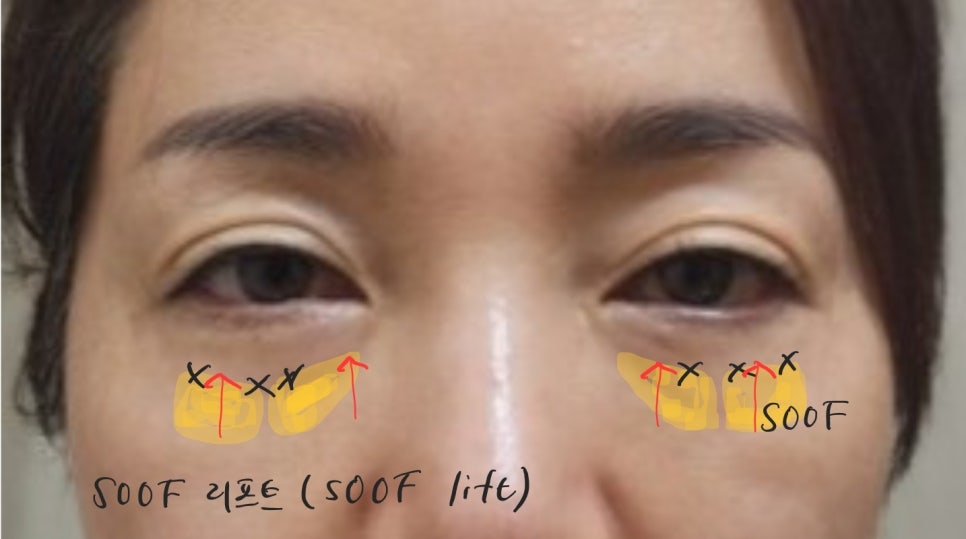
SOOF lift that reinforces the elasticity of the midface
After repositioning the under-eye fat, an additional step is performed to reinforce the elasticity of the midface connected to the under-eye area. This is called a SOOF lift.
Beneath the orbicularis oculi muscle under the eyes, there is another fat layer called SOOF (SubOrbicularis Oculi Fat). Lifting this fat layer upward increases the elasticity of the midface and shortens the orbital length under the eyes, allowing the under-eye area to look more youthful.
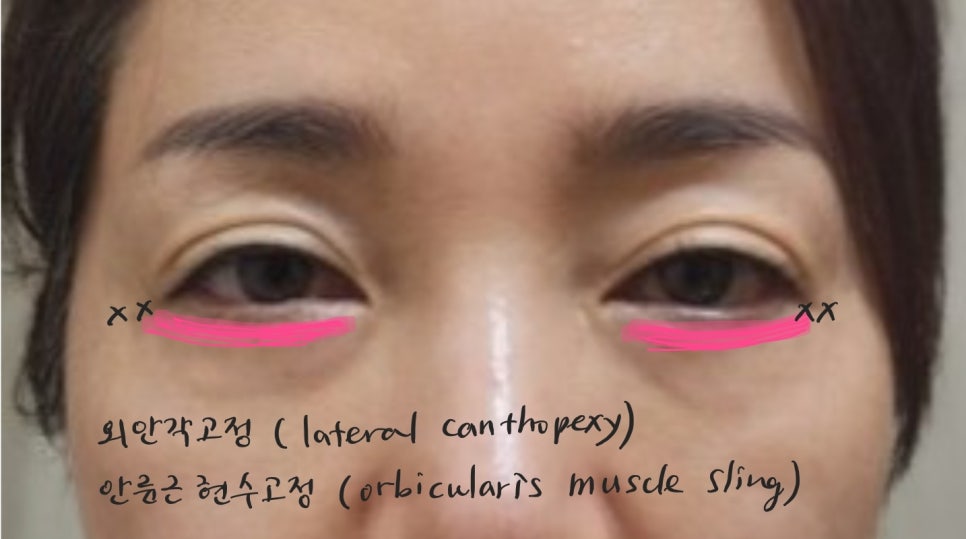
Method of lifting the under-eye orbicularis muscle in lower blepharoplasty
In the next step, the elasticity of the under-eye area is improved and aegyosal is reinforced.
Only when the tissues and muscles supporting the under-eye area are made elastic can ectropion, a condition in which the lower eyelid turns outward, be prevented, and aegyosal can also be made more elastic.
An outer canthopexy is performed to fix the lower eyelid tarsus or surrounding tissue to the firm tissue at the outer corner of the eye, and orbicularis muscle suspension fixation is performed to additionally secure the orbicularis oculi muscle that creates aegyosal to the outer corner of the eye.
The final step is removing the excess skin and completing the surgery with delicate suturing.

Lower blepharoplasty that preserves aegyosal. Quad Plus lower blepharoplasty
'Comparison before and after 1 month of lower blepharoplasty'
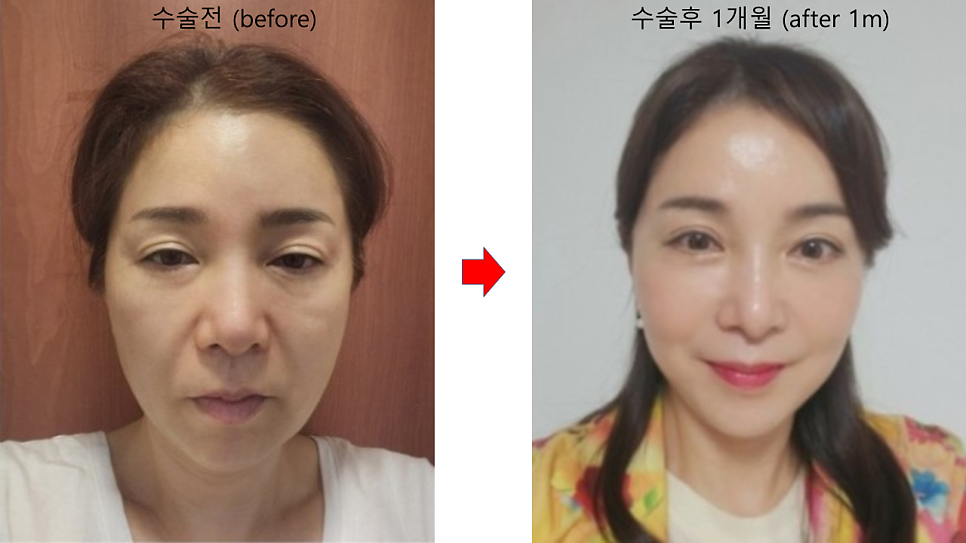
One-month review of Quad Plus lower blepharoplasty. A real model who consented to disclosure.
Quad Plus lower blepharoplasty is a procedure with the advantage of a natural result because it corrects the various factors of under-eye aging one by one.
If aegyosal is preserved in lower blepharoplasty, it appears naturally when smiling, creating a natural and lively look.
It is also a lower blepharoplasty that can create a more youthful appearance by restoring the orbital length and the elasticity of the midface under the eyes, which are easy to overlook.

This is a real model who consented to disclosure. Lower blepharoplasty review. Lower blepharoplasty review.