Left-right facial asymmetry is something everyone has to some degree, and if it is not severe, it is not a problem.
However, people who come in for plastic surgery consultations may be sensitive about asymmetry, and they often ask many questions about facial asymmetry.
Today, among the various forms of facial asymmetry, let’s look at cases where facial asymmetry is alleviated after rhinoplasty.
'Facial asymmetry with one side of the face higher'
When there is left-right asymmetry, there are cases where there is a difference not only in the size of the left and right sides of the face, but also in their height.
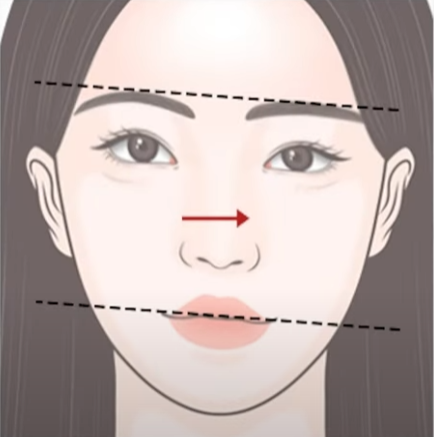 When facial asymmetry includes a height difference between the left and right sides of the face
In cases like this, where one side of the face is higher and the other side is lower, the eyebrows, eyes, ears, and mouth are also often positioned higher on one side.
In such cases, one side of the nasal ala may also sit higher than the other, which can make the nose feel crooked.
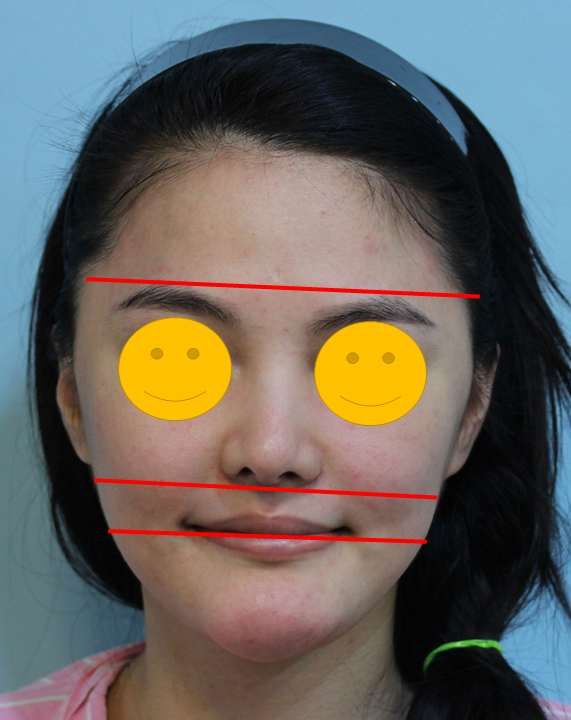 Alignment lines when one side of the face is higher
If you plan rhinoplasty in such a case, it is important to make the nose, which is located at the center of the face, not only harmonize with the entire face but also help reduce asymmetry as much as possible.
'Deviation of the septal cartilage and alar cartilage'
Since the nose is also part of the face, its shape inevitably follows the pattern of facial asymmetry.
For that reason, even without nasal trauma, facial asymmetry can cause the nose to look crooked, and if such asymmetry is present, surgery should be performed in a way that reduces it as much as possible.
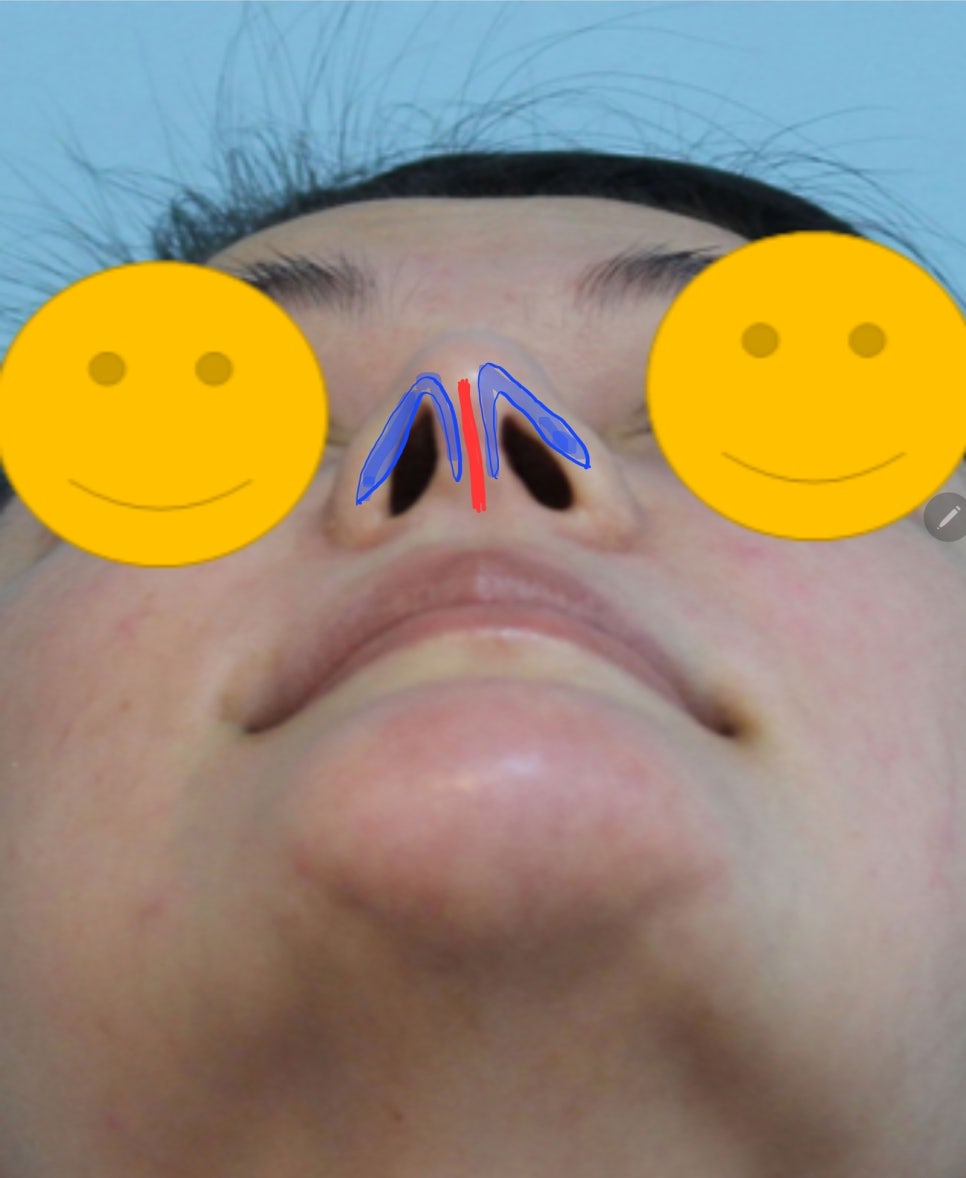 Deviated septum and curvature of the alar cartilage
Septal deviation and asymmetry of the alar cartilage are often more clearly seen in photos taken from below than in frontal photos.
Of course, it can also be assessed through a plastic surgery consultation, and more detailed diagnosis can be made through a preoperative CT scan.
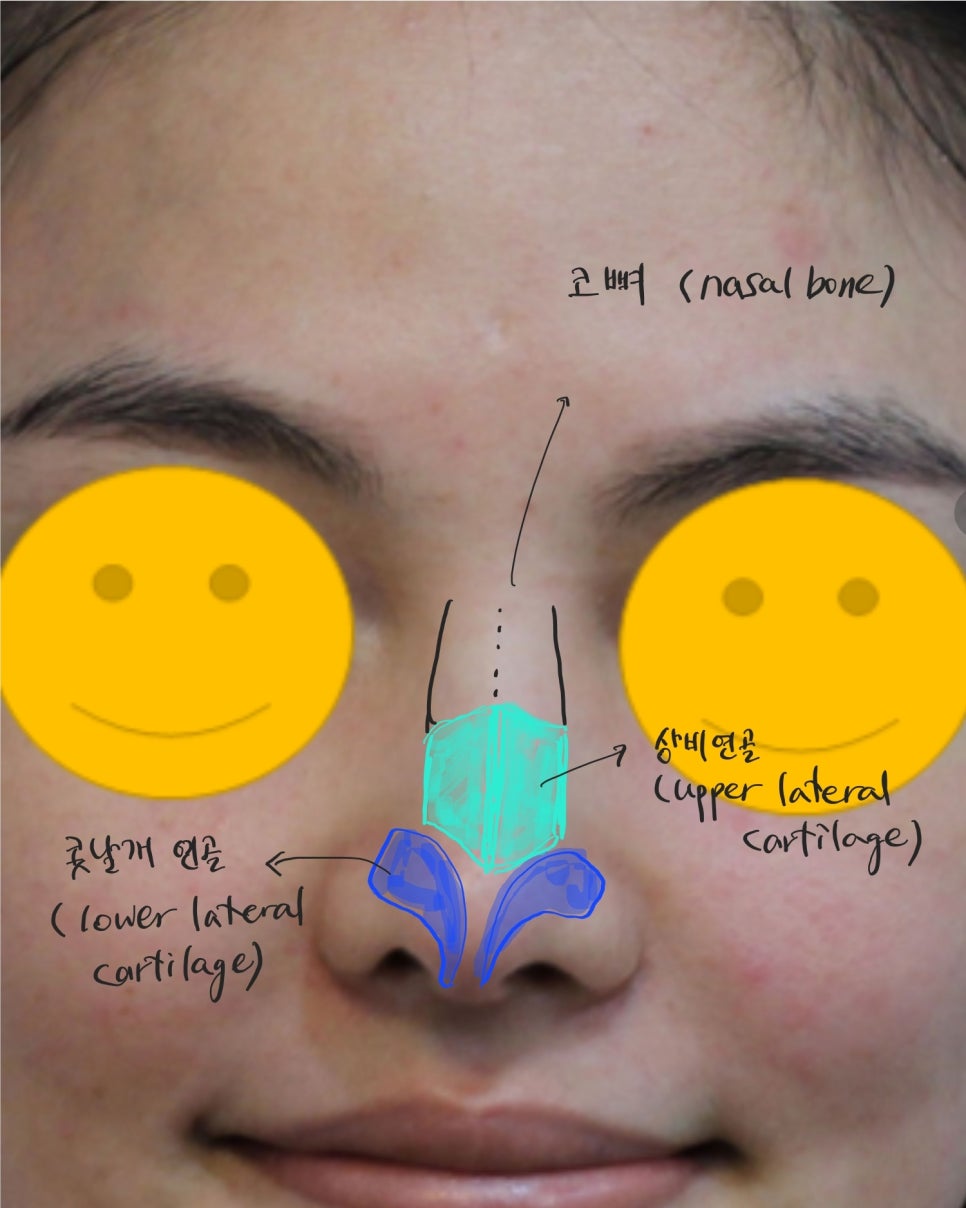 Left-right height difference of the alar cartilage
The structure of the nose can be divided, from top to bottom, into the 'nasal bone,' 'upper lateral cartilage,' and 'alar cartilage.'
When there is facial asymmetry or a crooked nose, the left and right sides of the alar cartilage may appear at different heights from the front, or the nostrils may look uneven.
The cause of this asymmetry is often a deformation in the arrangement of the alar cartilage, which determines the shape of the nostrils.
And because the nasal bone, upper lateral cartilage, and alar cartilage are organically connected to one another, these structures must be handled delicately in rhinoplasty to achieve good results.
'Correction of septal deviation and rearrangement of the alar cartilage'
In crooked nose surgery accompanied by facial asymmetry, it is important to establish the facial midline well and align the nasal structures with that midline.
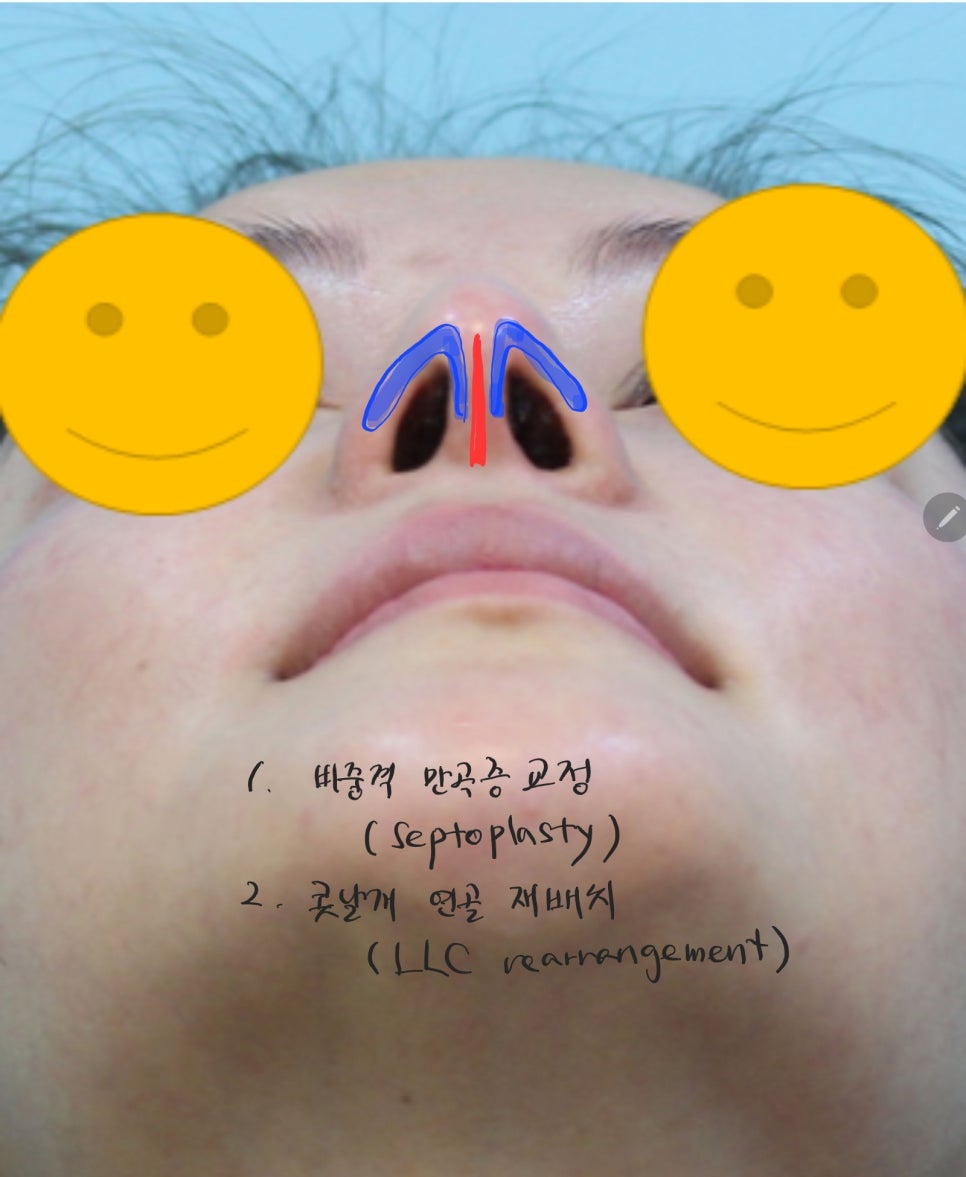 Correction of septal deviation and repositioning of the alar cartilage.
If septal deviation is present during surgery, it must be corrected, and an additional septal extension should be performed on the corrected septal cartilage so that the nasal tip no longer bends.
After the septal cartilage, which serves as the support for the nasal tip, is properly aligned in the center, the left and right alar cartilages can be securely fixed to correct nostril asymmetry.
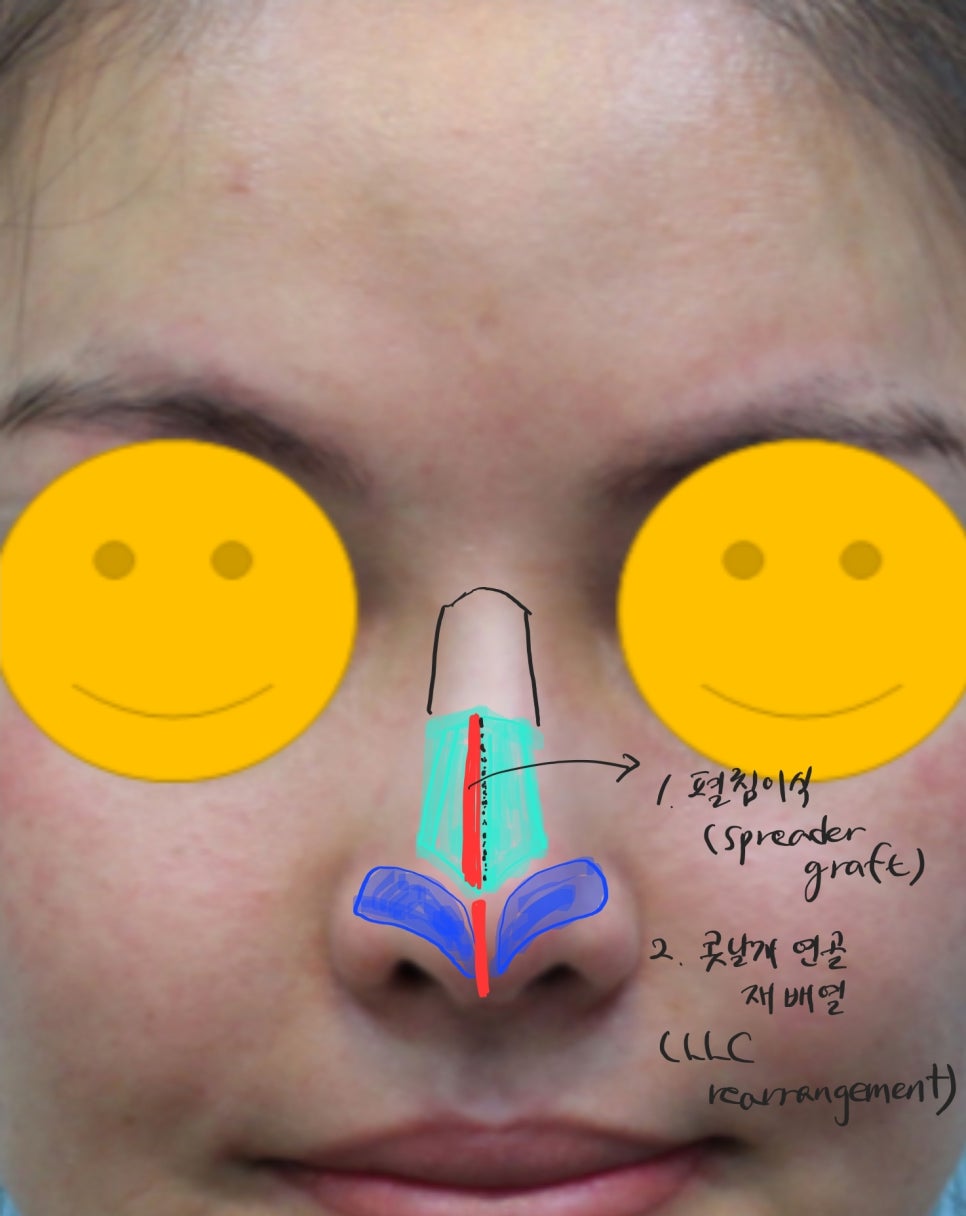 Spreader grafting in the upper lateral cartilage area and repositioning of the alar cartilage.
Also, if there is a difference in width or support on the left and right sides in the upper lateral cartilage area, the width can be adjusted through a spreader graft and the weaker side’s support can be reinforced.
Even from a frontal view, nostril asymmetry can be reduced through repositioning (rearrangement) of the alar cartilage.
'Alleviating facial asymmetry through crooked nose correction'
When the nose, located at the center of the face, is straightened through rhinoplasty in this way, facial asymmetry can also be alleviated.
By properly setting the facial midline to a new position through rhinoplasty, the left-right asymmetry of the face can appear less severe from the front.
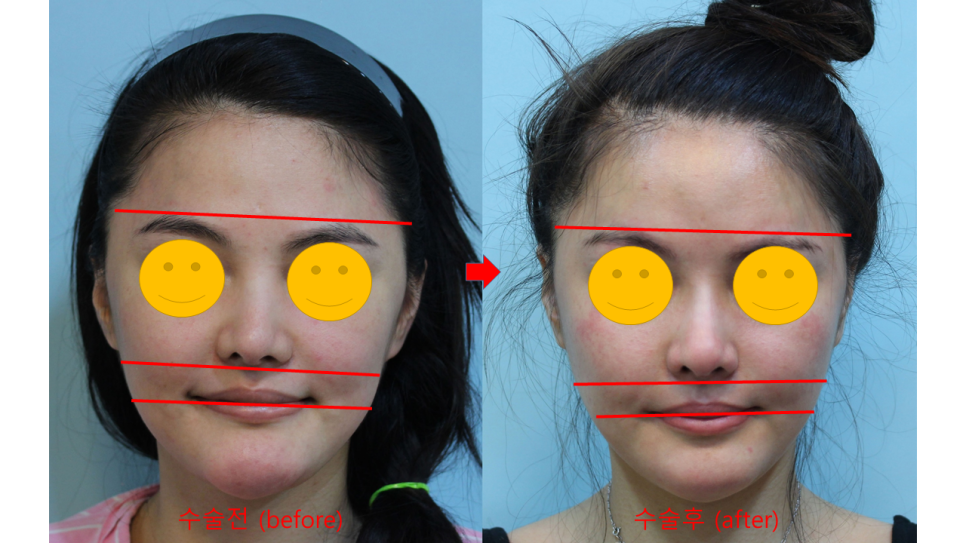 A review of facial asymmetry and crooked nose surgery
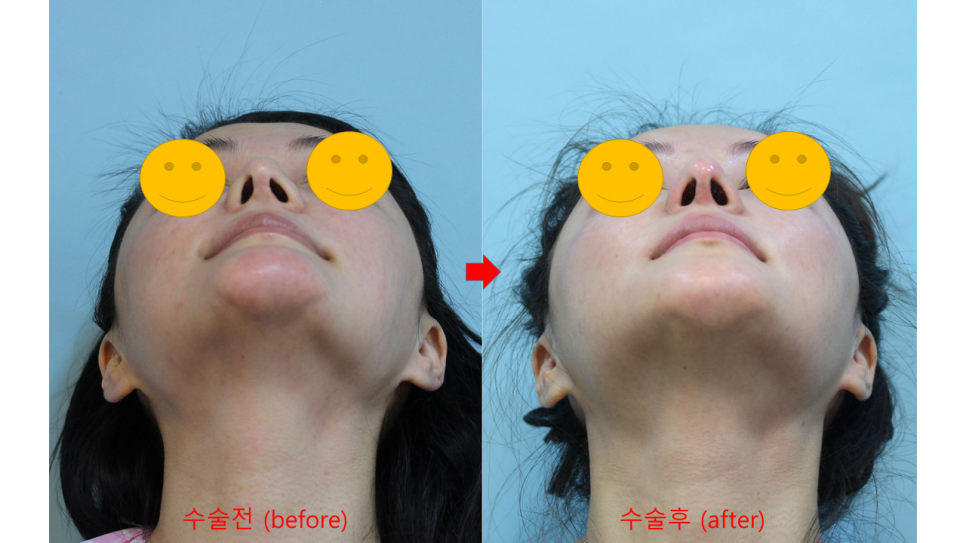 A review of crooked nose surgery. A review of deviated septum correction.
Facial asymmetry arises from very diverse causes, so it cannot be corrected with just one type of surgery.
And severe asymmetry may require fundamental correction, such as double jaw surgery.
However, if you are considering rhinoplasty, making the alignment line of the nose, which corresponds to the center of the face, straight can help alleviate facial asymmetry.