There are several types of mini facelifts that partially use incisions from a facelift, but the most effective mini facelift is the deep mini facelift.
The incisions for a deep mini facelift can be divided into two types: a hidden incision near the scalp and an incision in front of the ear.
The incision hidden near the scalp is not visible because it is covered by hair, but many people feel uneasy about the incision in front of the ear.
'Incisions and Surgical Method of the Deep Mini Facelift'
As mentioned earlier, because the deep mini facelift includes an incision in front of the ear, it can achieve the best results among mini facelifts through incisions in the lower part of the face.
Compared with a facelift, the deep mini facelift has a shorter incision, but it can apply most of the deep plane facelift technique because, in addition to subcutaneous dissection, the SMAS layer is sufficiently dissected and the facial retaining ligaments are appropriately released.
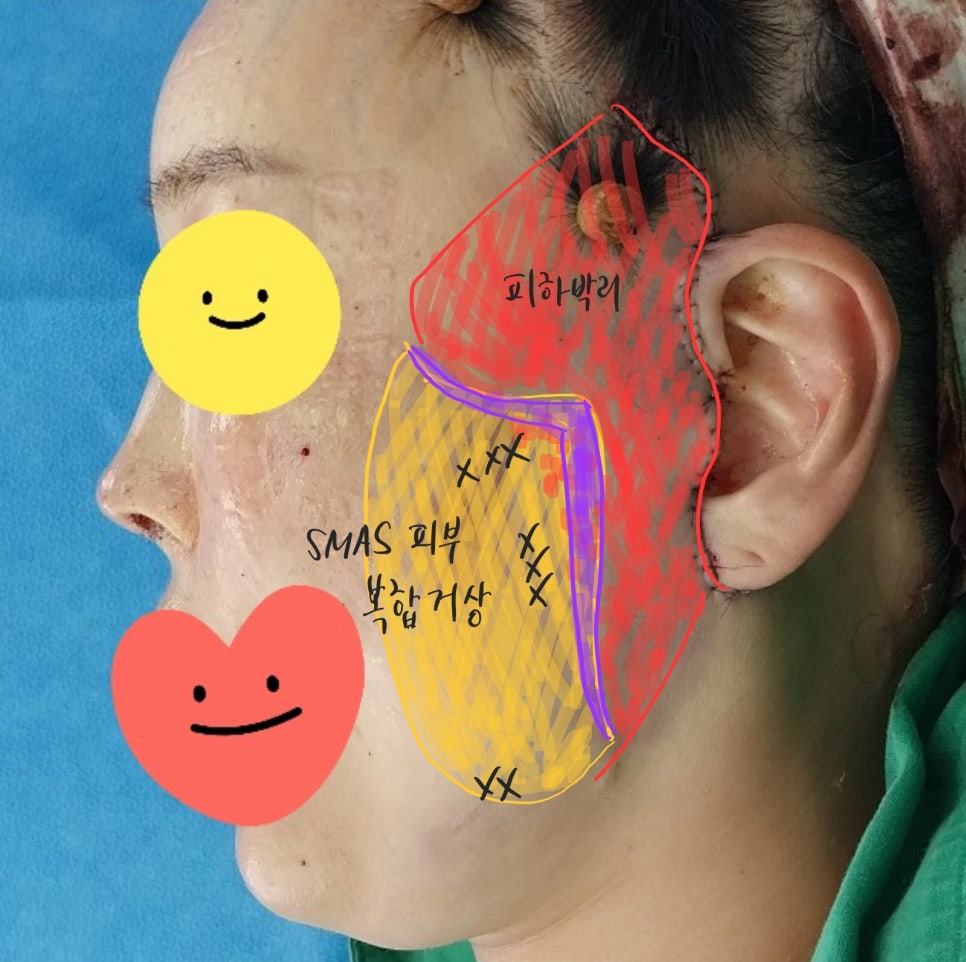 Incisions and surgical method of the deep mini facelift
Because the deep mini facelift uses a deep plane method that combines dissection of the SMAS layer and the skin, recovery after surgery is faster, and since the lifting tension of the face is borne by the SMAS layer, the scar on the incision line does not darken and has the advantage of staying clean.
Sutures are removed about 7 to 10 days after surgery, and after that, even without special scar care, the scar will improve greatly over time.
However, many people are curious about postoperative scar care or how to apply scar ointment.
'How to Apply Scar Ointment'
First, the incision site after surgery can be divided into a 'wound' and a 'scar.'
A 'wound' refers to the surgical incision site, and it refers to the period until the skin is held together by sutures and the skin joins together (usually 1 to 2 weeks).
A 'scar' refers to the process after the wound has healed, that is, from after the surgical sutures are removed, and it goes through a long maturation process from about 2 weeks to 6 months after surgery.
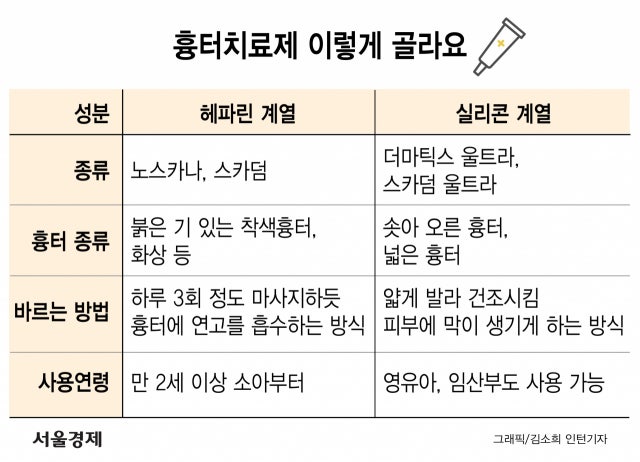 Classification of scar treatments. Source: Seoul Economic Daily
For the first 1 to 2 weeks after surgery, the wound is helped to heal well through sufficient treatment and recovery at the hospital.
You can start applying scar ointment at home after the sutures are removed.
Scar ointments can be broadly divided into 'heparin' ointments and 'silicone' ointments.
Heparin-based ointments are absorbed into the skin, so you can apply the ointment to the scar area two or three times a day and massage it in.
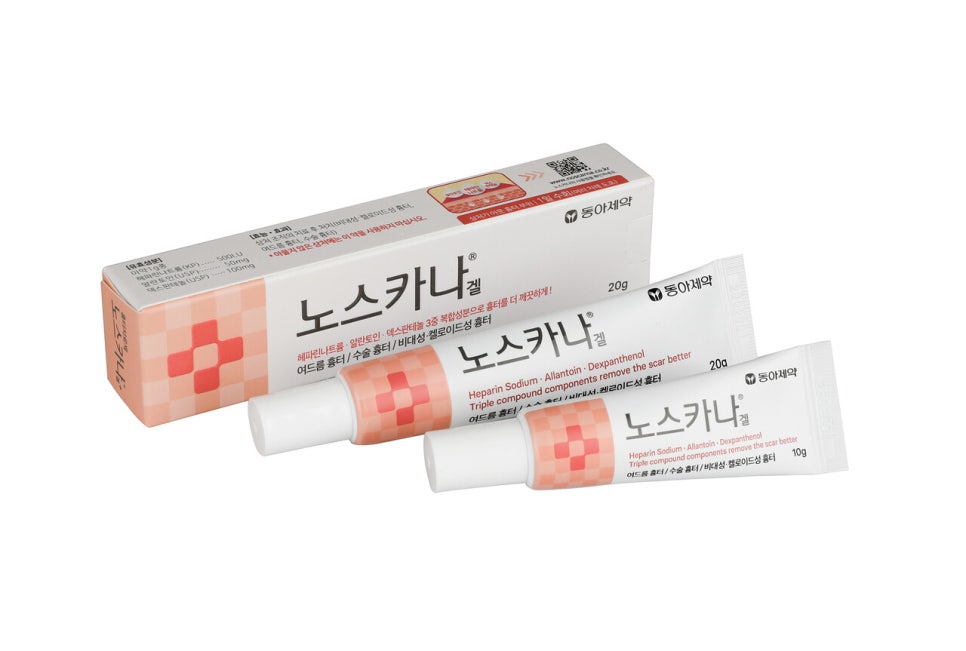 Heparin-based scar ointment
Silicone-based ointments work by being applied to the skin and dried to form a protective layer, so instead of massaging, you apply it to the skin and let it dry. This creates a coating over the scar area and helps the scar mature.
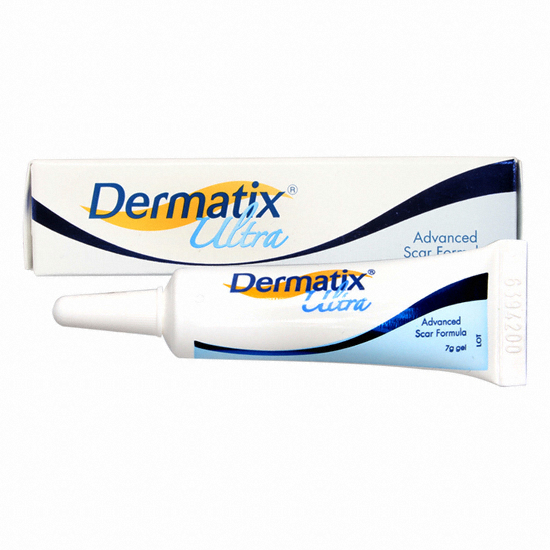 Silicone-based scar ointment
'Changes in Scars After Deep Mini Facelift Surgery'
Sutures in the incision area of a deep mini facelift are removed around 7 to 10 days after surgery. After that, the scar gradually goes through the maturation process, and even without special care through scar ointment, it becomes almost unnoticeable over time.
Of course, there are slight individual differences, but usually from about 2 months onward, the scar color becomes lighter and you can see that it changes to being less noticeable.
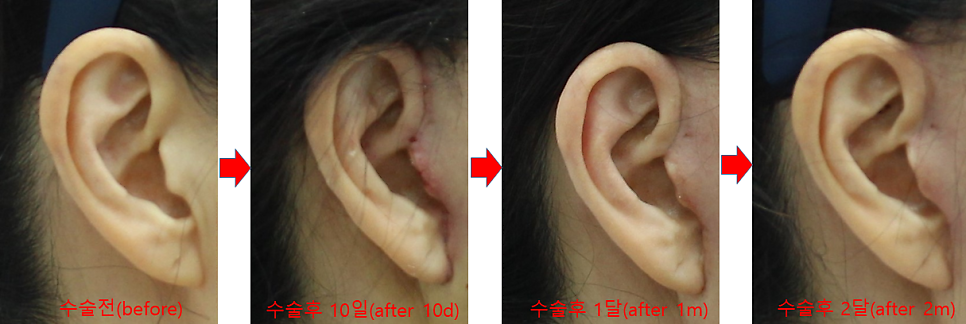 The maturation process of scars after a deep mini facelift
And most importantly, it is necessary to maintain the shape of the ear exactly as it was before surgery.
The incision should be made in an appropriate position according to each person's different ear shape, and the lifting tension should be borne by the SMAS layer rather than the skin. Only then can scarring after a facelift be minimized and ear deformities such as 'pixie ear deformity' and 'tragus deformity' be prevented.
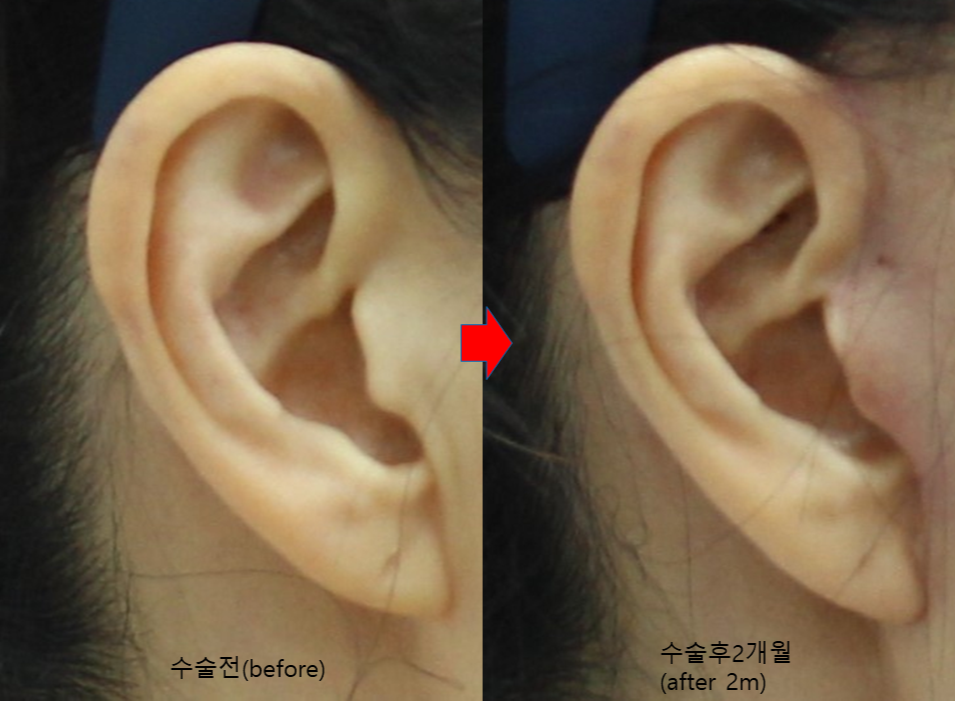 Scar changes after a deep mini facelift. Incision behind the tragus. Deep mini facelift incision, 2 months after surgery