Under-eye fat repositioning is a surgery that can be performed on a wide range of age groups, from people in their 20s to their 40s. It is a broad anti-aging procedure, but it is also commonly performed by younger patients in their 20s and 30s.
As a result, it is common to have under-eye fat repositioning along with eye plastic surgery such as double-eyelid surgery or canthoplasty.
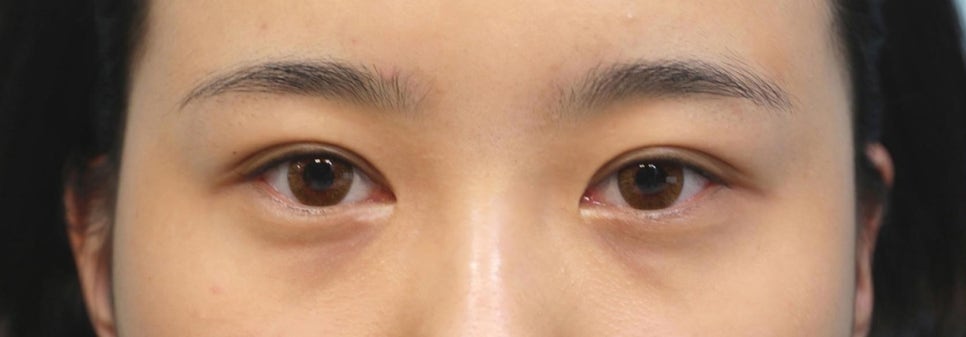
Review of under-eye fat repositioning in a patient in her 20s
This is a woman in her 20s who visited the clinic with dark circles under her eyes. Due to the tear trough and the under-eye fat, there were irregular contours, and her skin tone had also darkened, so she wanted to improve the tired-looking impression.
Women in their 20s and 30s often choose canthoplasty because they want brighter-looking eyes, and in the case of lateral and lower canthoplasty, it is a procedure that pairs well with under-eye fat repositioning.
'Lower canthoplasty performed together with under-eye fat repositioning'
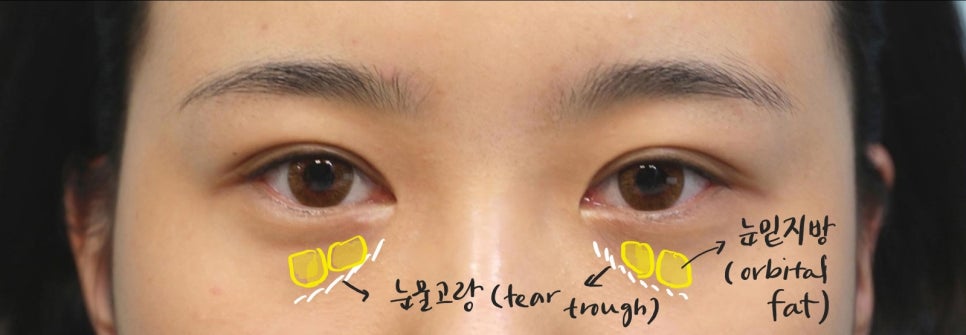
The under-eye fat and tear trough that create dark circles
The structures that make up dark circles under the eyes are under-eye fat and the tear trough.
In particular, if the under-eye fat protrudes or the adhesion of the tear-trough ligament is strong, a more pronounced contour irregularity is created under the eyes, which can make the dark circles appear worse.
In the case of under-eye fat repositioning, the incision is made through the conjunctiva rather than through an external skin incision, so recovery is faster. Another advantage is that because it uses a shared incision with lower canthoplasty, there is no additional incision needed for the lower canthoplasty procedure.
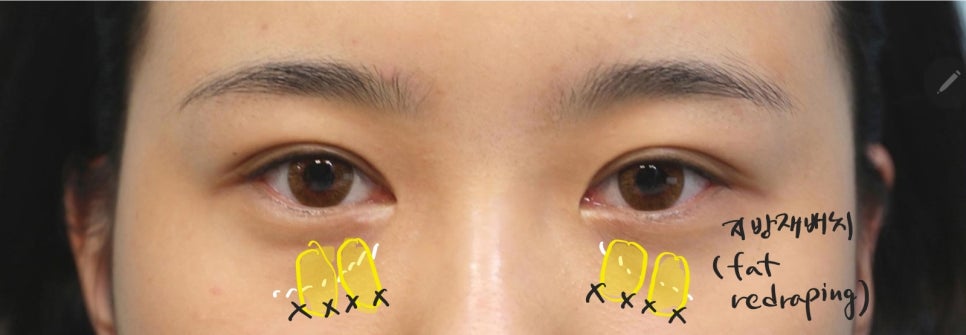
Surgical method of under-eye fat repositioning
First, through a conjunctival incision, the tear trough under the eye is dissected, and the under-eye fat pad is made long in the form of a flap.
Then, the fat flap is moved to the inside of the dissected tear trough and firmly fixed using an internal fixation method.
If the under-eye fat is made into a flap and fixed from the inside, the volume of the under-eye fat can be preserved while still being firmly moved beneath the tear trough, so the result is excellent and the duration of the effect is long.
'Wide-angle lateral and lower canthoplasty'
The eye as seen from the front may look like a two-dimensional plane, but in fact it is closer to a three-dimensional sphere like a ball.
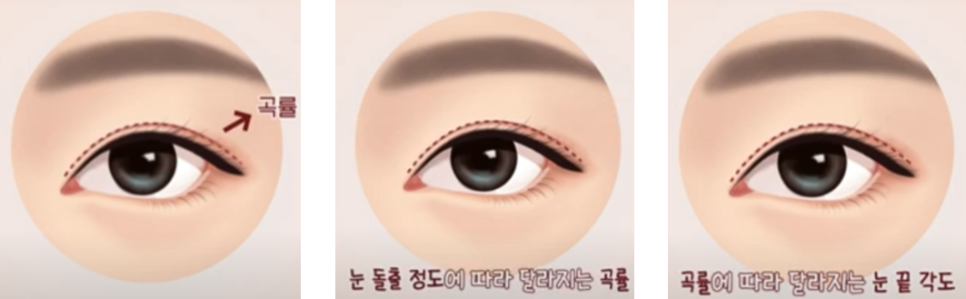
The curvature of the eye and the angle of the eye corner
Because each person has a different degree of eye protrusion, the curvature also differs, and depending on the curvature, the angle of the outer corner of the eye also changes.
There is another angle that must be considered in the eye: the slant of the eye when viewed from the front.
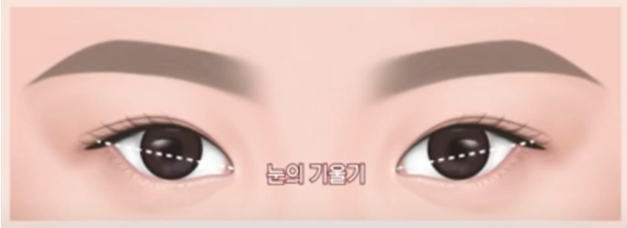
The slant of the eye when viewed from the front
In many East Asians, the eyes slant upward, which can create a strong impression, and this angle also inevitably varies slightly from person to person.
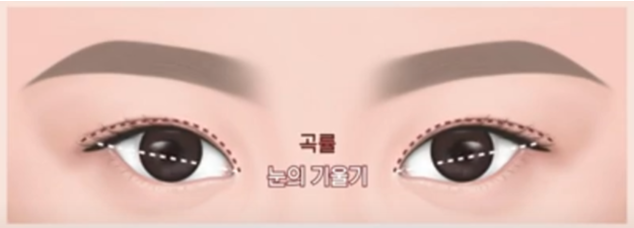
Different curvature and eye slant for each person
Therefore, by considering each person's different eye curvature and eye slant, 'wide-angle lateral and lower canthoplasty' finds the most appropriate incision line and opens the eyes in a refreshed, wider way.
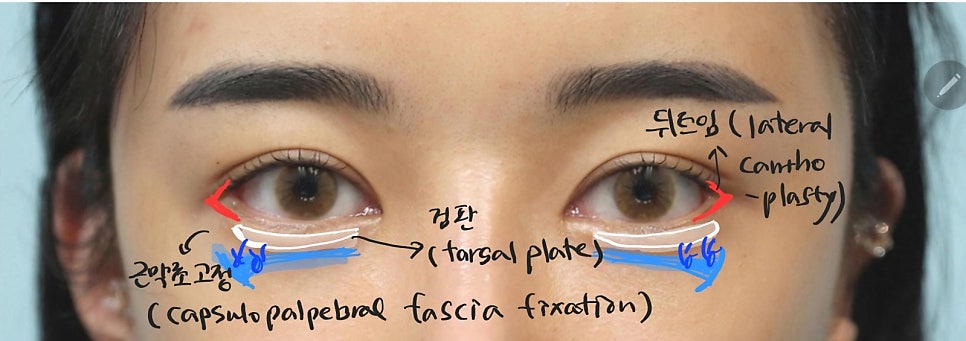
Surgical method of wide-angle lateral and lower canthoplasty
By performing customized lateral and lower canthoplasty while taking into account each person's different curvature and eye slant, it is possible to find even a hidden 1-degree angle and open the eyes, creating a brighter look.
In addition, in the case of lateral canthoplasty, fixation is made to the outer periosteum, and in the case of lower canthoplasty, fixation is made to the capsulopalpebral fascia below, which can help prevent the canthoplasty from closing again.

Wide-angle lateral and lower canthoplasty patent office trademark registration certificate
'Before and after wide-angle lateral and lower canthoplasty performed together with under-eye fat repositioning'
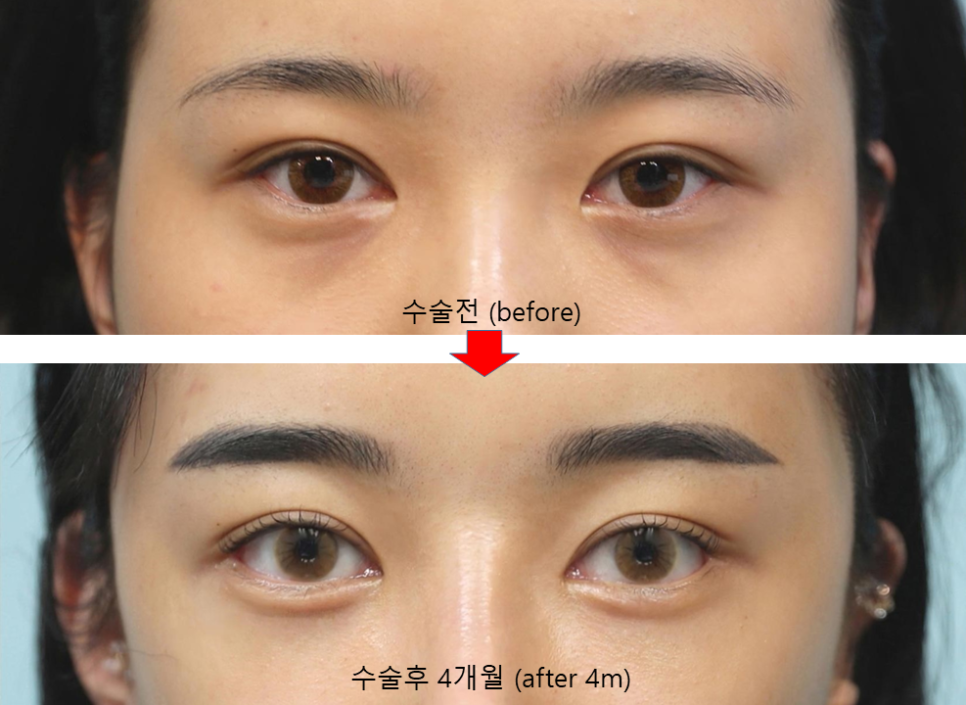
After lateral and lower canthoplasty. Wide-angle lateral and lower canthoplasty. After under-eye fat repositioning.
After the surgery, the dark circles under the eyes disappeared, and the tired-looking impression was improved.
In addition, through 'wide-angle lateral and lower canthoplasty,' the horizontal length of the eyes became longer, and the slightly upturned outer corners of the eyes were lowered, creating a brighter and gentler impression.
If you are considering eye plastic surgery along with under-eye fat repositioning, you can create a brighter and softer impression through lateral and lower canthoplasty using the same incision site.