In winter, plastic surgery clinics see many consultations about the eyes from younger patients. Because winter break is usually long, many people want to have eye surgery during a period when they can 충분히 recover after the procedure, and they also often use the year-end and holiday breaks to undergo cosmetic surgery.
Among younger patients, eye surgery has a wide range of preferences. Some people usually prefer a natural-looking result, while many others want brighter, more striking eyes.
'What to Check in Eye Surgery for Younger Patients'
When consulting about eye surgery, especially double eyelid surgery, a lot of the discussion is about the size and shape of the double eyelid.
In general, double eyelids are classified as inline, in-out line, semi-out line, and out line depending on their shape and size. However, there is actually a more important factor than the shape and size of the double eyelid.
The important point in eye surgery is to check whether there is enough strength to open the eyes. If the strength to open the eyes is insufficient, the cause that interferes with opening the eyes should be identified and addressed, and appropriate eye correction (ptosis correction) should be performed.
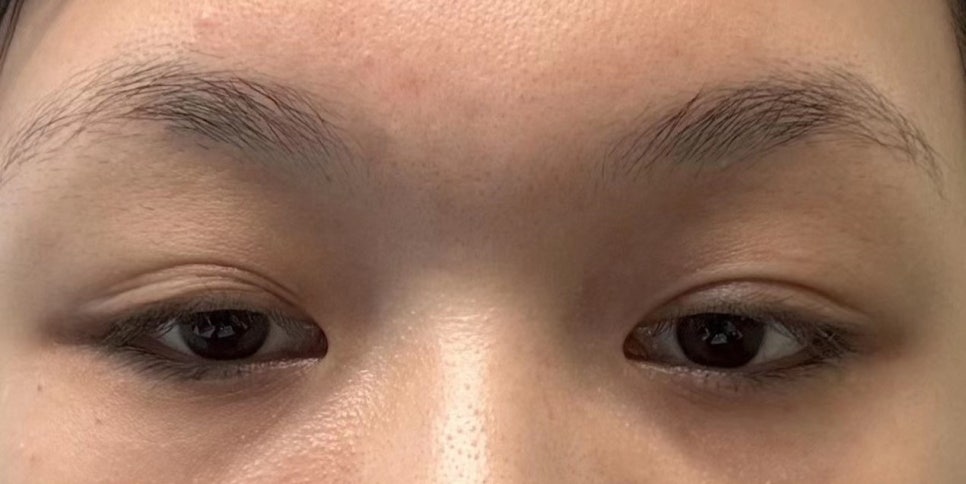
Ptosis in a patient in their 20s. Double eyelid with multiple folds. Real model with consent for release.
A woman in her 20s visited the clinic wanting brighter eyes.
Overall, her ability to open her eyes appeared to be weak, and one eye in particular seemed slightly more difficult to open, along with multiple eyelid folds.
When ptosis is accompanied by multiple folds like this, there is a high chance that there are factors interfering with eye opening, so the surgery should be performed through incision double eyelid surgery while removing those interfering factors.
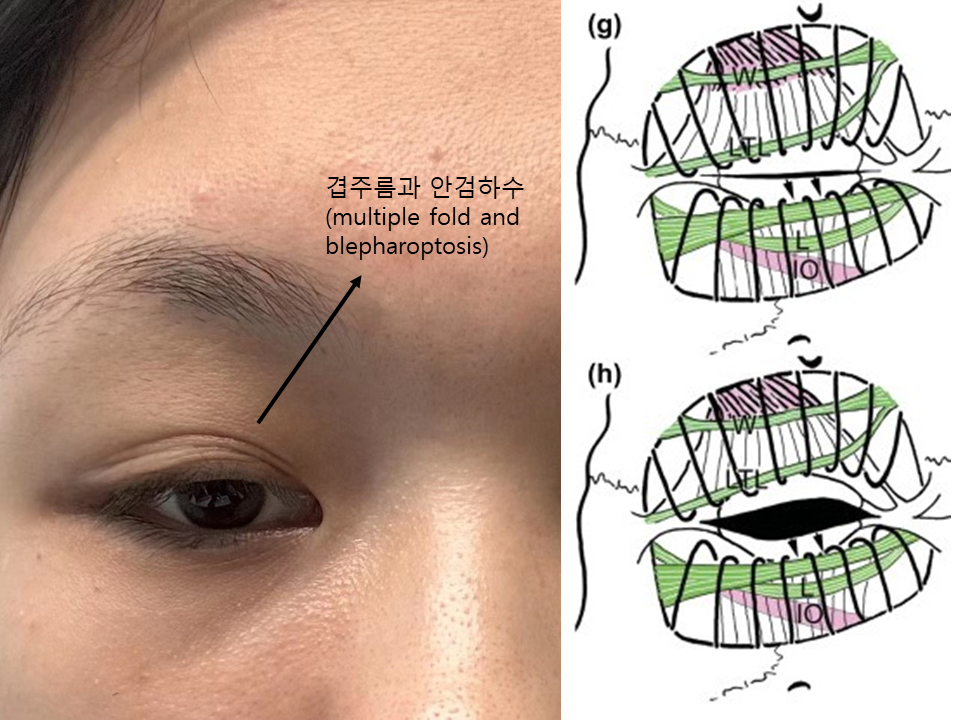
Ptosis accompanied by multiple eyelid folds. Real model with consent for release.
'Lower Positioned Transverse Ligament and Ptosis in East Asian Eyes'
When performing eye surgery on East Asian patients, a tough membrane or ligament-like tissue is often found between the orbital fat and the levator muscle. This is called the lower positioned transverse ligament or transverse ligament.
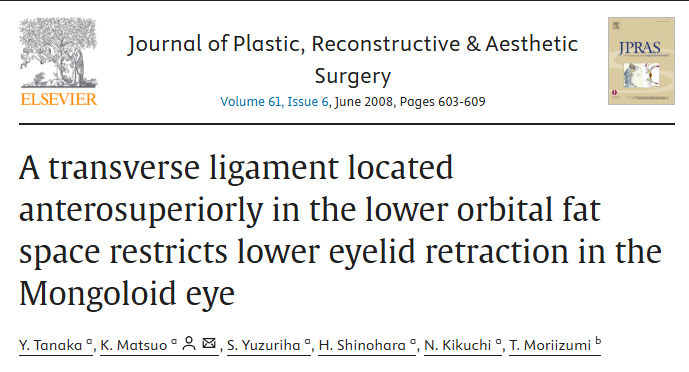
Paper related to the transverse ligament. Source: Journal of Plastic, Reconstructive and Aesthetic Surgery.
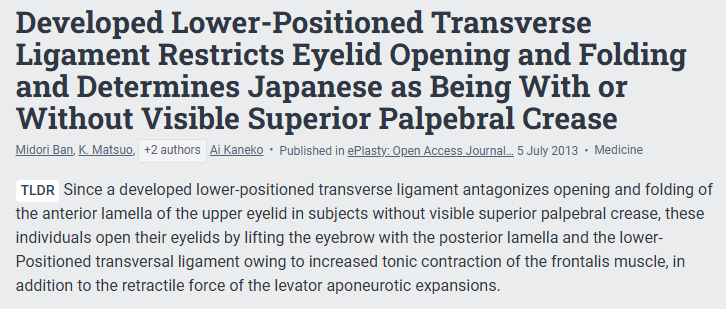
Paper related to the lower positioned transverse ligament.
According to a paper published in Japan, the transverse ligament in East Asian eye surgery is known to interfere with eye opening, and it is also known that properly dissecting the transverse ligament during surgery can improve eye opening.
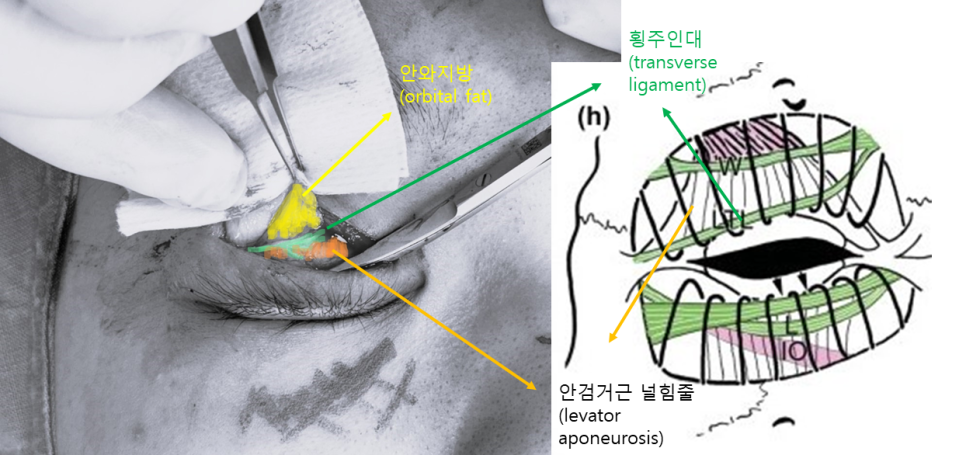
The transverse ligament (lower positioned transverse ligament) seen in actual surgery.
In this woman’s surgery as well, a transverse ligament was found on the side with severe ptosis and multiple eyelid folds, and the eyelid shape was corrected while removing this ligament.
To remove factors such as the transverse ligament that interfere with eye opening, eye surgery must be performed by incision method, and it cannot be resolved with a non-incision approach.
After improving the strength to open the eyes through appropriate eyelid correction, creating the size and shape of the double eyelid to match the patient’s preference can be considered a way to achieve high satisfaction with eye surgery.
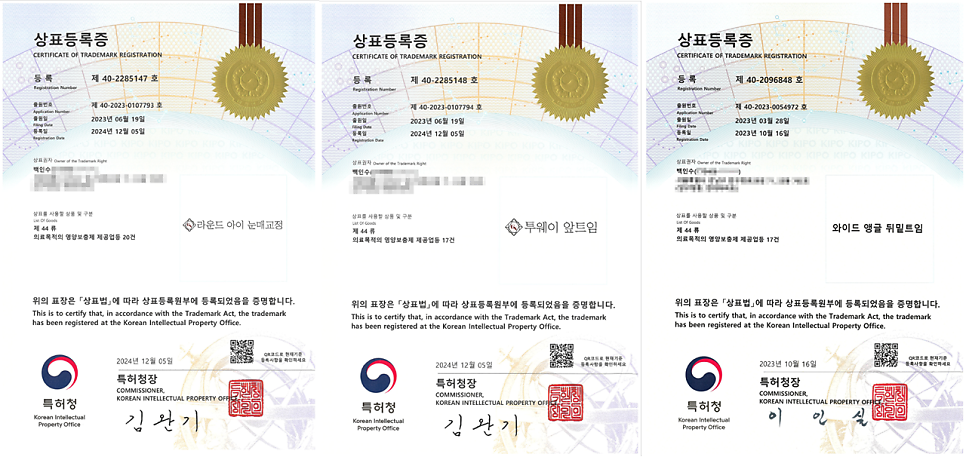
Trademark registration with the Korean Intellectual Property Office: Round Eye Eyelid Correction, Two-Way Epicanthoplasty, Wide Angle Rear/Lower Canthoplasty
After eyelid correction and double eyelid surgery are completed, additional canthoplasty procedures are performed.
By adding Two-Way Epicanthoplasty, which combines inner corner surgery and upper corner surgery to suit the patient’s eyes, and Wide Angle Rear/Lower Canthoplasty, which opens the eye more brightly in line with the eye’s curvature and angle, a brighter eye can be created.
'Before and After Eye Surgery in a Patient in Their 20s'
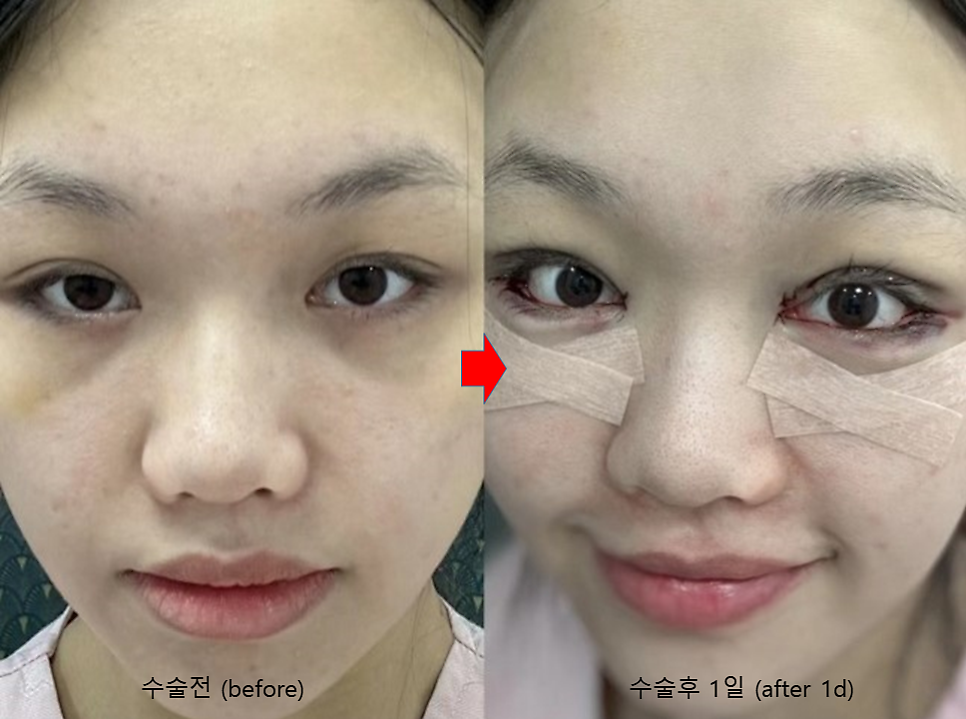
Eyelid correction review. Incision double eyelid surgery review. Epicanthoplasty review. Rear/lower canthoplasty review. Incision eyelid correction review
The important point in East Asian eye surgery for younger patients is to properly correct the eyelids when the strength to open the eyes is insufficient, and if there are factors interfering with opening the eyes, to remove those factors through appropriate dissection.
In addition, with extra canthoplasty, it is possible to create the brightest possible eye shape based on the patient’s own eyes.

The principle by which appropriate dissection and canthoplasty create brighter eyes

Eyelid correction review. Before and after eyelid correction. Real model with consent for release.