In people in their 50s, where signs of aging under the eyes are noticeable, there are many inquiries about lower blepharoplasty.
Aging under the eyes occurs due to various factors, and the representative symptoms are as follows.
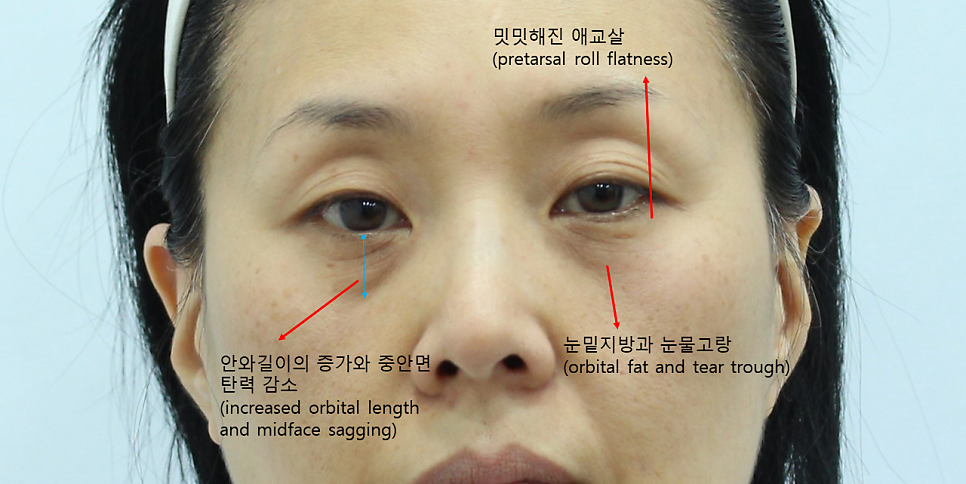
Signs of aging under the eyes in your 50s. This is a real model who has consented to public release.
First, the fat pads under the eyes lose elasticity and become slightly bulged, creating tear troughs and contours.
In addition, as the midface loses firmness and sags downward, the orbital length increases, resulting in an aged face.
Also, due to sagging of the skin and orbicularis oculi muscle, the elasticity of the under-eye aegyo-sal decreases, creating a flat appearance.
To address these aging factors under the eyes and in the midface, it is important to correct each of the various aging elements under the eyes individually.
'Lower Blepharoplasty and Midface Lifting in Your 50s'
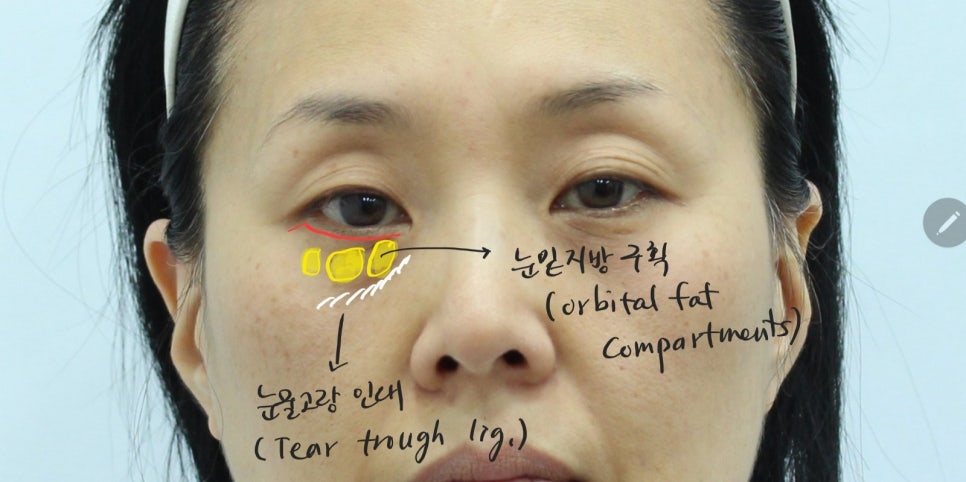
Incision location for lower blepharoplasty. Under-eye fat and the tear trough ligament.
Because the incision for lower blepharoplasty is made in the skin just below the lower eyelashes, the incision scar is not easily visible after surgery.
And because the orbicularis oculi muscle can be damaged during the incision process in lower blepharoplasty, it is important to dissect in a way that preserves the orbicularis oculi muscle as much as possible.
Through the incision and dissection under the eyes, the under-eye fat can be reached, and after organizing the under-eye fat by compartment and appropriately releasing the tear trough ligament, the hollow tear trough can be well filled through fat repositioning.
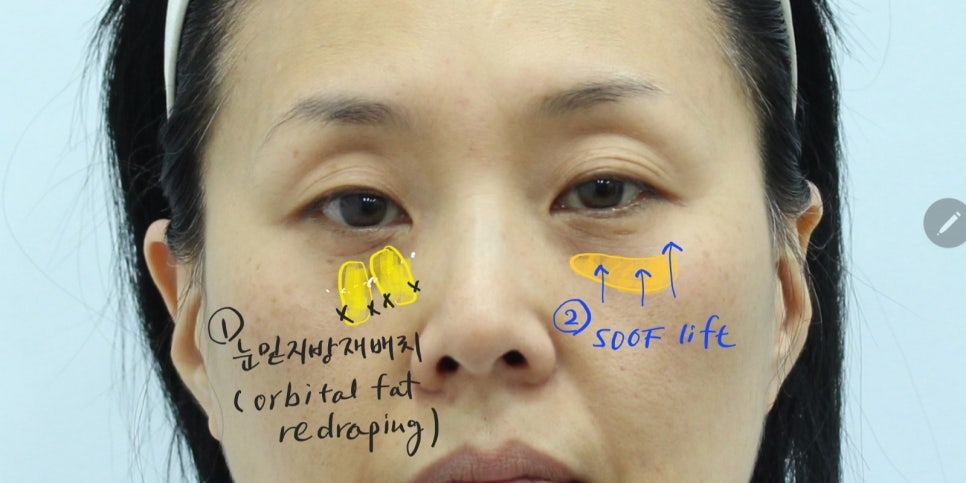
During lower blepharoplasty, under-eye fat repositioning and midface lifting. SOOF lift. SOOF lifting. SOOF lifting.
Under the eyes, there is another fat layer in addition to the orbital fat called under the orbicularis oculi fat, or SOOF (Sub Orbicularis Oculi Fat).
To lift the SOOF, additional dissection is needed beyond the tear trough dissection, and releasing the retaining ligament in this area allows the SOOF to move upward smoothly.
SOOF lift is not an essential procedure in all lower blepharoplasty cases, but in cases where the midface has lost firmness or the orbital length has become longer, it is a procedure that can greatly enhance the results of lower blepharoplasty.
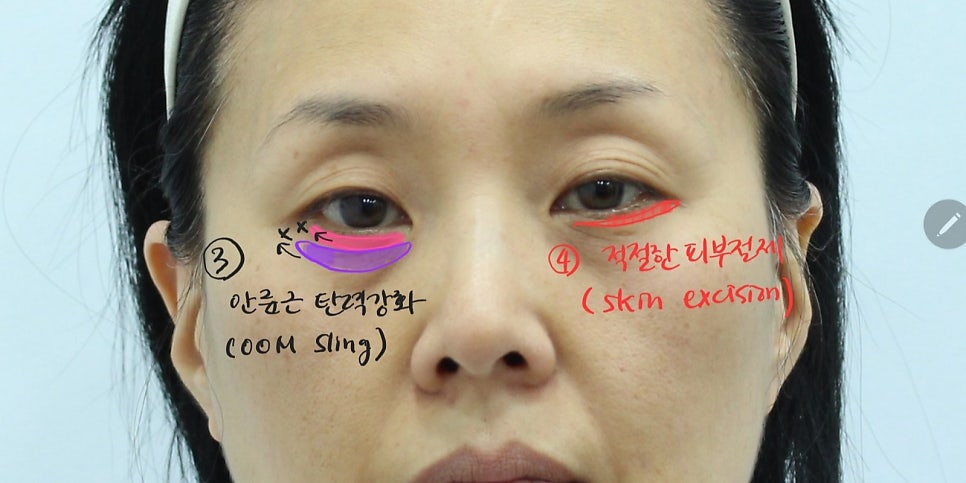
Strengthening the elasticity of the orbicularis oculi muscle in lower blepharoplasty. Aegyo-sal enhancement procedure.
In lower eyelid surgery, the orbicularis oculi muscle under the eye is separated into two layers, and by suspending each layer onto the periosteum of the lateral canthus, it is possible to increase elasticity under the eye and enhance the aegyo-sal.
Through this method, the under-eye aegyo-sal is reinforced in two layers, allowing the under-eye area to be restored to a shape similar to the aegyo-sal from one’s younger years.
Finally, the surgery is completed with an appropriate amount of skin excision that is not excessive and with delicate suturing.
Lower blepharoplasty has evolved to correct each aging factor under the eyes—such as under-eye fat, SOOF, orbicularis oculi muscle, and skin—by addressing them one by one, and the lower blepharoplasty currently performed is called fourth-generation lower blepharoplasty.

Patent Office trademark registration for Quad Plus lower blepharoplasty. Fourth-generation lower blepharoplasty.
'Before and after lower blepharoplasty in your 50s. Before and after Quad Plus lower blepharoplasty.'
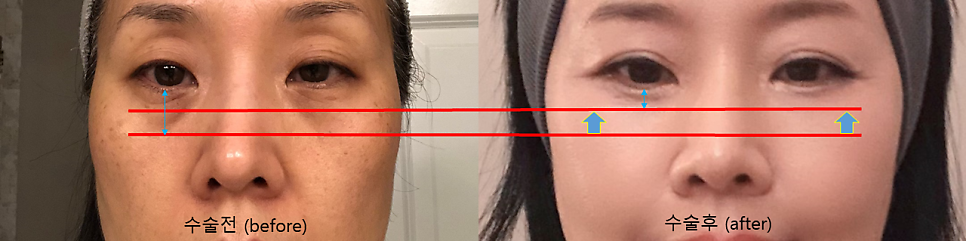
Before and after lower blepharoplasty. Changes in orbital length and midface lifting.
The distance from under the eye to the lowest point of the tear trough is called the orbital length, and as people age, the orbital length tends to increase.
The previously long orbital length has become shorter, which is because the midface was lifted by the SOOF lift.
In addition, the previously flat aegyo-sal can be seen to have somewhat returned, because damage to the orbicularis oculi muscle was minimized during the lower blepharoplasty and the two layers of orbicularis oculi muscle were suspended and fixed at the lateral canthus.
By avoiding excessive skin excision and appropriately suspending the two layers of orbicularis oculi muscle, one of the side effects of lower blepharoplasty, ectropion, can be prevented.
Lower blepharoplasty has evolved toward correcting each aging factor under the eyes by element.
Quad Plus lower blepharoplasty is a surgical method that includes detailed techniques to improve the aging factors under the eyes by element and prevent undesirable side effects.
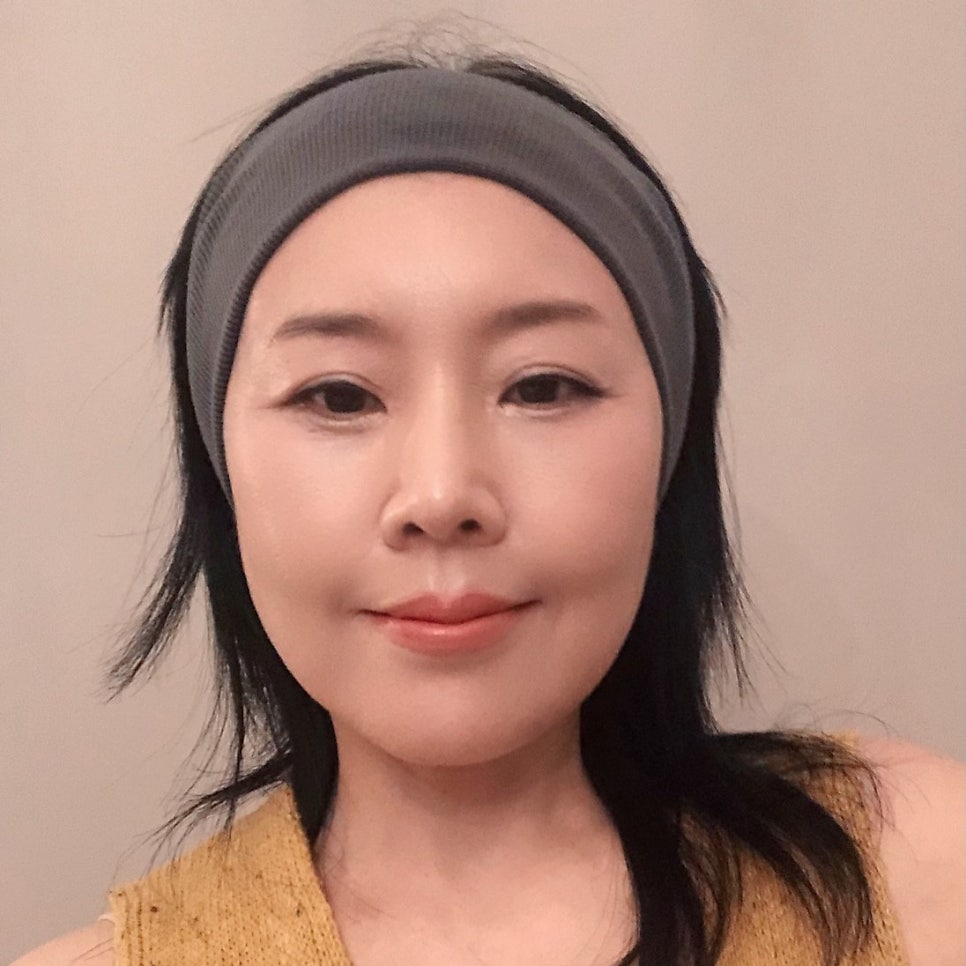
After lower blepharoplasty review. After midface lifting review. After midface lift review. After lower blepharoplasty review. This is a real model who has consented to public release.