Fat grafting is a very safe procedure that uses your own fat to fill in sunken areas of the face or body.
In general, fat is harvested and then processed through centrifugation to remove blood, anesthetic fluid, and impurities, leaving only the fat layer to be grafted.
However, this traditional method has a drawback: the fat particles are not uniform in size, and relatively large clumps of fat remain as they are.
- Disadvantages of conventional fat grafting -
The “microfat” used in conventional fat grafting has relatively large fat cell size, and the adipocyte cluster remains in a clumped form.
When these large fat particles are injected into areas with thin skin, the following problems can occur.
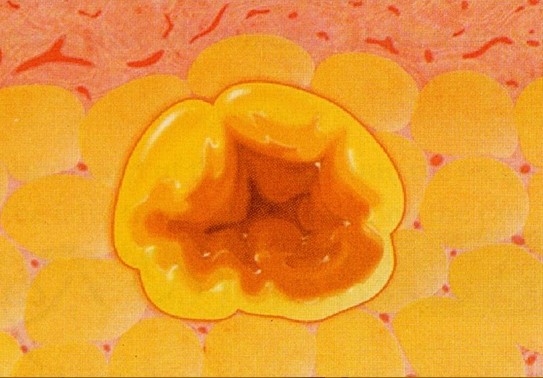 Fat grafting clumping. fat clumping, fat lump.
• Particle-size inconsistency
Large fat cell clusters can settle irregularly, leaving the surface uneven.
• Limited dispersion within tissue
If the fat particles are large, they cannot spread through delicate tissue, which may create localized bulges.
• Increased risk of failed vascular regeneration (reperfusion)
It is difficult for new blood vessels to grow into the interior of large fat clumps, so some of the graft may not take and may be absorbed or turn into clumps.
- Nanofat made with a microfat filter -
Nanofat is made by passing harvested fat through a special microfat filter multiple times to mechanically emulsify the fat tissue.
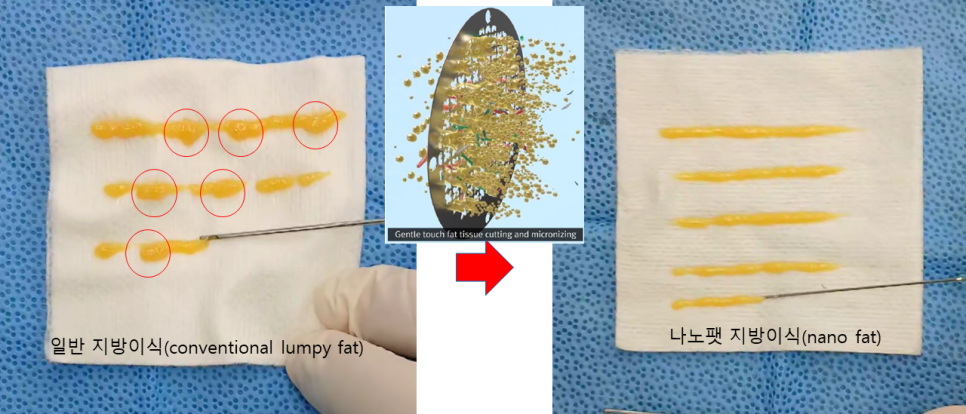 Nanofat fat grafting through fat filtering. Stem cell fat grafting. Comparison with conventional fat grafting.
The size of the fat cells (adipocytes) is significantly reduced
Instead, abundant adipose-derived stem cells (ADSCs) and growth factors remain
-
Stromal Vascular Fraction (SVF) components increase
-
This contributes to skin regeneration and promotes collagen production
-
Particle size becomes uniform
-
The filter forms micro-particles of standardized size, allowing even distribution in thin layers.
In other words, nanofat is closer to a “regenerative fat graft” that aims to achieve both delicate volume correction and skin improvement, rather than a traditional volume fat graft.
- Uses of nanofat fat grafting -
Areas where thin skin makes irregularities easy to show
-
Fat grafting around the eyes, such as under the eyes, eyelids, and aegyo-sal
-
Nasolabial folds, marionette lines, and other lines around the mouth
-
Neck wrinkles
-
Because the particles are much smaller than ordinary fat particles, natural results are possible in fine areas.
-
Areas where small volume changes have a major impact on the result
-
Areas where boundaries should not be visible
For skin regeneration purposes
- Nanofat is rich in SVF, growth factors, and stem cells, so it may help improve skin quality and is also applied in procedures injected thinly, similar to a skin booster.
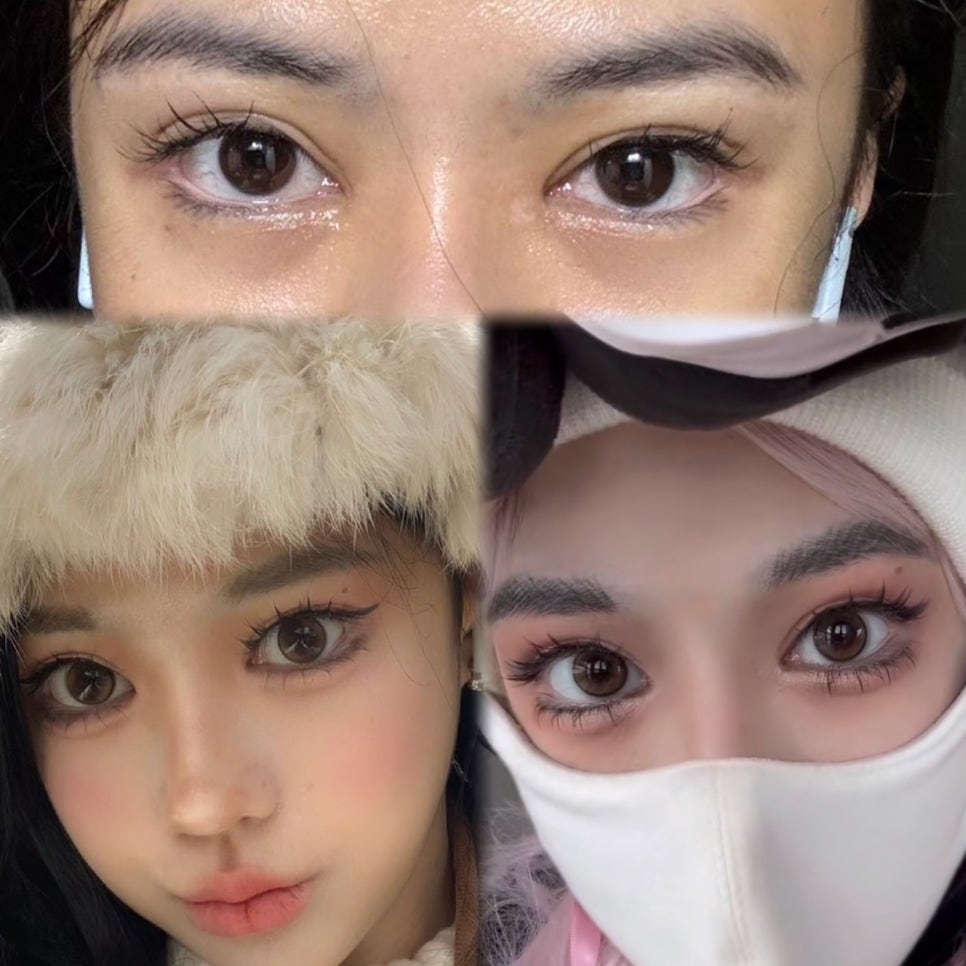 Nanofat before and after fat grafting. Nanofat fat grafting review. Real model with consent for disclosure.