An endoscopic forehead lift is not simply a surgery that pulls the forehead skin tight. It is an anti-aging procedure that improves the aging of the entire upper face, from the forehead to the temples, eyebrows, and upper eyelids.
Because the procedure is performed by making a small incision inside the hairline and inserting a high-resolution endoscope, it has the advantage of allowing the underlying cause to be corrected while delicately preserving nerves and blood vessels.
- Causes of forehead unevenness (irregularity) -
In many cases, the main reason a forehead looks uneven rather than smooth is the muscles.
-
Strength of the glabellar muscles: When the glabellar muscles (corrugator muscles) become stronger due to habits such as frowning, deep irregularities appear between the eyebrows.
-
Overuse of the forehead muscles: When the eyelids droop, the forehead muscles are used excessively to open the eyes, which leads to prominent horizontal wrinkles and irregularity.
-
Understanding the key muscles that create forehead irregularity and wrinkles -
Endoscopic forehead lift is not simply about pulling the skin,
but rather a method of precisely controlling the facial expression muscles summarized in the table below to smooth out uneven irregularities.
| Muscle name | Main function and role | Changes seen with aging and overuse |
|---|
| Frontalis (forehead muscle) | Lifts the eyebrows upward and contracts the forehead horizontally | Deep horizontal wrinkles and irregularity form on the forehead |
| Corrugator muscle (brow furrow muscle) | Pulls the eyebrows inward and downward to frown the glabella | Causes deep vertical irregularity and wrinkles between the eyebrows |
| Procerus muscle | Pulls the skin on the bridge of the nose downward | Forms horizontal wrinkles above the bridge of the nose |
| Depressor supercilii | Pulls down the inner end of the eyebrow | Makes the inner brow area look droopy and creates a cramped impression |
| Orbicularis oculi | Closes the eyes and controls the muscles around the eyes | Causes wrinkles around the eyes and drooping of the outer eyebrows |
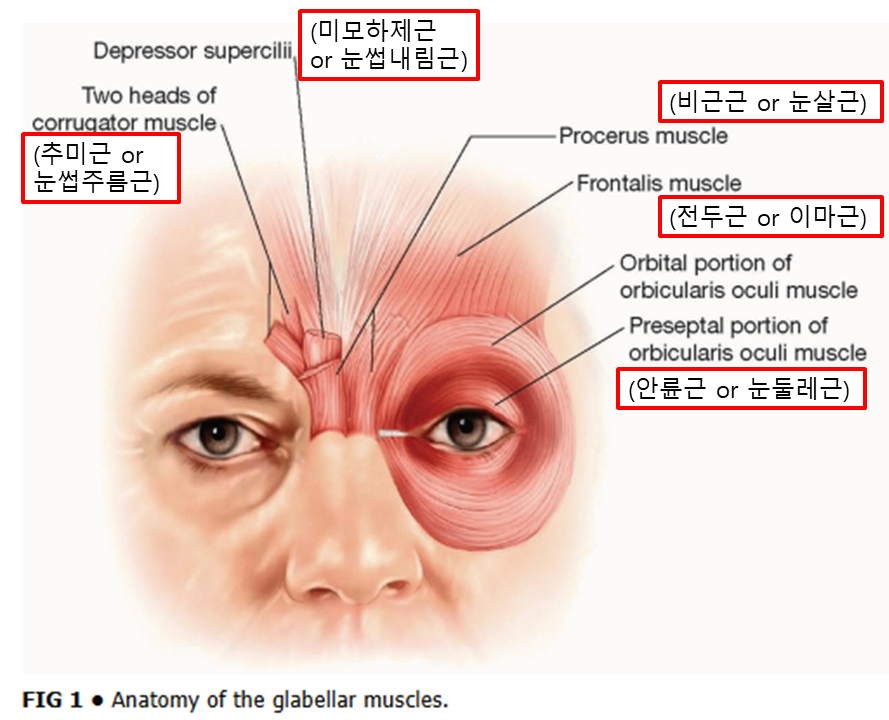
Muscles of the forehead and glabella. Frontalis. Orbicularis oculi. Corrugator. Procerus. Depressor supercilii. Source: Plastic Surgery Keys
- Treatment of the glabellar muscles in an endoscopic forehead lift -
As you can see in the endoscopic image, dissection is performed with a high-resolution endoscope and the glabellar muscles are directly identified.
Through this process, the glabellar muscles are appropriately treated and the forehead muscles are partially dissected to control muscular tension.
By properly adjusting the muscles that cause irregularity in the forehead and glabella, the forehead and glabella can be made smooth without having to consciously apply force.
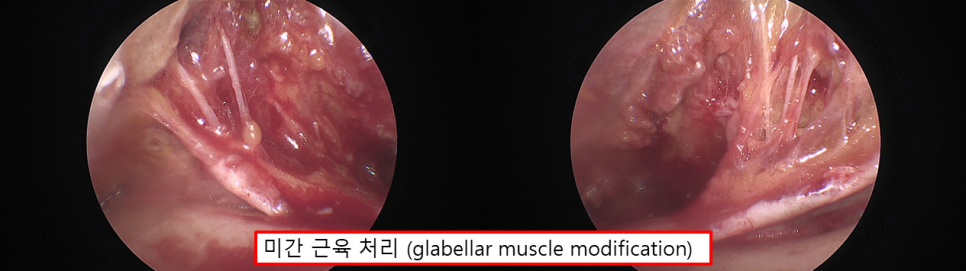
Glabellar muscle resection. Glabellar muscle dissection. The process of an endoscopic forehead lift.
-Endoscopic forehead lift before and after-
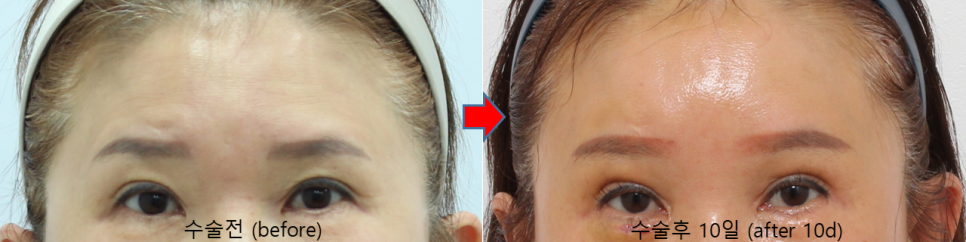
Before and after endoscopic forehead lift. Endoscopic forehead lift review. Before and after forehead lift. Forehead lift review. This is a partially modeled example with consent for disclosure. 10 days after forehead lift.
However, if ptosis is present or the eyelid skin sagging is too severe, an forehead lift alone cannot fully limit the movement of the forehead and glabellar muscles.
Because the eyes and forehead are inseparable from each other, the choice of procedure should be determined through consultation with a board-certified plastic surgeon.
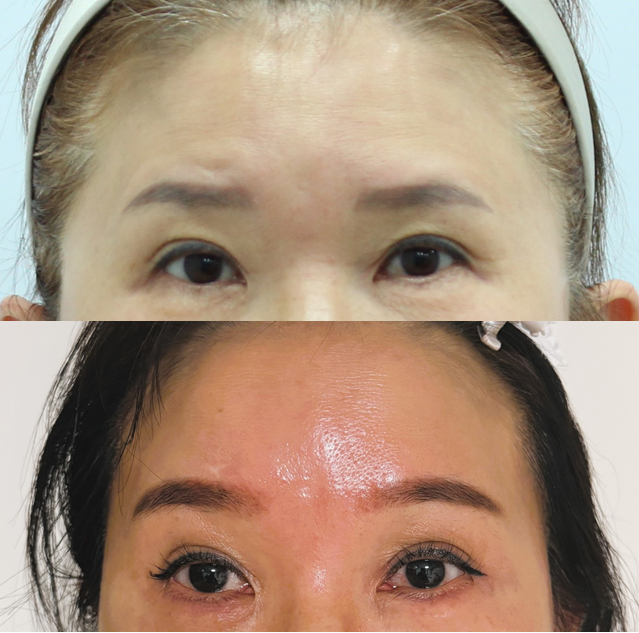
Forehead lift swelling. Before and after forehead lift. Recovery after forehead lift. Forehead lift review. This is a partially modeled example with consent for disclosure. One month after forehead lift. 1 month after forehead lift.