There is one question I hear most often in consultations about the under-eye area for people in their 40s and 50s.
“Should I get under-eye fat repositioning, or should I get lower blepharoplasty?”
To answer this question, it is important to first understand the fundamental difference between the two procedures.
- What is under-eye fat repositioning?
Under-eye fat repositioning is a procedure performed through the inner conjunctiva of the eye (the inside of the eyelid).
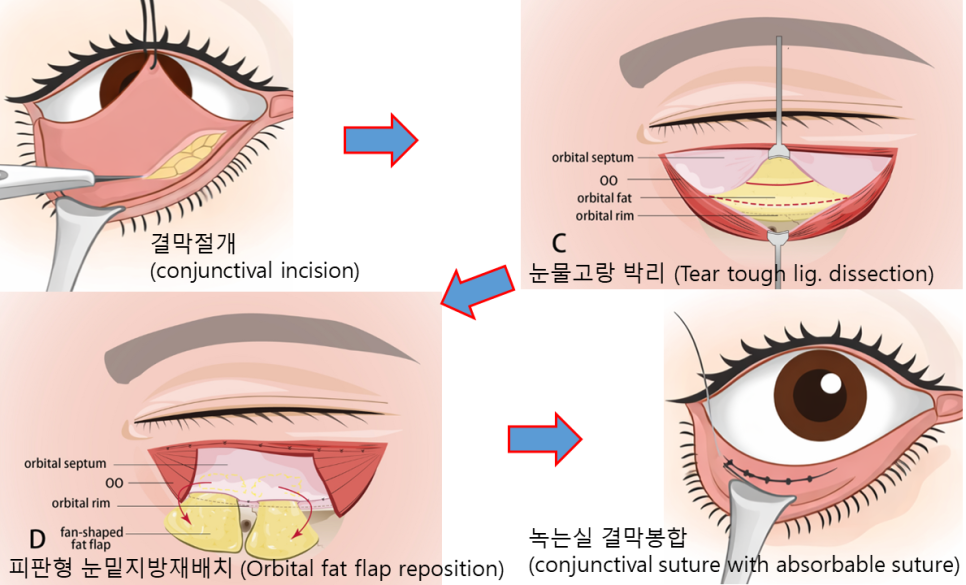 The surgical method of under-eye fat repositioning. Flap-type under-eye fat repositioning. Under-eye surgery method.
-
Skin incision ❌ (no visible external scar)
-
After releasing the tear trough
-
The orbital fat under the eyes is moved downward in a flap form and repositioned
👉 Key point
➡️ A procedure that flattens protruding fat by moving it
In other words, it is a procedure focused on just one issue: under-eye fat.
- What is lower blepharoplasty?
Lower blepharoplasty is a broader concept than under-eye fat repositioning.
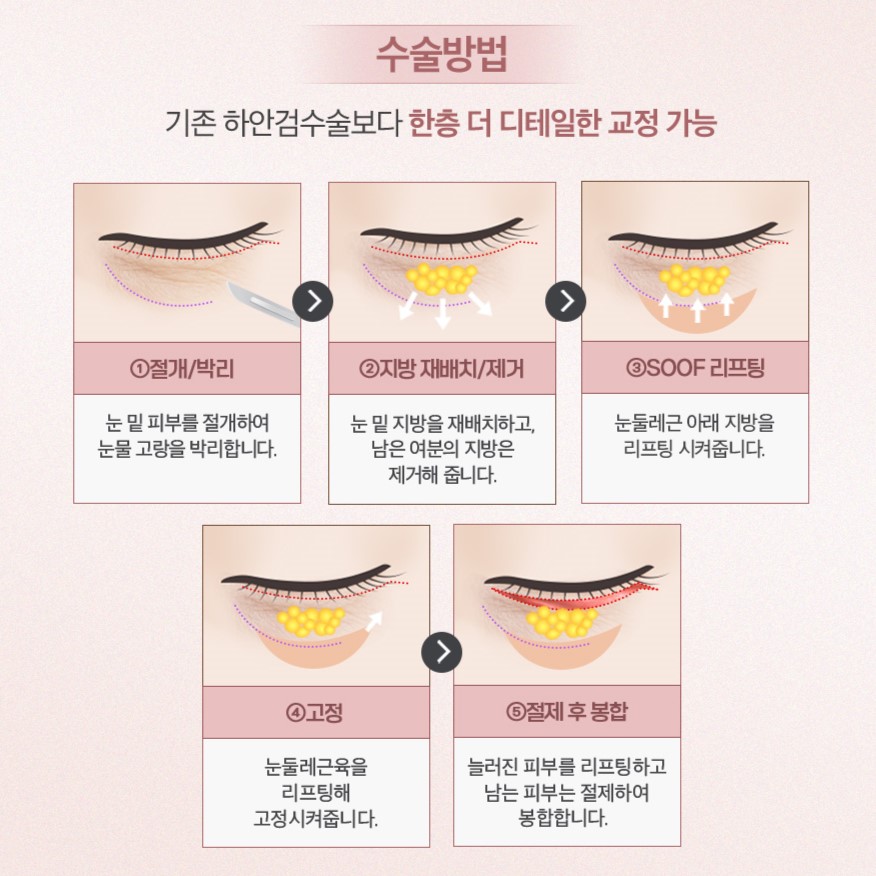 Lower blepharoplasty method. Lower blepharoplasty. Lower eyelid surgery. Quad Plus lower blepharoplasty. Source: Garnet Plastic Surgery
-
Skin incision made just below the eyelashes
-
Tear trough release + fat repositioning
-
SOOF lifting (sub-orbicularis oculi fat lifting)
-
Fixing the orbicularis oculi muscle to the lateral canthus (muscle lifting)
-
Removal of excess skin
👉 Key point
➡️ A procedure that corrects fat, skin, and muscle at the same time
In other words, it improves the overall sagging caused by aging, not just a simple fat issue.
- Comparison table: lower blepharoplasty vs. under-eye fat repositioning -
| Category | Under-eye fat repositioning | Lower blepharoplasty |
|---|
| Approach | Conjunctival incision (inside the eye) | Skin incision (below the eyelashes) |
| Scar | None | Initially may be red, but it becomes barely visible over time |
| Main surgical content | Move the orbital fat downward and reposition it | Fat repositioning + SOOF lifting + orbicularis oculi muscle fixation + skin removal |
| Scope of correction | Fat (volume issue), improvement of tear trough | Fat + skin + muscle (overall structural improvement) |
| Improvement effect | Improves under-eye contour, hollowness, and protrusion | Improves under-eye hollowness, protrusion, wrinkles, and sagging |
| Suitable candidates | Relatively younger people with good skin elasticity | Middle-aged people with skin sagging |
| Recommended age range | Late 30s to 40s | Late 40s to 50s and older |
| Recovery period | Relatively fast | Relatively longer needed |
| Surgical burden | Relatively low | Relatively high |
| Main purpose | Fat repositioning (volume balance) | Overall under-eye lifting (aging improvement) |
- The biggest reason people hesitate about lower blepharoplasty -
This is the part many people worry about when considering lower blepharoplasty.
👉 “Will the skin incision scar be okay?”
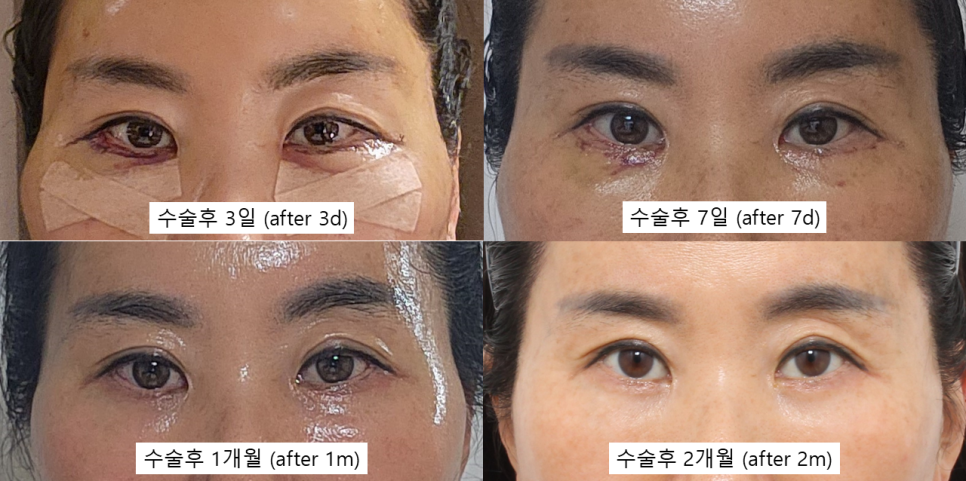 Recovery process after lower blepharoplasty. Recovery process after lower blepharoplasty. Before and after lower blepharoplasty. Lower blepharoplasty review. A partially visible model with consent for release. Lower blepharoplasty in the 50s.
Looking at the recovery process after surgery:
-
Day of surgery to day 3: Sutures and taping are in place, and the tape can be removed starting on day 3
-
Week 1: Sutures removed below the eyelashes
-
Weeks 2–4: Slight redness remains
-
2–3 months: As the scar matures, the skin becomes smoother and the scar gradually fades
-
After that: It changes to a state that is hardly noticeable
👉 Important point
➡️ Because the incision follows the eyelash line, the scar is naturally concealed.
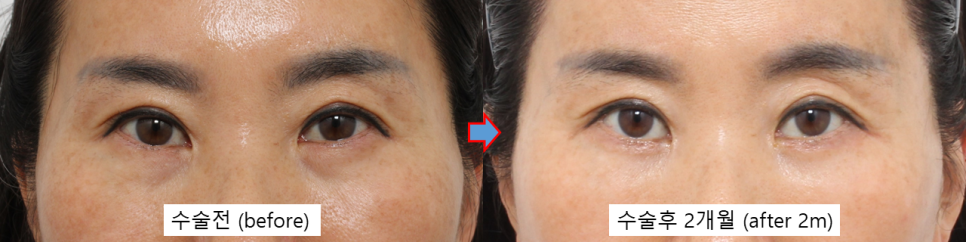 Before and after lower blepharoplasty in the 50s. Before and after lower blepharoplasty in the 50s. Lower blepharoplasty incision scar. Lower blepharoplasty scar. Lower blepharoplasty incision. A partially visible model with consent for release.
Under-eye surgery is not about which procedure is better, but about which procedure is appropriate for your current condition.
Especially after your 50s, there are limits to simply moving the fat, so combining structural lifting through lower blepharoplasty is much more natural and lasts longer.
Also, the incision scar below the eyelashes becomes almost unnoticeable over time, and by using a technique that preserves the orbicularis oculi muscle, the shape and size of the aegyo-sal can also be maintained.
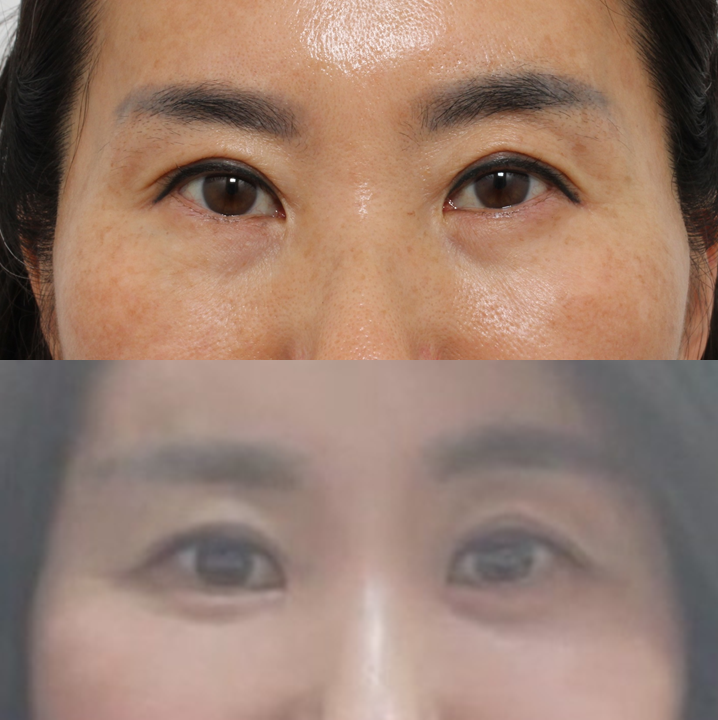 Before and after lower blepharoplasty in the 50s. Review of lower blepharoplasty in the 50s. Aegyo-sal lower blepharoplasty. Aegyo-sal lower blepharoplasty. Aegyo lower blepharoplasty. A partially visible model with consent for release.