Lower eyelid surgery in the past was a relatively simple procedure.
In most cases, it involved removing or repositioning protruding fat under the eyes and excising sagging skin.
Of course, these methods were effective in improving under-eye fat pockets and sagging skin. However, over time, plastic surgeons began considering another important question.
“Why do some patients look as though only their under-eye area has been improved, while others look significantly younger overall?”
In many cases, the difference lies not simply in how much skin is removed, but in how extensively the midface structure is improved as well.
- Recent Changes in Lower Eyelid Surgery -
Modern lower eyelid surgery can no longer be viewed simply as “under-eye fat removal surgery.”
Recent lower eyelid surgery has developed into a more three-dimensional procedure that incorporates the following elements:
-
Under-eye fat repositioning: Repositioning bulging orbital fat (orbital fat reposition)
-
Skin excision: Addressing skin laxity (skin excision)
-
Strengthening support for the orbicularis oculi muscle: Suspension and fixation of the orbicularis oculi muscle (OOM suspension and fixation)
-
Repositioning and lifting of the SOOF and midface tissues: Lifting the fat layer beneath the orbicularis oculi muscle (SOOF lifting)
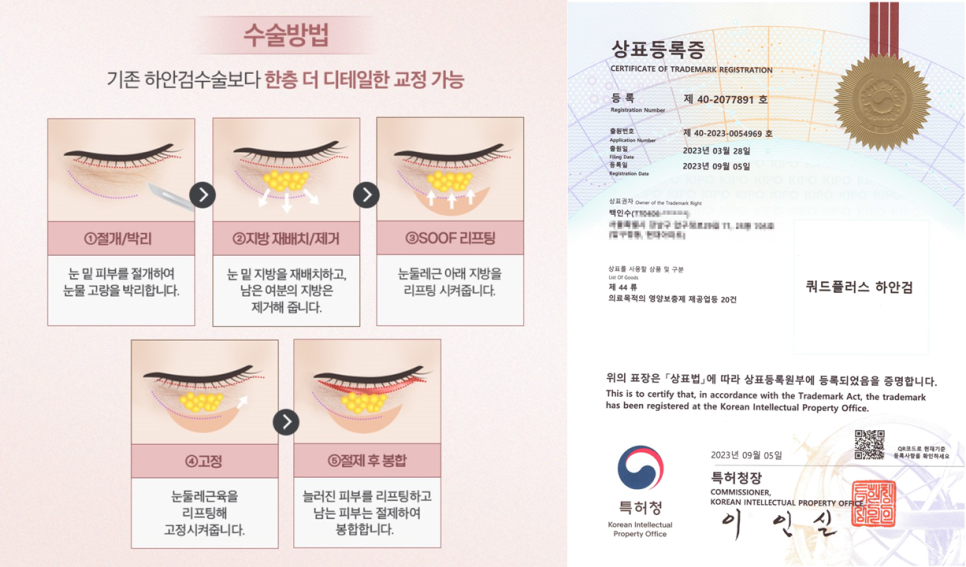
Lower eyelid surgery technique. Quad Plus lower eyelid surgery patent and trademark registration.
In other words, the procedure is evolving to consider not only the area beneath the eyes,
but also the midface structure extending from the under-eye area to the upper cheekbones.
- The Incision Is Small, but the Surgical Area Is Deeper and More Extensive -
Patients often think:
“Since the incision is made just below the eyelashes, isn’t this a procedure involving a limited area?”
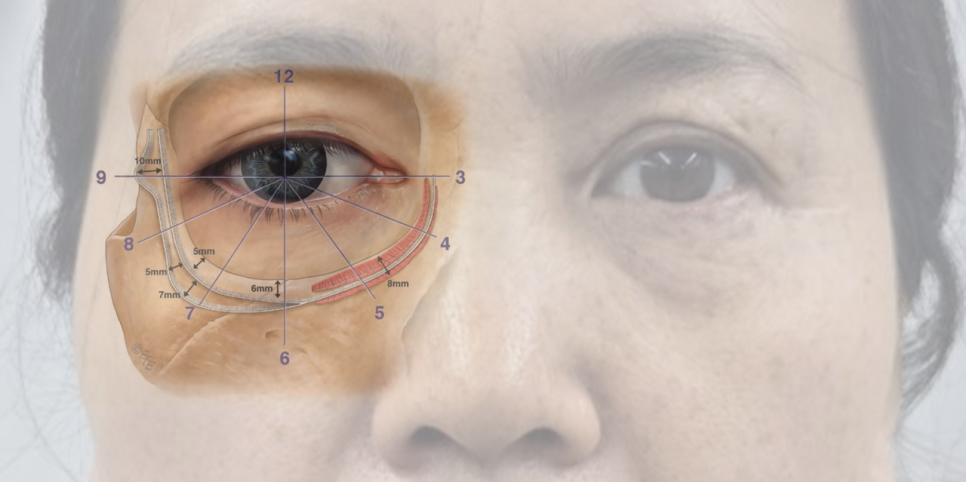
Tear trough ligament. Under-eye retaining ligament. Source: A paper in Plastic and Reconstructive Surgery. A partial model for which consent for public disclosure has been obtained.
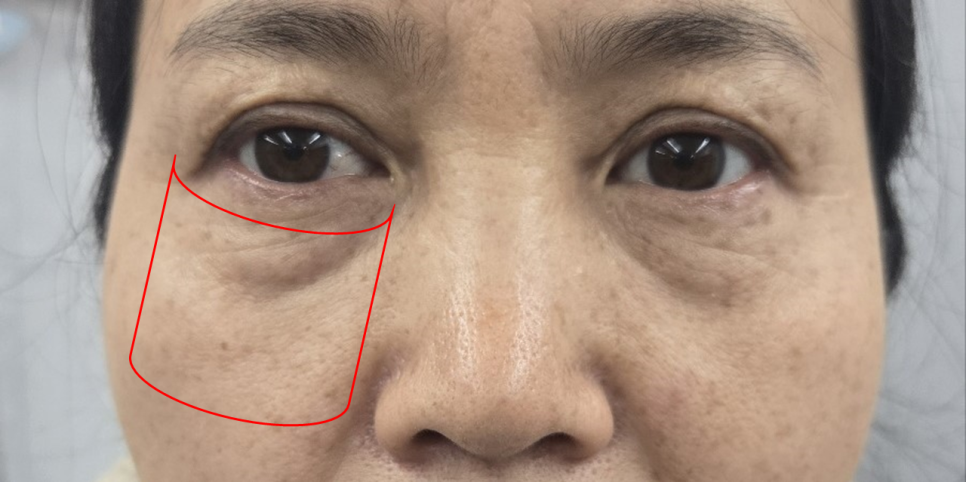
Extent of lower eyelid surgery. Dissection range in lower eyelid surgery. Lower eyelid surgery technique. A partial model for which consent for public disclosure has been obtained.
However, in actual surgery, even when the procedure begins with an incision below the eyelashes,
it is often necessary to sufficiently dissect the tear trough area and extend the work downward into the midface region.
In other words, although the skin incision itself is not large,
the actual dissection range and surgical concept extend to the midface, making this a more sophisticated procedure.
- Postoperative Changes Go Beyond Simple Under-Eye Improvement -
When comparing before-and-after photographs, the most noticeable changes include:
-
Improvement in the tear trough
-
Reduction of under-eye fat pockets
-
Reduction of dark circles
-
Improvement in skin laxity
and more.
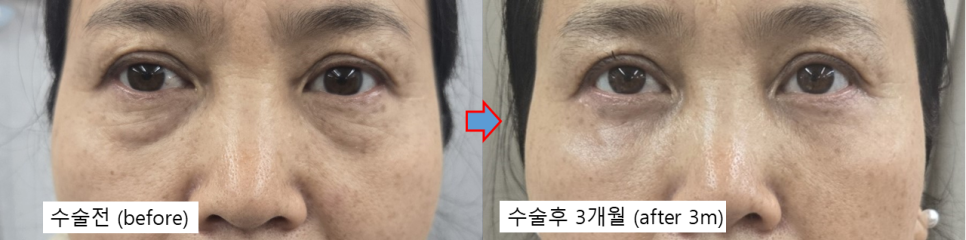
Before and after lower eyelid surgery. Lower eyelid surgery reviews. Lower eyelid surgery recovery progress. A partial model for which consent for public disclosure has been obtained.
However, on closer observation, the improvement is often not limited to the under-eye area:
-
The midface appears gently smoothed
-
The anterior cheekbones appear naturally enhanced
-
The central area of the face gives an overall lifted impression
These changes help explain why recent lower eyelid surgery has moved beyond simple “under-eye fat surgery”
to become a form of midface anti-aging surgery.
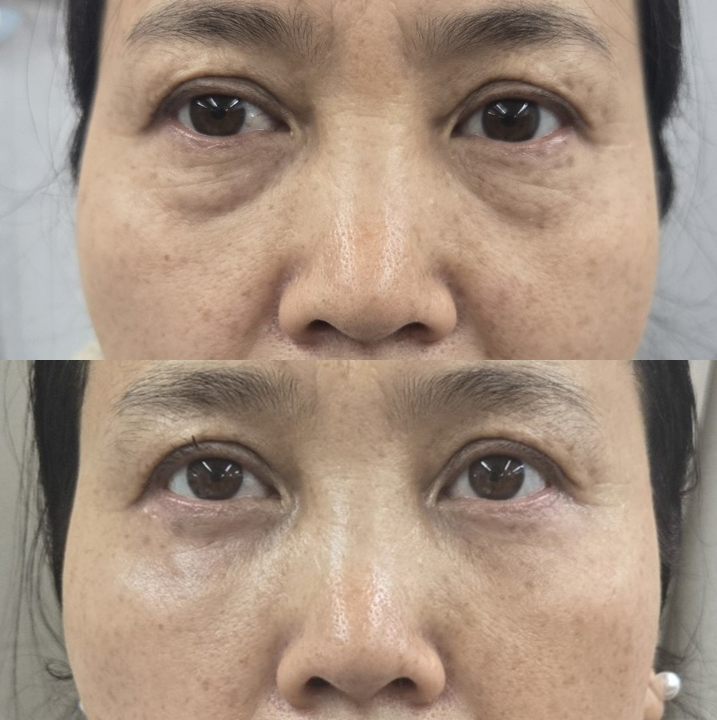
Before and after lower eyelid surgery. Lower eyelid surgery reviews. Lower eyelid surgery for patients in their 50s. Lower eyelid surgery for patients in their 60s. A partial model for which consent for public disclosure has been obtained.
If you are curious about the recovery period for lower eyelid surgery, please refer to the blog post below.