When treating people in their 50s and older who are considering upper blepharoplasty (a midlife double-eyelid surgery involving skin excision) due to drooping eyelids, there is something I hear surprisingly often.
"I want my eyes to feel more comfortable, but I don't want my double-eyelids to look too pronounced or my overall appearance to change."
In reality, eye surgery after the age of 50 requires a different approach from double-eyelid surgery in one's 20s and 30s.
This is because it is necessary not only to address sagging skin but also to preserve, as naturally as possible, the image that a person has maintained for many years.
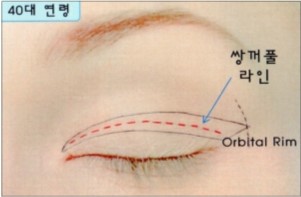
A typical method of midlife double-eyelid surgery. Upper blepharoplasty method. Upper blepharoplasty technique. Source: paper
- Why Having Your First Double-Eyelid Surgery After 50 Can Feel Burdensome -
Double-eyelid surgery has become very common among people in their 20s and 30s.
Some people undergo the procedure as early as middle or high school, while it is generally performed in the early 20s.
In contrast, double-eyelid surgery was not as common when today’s people in their 50s and older were young.
As a result, many have lived their entire lives without double-eyelids or with very shallow creases.
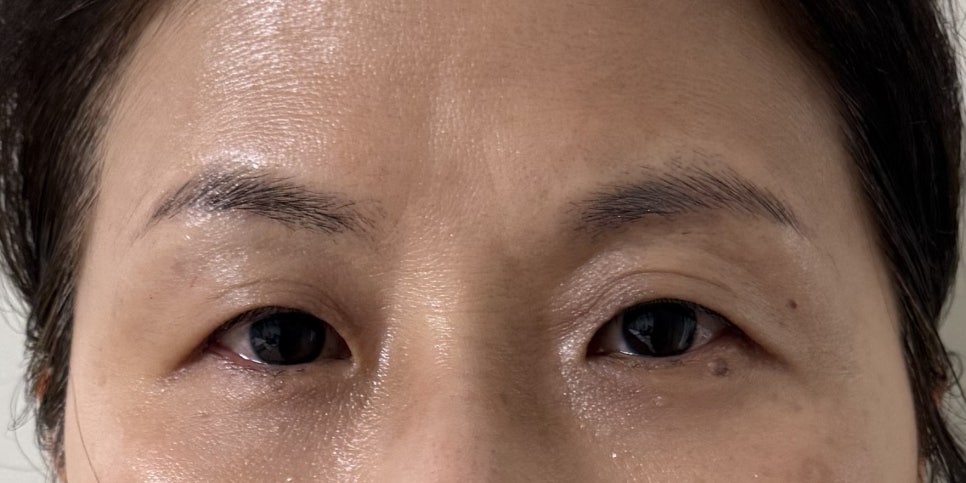
Double-eyelid surgery review in the 50s. Double-eyelid surgery in the 50s. Midlife double-eyelid surgery. This is a partial model who consented to the images being made public.
When such people undergo upper blepharoplasty after the age of 50 because of drooping eyelids,
The drooping eyelids may improve, but a greater-than-expected change in their overall appearance may occur.
This is why someone may feel, even though the surgery was successful, "I don't look like myself."
- Changes That Can Occur with Upper Blepharoplasty Alone -
Removing a substantial amount of eyelid skin can effectively improve sagging.
However, excessive skin excision can lead to unexpected changes.
Typical examples include the following.
- An Awkward Double-Eyelid Crease
For someone who has lived their entire life without double-eyelids or with a shallow crease, suddenly having a distinct, parallel-style double-eyelid crease can feel unfamiliar to them and may make others feel that the surgery is especially noticeable.
- A Reduced Distance Between the Eyes and Eyebrows
Removing a significant amount of eyelid skin can narrow the distance between the eyes and eyebrows.
In this case, the eyes may appear more defined, but the overall appearance may become stronger or sharper than expected.
- Worsening Brow Ptosis and Nasal-Bridge Wrinkles
After upper blepharoplasty, the sagging eyelid skin may be resolved, but it is very common for the forehead and eyebrows to descend.
In this case, eyebrow drooping may worsen, and the wrinkles between the eyebrows and on the bridge of the nose may become deeper.
Patients sometimes say:
"My eyes look better, but the wrinkles on my nasal bridge have become worse."
- Why a Forehead Lift Should Also Be Considered -
When these changes are anticipated, considering a forehead lift together with upper blepharoplasty, rather than performing upper blepharoplasty alone, may be helpful.
The purpose of the forehead lift is important here.
Many people think of a forehead lift as "a surgery to pull the eyebrows as high as possible," but that is not actually the case.
In natural-looking eye surgery after the age of 50, the purpose of a forehead lift is not excessive lifting.
Rather, it has greater significance in terms of
-
maintaining the position of the eyebrows stably,
-
preventing brow ptosis that may occur after surgery,
-
preventing worsening of wrinkles between the eyebrows and on the nasal bridge, and
-
preserving the person’s original appearance as much as possible.
Therefore, in cases like this, combining conservative upper blepharoplasty, which minimizes eyelid skin excision, with a forehead lift may lead to a more natural result.
- For a Natural Result, 'Preserving Your Appearance' Is Important -
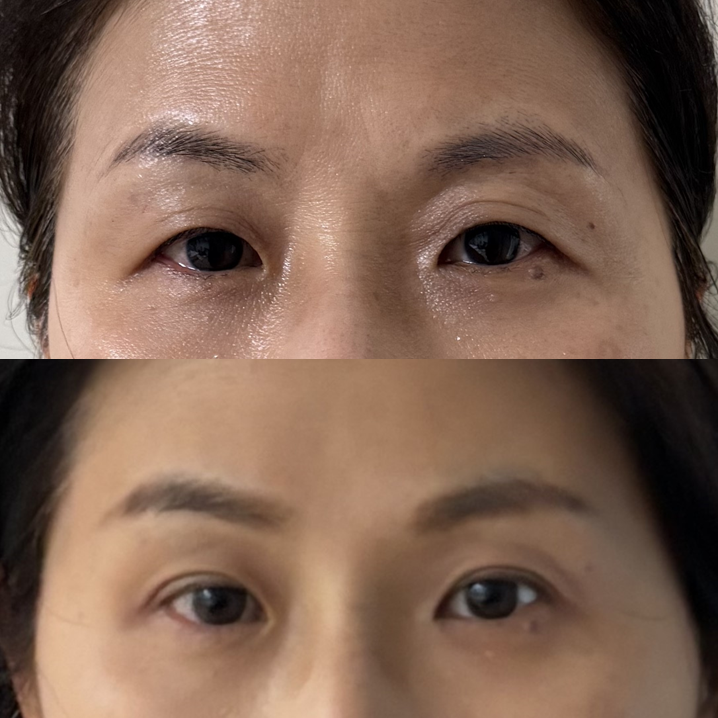
In this patient’s case, because the eyes were not originally large, a natural in-out crease was planned rather than a glamorous parallel-style crease.
The goal was not simply to make the eyes look larger, but to preserve as much as possible the favorable image the patient had maintained for many years.
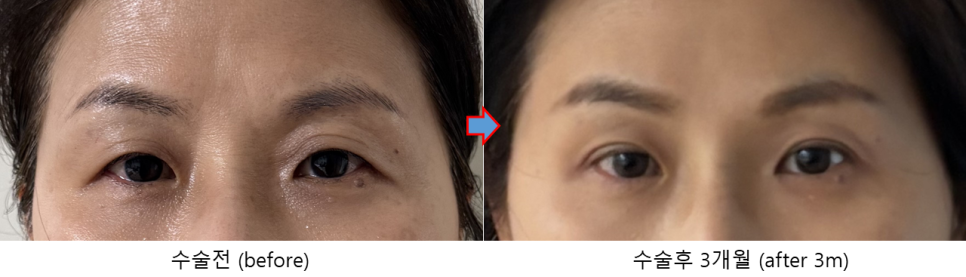
Before and after upper blepharoplasty in the 50s. Upper blepharoplasty review in the 50s. This is a partial model who consented to the images being made public.
After surgery,
-
the eyebrow position remained stable,
-
the wrinkles on the nasal bridge improved,
-
there was no excessively strong change in appearance, and
-
a natural-looking eye shape was achieved.
-
Recovery Process After Surgery -
The stitches from upper blepharoplasty are generally removed 5–7 days after surgery.
The stitches from a forehead lift are usually removed within 10 days.
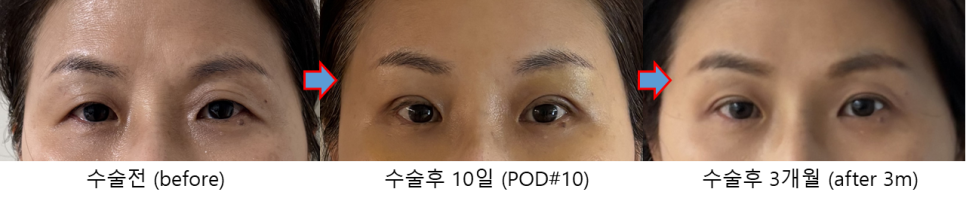
Looking at the actual 10-day follow-up photo, there is less swelling than expected,
and the eyebrows remain stable, allowing a relatively natural appearance to be observed.
Of course, the final result settles into a more natural appearance over the course of several months.
- Points to Consider in Midlife Eye Surgery -
Upper blepharoplasty or double-eyelid surgery after the age of 50 is one method of removing sagging skin.
For that reason, it is very important to consider how naturally the appearance a person has maintained for many years can be preserved.
If upper blepharoplasty alone could make the distance between the eyes and eyebrows excessively narrow,
or if brow ptosis and worsening wrinkles on the nasal bridge are expected after surgery, it is worth considering a forehead lift as well.
Double-eyelid surgery in the 50s. Eye surgery in the 50s. Eye surgery in the 40s. Double-eyelid surgery in the 40s. Midlife eye surgery. This is a partial model who consented to the images being made public.
If you are curious about another case in which double-eyelid surgery was performed together with a forehead lift, please see the article below.