When discussing lower-eyelid fat repositioning, many people say:
"I just wish my dark circles would disappear."
However, in the actual consultation room, the issue is often more than just dark circles.
In particular, some people begin to experience lower-eyelid aging faster than expected starting in their late 30s.
Even at the same age, some people may look as though they are in their late 40s,
while others still retain the impression of being in their late 20s.
This difference is not simply due to the skin.
The surrounding bone structure, the position of the fat, and the volume of the midface have a significant influence.
- A face with slightly protruding eyes but insufficient mid-cheek volume -
This case involves a woman in her late 30s.
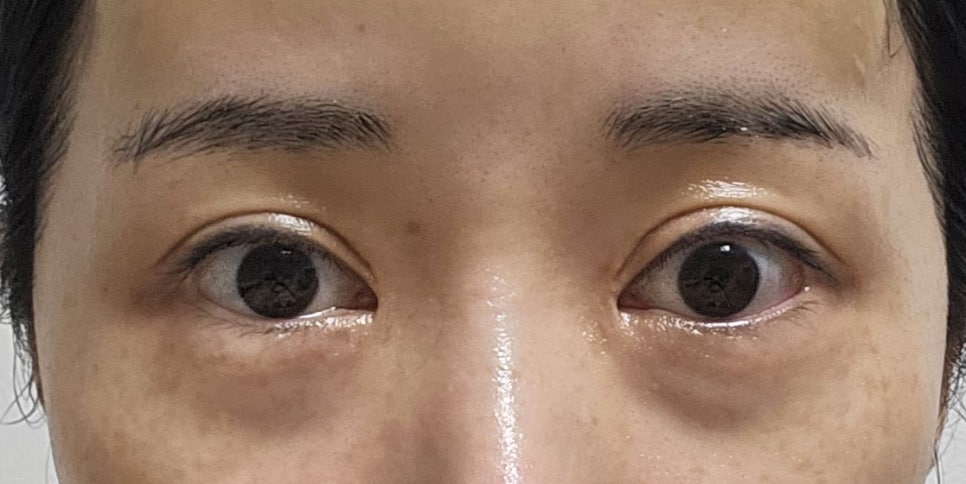
Lower-eyelid fat repositioning. Dark-circle surgery review. SOOF lower-eyelid surgery review. This is a real model who consented to publication.
Her eyes were open and well-defined, but from the side, they had the appearance of slightly protruding eyes, positioned somewhat forward.
On the other hand, the volume of the mid-cheek supporting the area beneath the eyes was insufficient.
With this facial structure, the lower-eyelid fat tends to become more prominent over time, and the boundary between the eyes and cheeks develops earlier.
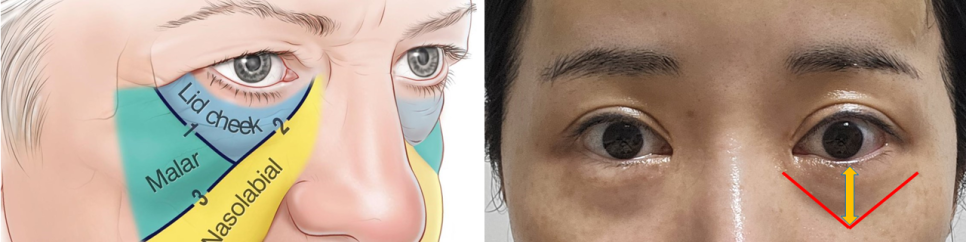
Lower-eyelid changes. Lower-eyelid aging. V deformity. Tear trough. Lower-eyelid fat. Orbital height. This is a partial-face model who consented to publication.
As a result, the visible orbital height becomes greater,
and a V-shaped deformity, or V deformity, often appears earlier than in others of the same age.
Protruding eyes may look open and bright, but they do not necessarily create a youthful appearance.
When the tissues supporting the area beneath the eyes descend, the connection between the lower eyelid and cheek is disrupted,
causing the visible orbital height to increase.
At this point, the area beneath the eyes appears longer, and the V-shaped boundary becomes more pronounced,
creating an impression that looks more tired and older than the person's actual age.
- A case involving both lower-eyelid fat repositioning and mid-cheek lifting -
Lower-eyelid fat repositioning is a procedure that relocates protruding orbital fat to an appropriate position, reducing the uneven contour beneath the eyes.
The key is not to remove the protruding fat, but to move it to areas where it is needed to create natural volume.
This process alone can significantly improve dark circles and protrusion beneath the eyes.
However, when support in the mid-cheek is insufficient, this alone may not be enough.
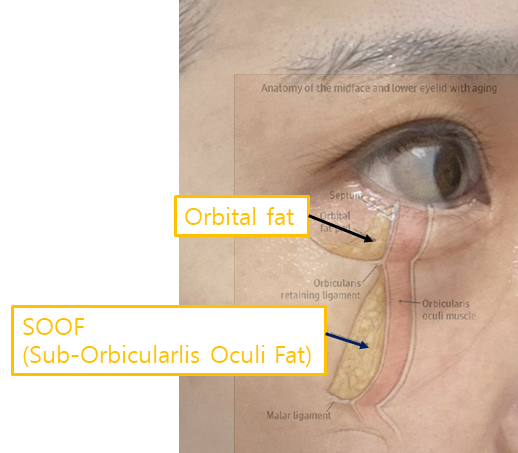
Mid-cheek fat. SOOF. SOOF lifting. Lower-eyelid structure. Lower-eyelid anatomy. This is a partial-face model who consented to publication.
SOOF (Sub-Orbicularis Oculi Fat) is a layer of fat located beneath the orbicularis oculi muscle under the eyes.
It differs from orbital fat and is an important structure connecting the lower-eyelid area with the midface.
As aging progresses, the SOOF also descends, making the boundary between the lower eyelids and cheeks more pronounced.
In this case, a SOOF Lift was performed together with lower-eyelid fat repositioning to lift the descended mid-cheek tissues upward.
As a result, not only was the protrusion of the fat improved,
but the supporting structure beneath the eyes was restored, reducing the visible orbital height,
and the previously elongated lower eyelids changed to a more compact proportion.
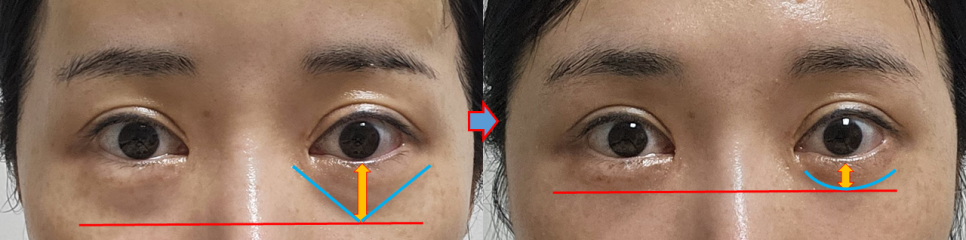
Lower-eyelid aging. Lower-eyelid deformity. Orbital height. SOOF lift. SOOF lifting. Before and after lower-eyelid fat repositioning. Before and after lower-eyelid surgery. This is a partial-face model who consented to publication.
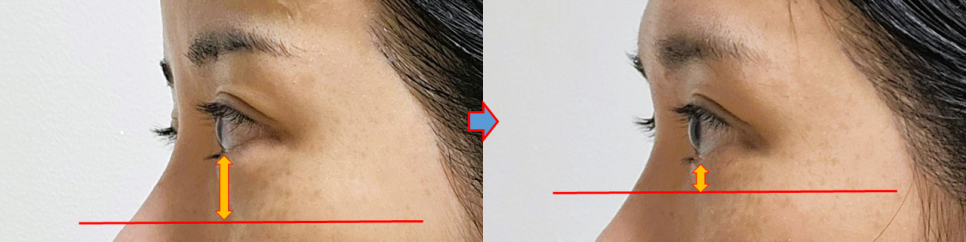
Reduced orbital height. Before and after lower-eyelid surgery. Lower-eyelid surgery review. SOOF lower-eyelid surgery. Before and after lower-eyelid fat repositioning. This is a partial-face model who consented to publication.
※ From V deformity to a round contour
In youthful eyes, the lower-eyelid area and mid-cheek flow naturally together like a single curve.
Conversely, as aging progresses, a V-shaped boundary develops between the eyes and cheeks, creating a more aged appearance.
SOOF Lift raises the descended midface tissues,
helping transform this V deformity into a smoother round contour.
Therefore, even with the same lower-eyelid fat repositioning procedure,
when SOOF Lift is performed at the same time, it often creates an impression in which the entire face looks significantly more youthful, beyond simply improving dark circles.
- Lifting the midface beyond lower-eyelid fat and the tear trough -
Lower-eyelid aging is not simply a problem of protruding fat.
To achieve a natural result, the position of the eyes, the volume of the mid-cheek, midface descent, the connection between the eyes and cheeks,
and even the visible orbital height must all be considered together.
Not everyone in their late 30s shows the same pattern of lower-eyelid aging.
In particular, people with slightly protruding eyes and insufficient mid-cheek volume may develop lower-eyelid aging earlier than others of the same age.
In such cases, planning lower-eyelid fat repositioning together with a SOOF Lift may lead to a more satisfying result.
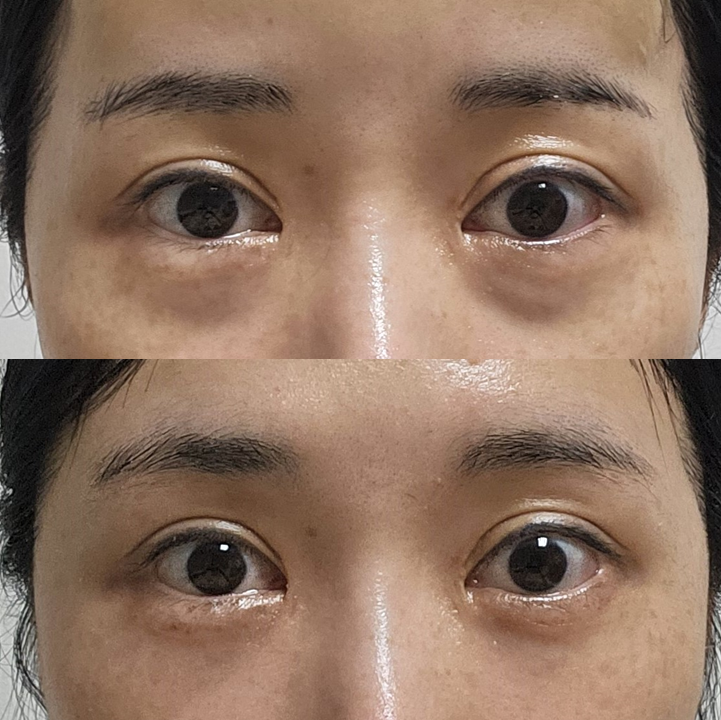
Lower-eyelid fat repositioning review. Before and after lower-eyelid fat repositioning. Lower-eyelid surgery review. Before and after lower-eyelid surgery. This is a partial-face model who consented to publication.
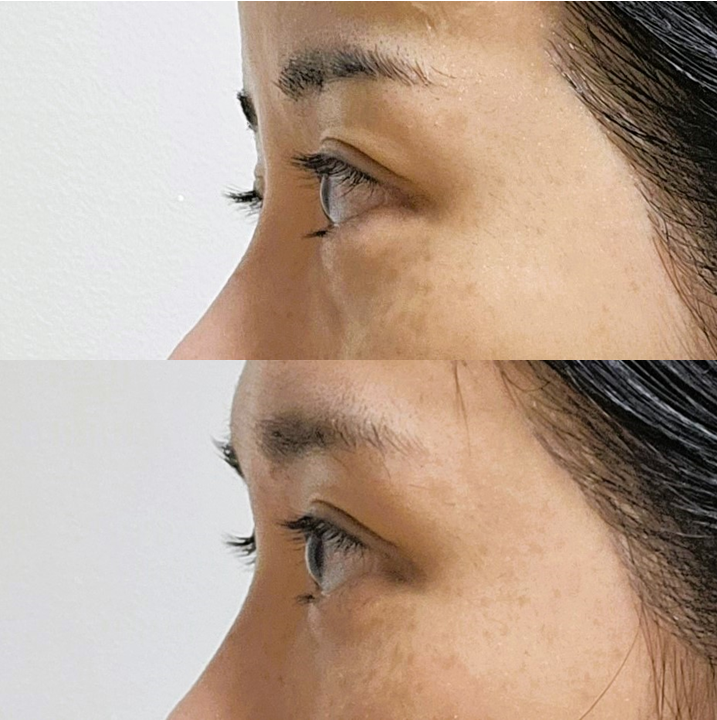
Mid-cheek lifting review. Before and after mid-cheek lifting. Lower-eyelid fat repositioning with lifting. Mid-cheek lift. Mid-cheek lifting. Midface lift. This is a partial-face model who consented to publication.