Endoscopic forehead lifting is a procedure that many people choose among recent anti-aging surgeries.
This is because it can improve forehead wrinkles, lift sagging eyebrows, and also relieve the heavy sensation in the eyelids.
It may be particularly helpful for people whose eyelids look thick or who put considerable strain on their foreheads when opening their eyes.
However, during consultations, there are questions that often come before questions about the surgical results.
“Do I have to shave my hair?”
“Will the incision leave a noticeable scar?”
“What if hair does not grow back at the incision site?”
Today, I will explain the incisions, scars, and hair loss that concern people considering an endoscopic forehead lift the most.
- Do I have to shave my hair for an endoscopic forehead lift? -
In the past, many people thought that a large area of hair had to be shaved for scalp surgery.
However, the endoscopic forehead lift currently performed does not require shaving the hair.
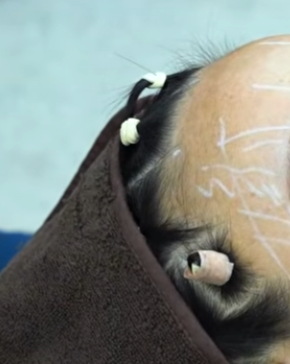
Arranging the hair for an endoscopic forehead lift.
The hair around the incision sites is braided and arranged before surgery, so it does not need to be cut short.
The procedure is performed through small incisions inside the scalp,
and surgery is possible either by arranging only the hair around the incision sites or by leaving it as it is.
Therefore, even immediately after surgery, the incision sites can be sufficiently concealed with the existing hairstyle,
so there is generally little disruption to daily life.
- How are the incisions made for an endoscopic forehead lift? -
An endoscopic forehead lift involves making 4–5 small incisions, approximately 1.5 cm long, inside the scalp to insert the endoscope and surgical instruments.
The incisions are not long, but what is more important is how they are made.
If the incisions are made without considering the direction of the hair follicles, or if the follicles are damaged during the incision process, the hair around the scars may become thinner.
Therefore, rather than the incision itself, the surgical method used to preserve the hair follicles as much as possible is important.
- Can hair loss occur after surgery? -
Hair loss is the main concern for people considering an endoscopic forehead lift.
In reality, hair loss is affected less by the length of the incision than by how much damage to the hair follicles can be minimized.
During surgery, the incisions should be made along the spaces between the hair follicles to minimize follicle damage,
and care must also be taken during hemostasis to prevent heat damage caused by excessive electrocautery.
If heat from the electrocautery device reaches the hair follicles, temporary hair reduction may occur,
so it is important to handle the tissue delicately.
When appropriate incisions and careful hemostasis are performed, the possibility of permanent hair loss is very low,
and most patients recover without noticeable hair loss.
- Recovery of the incision sites -
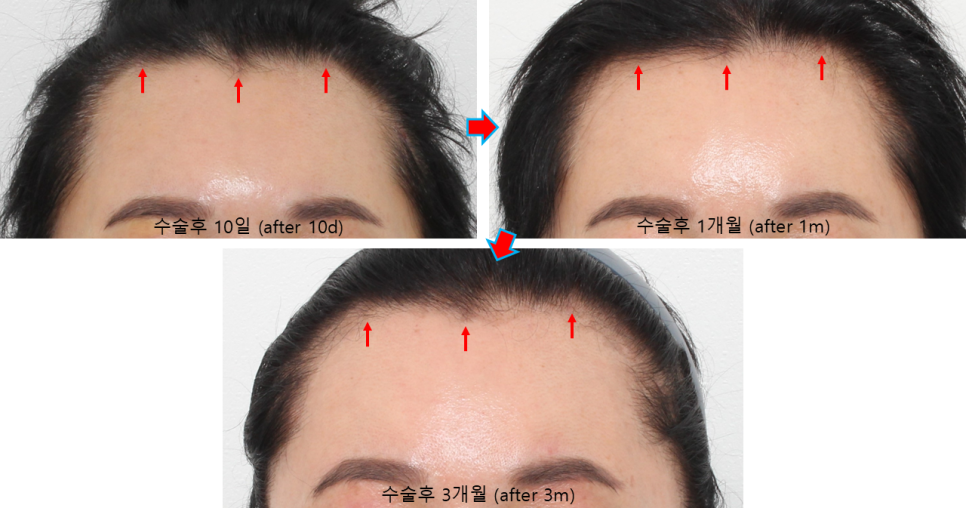
Endoscopic forehead lift incision site. Hair loss after an endoscopic forehead lift. Forehead lift scar. Forehead lift hair loss. Forehead lift recovery. Partial model shown with consent.
About 10 days after surgery
This is when the stitches are removed.
There may still be slight redness around the incision sites,
but because the incisions are located within the hair, they can generally be sufficiently concealed with the existing hairstyle alone.
One month after surgery
This is a stage when the scars are still maturing, so there may be redness and the tissue may feel slightly firm.
The incision lines may still be visible upon close examination,
but because the surrounding hair remains intact, they are barely noticeable in daily life.
Most importantly, because hair loss does not occur around the incisions, the incision lines are naturally concealed by the hair.
Three months or more after surgery
As the scars mature, the redness decreases further.
Hair begins to grow again from the hair follicles preserved during the incision process,
and as it covers the incision lines, the scars appear even more natural.
By this stage, many people recover to the point where even they have difficulty locating the incision sites.
- Changes before and after an endoscopic forehead lift -
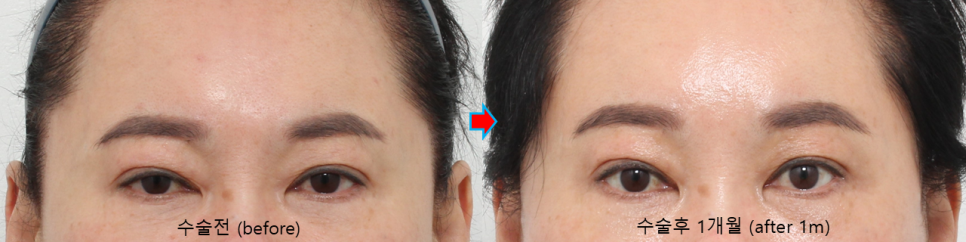
Before and after an endoscopic forehead lift. Before and after a forehead lift. Forehead lift review. Partial model shown with consent.
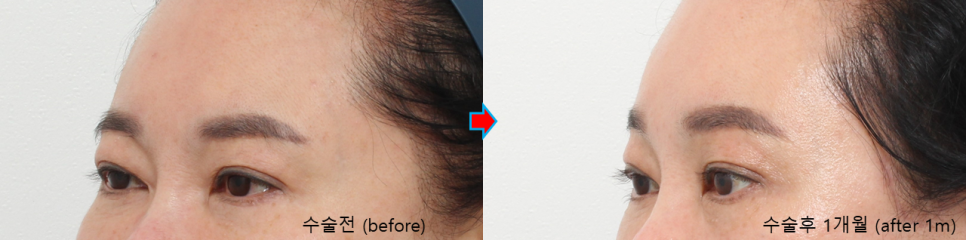
Endoscopic forehead lift review. Endoscopic forehead lift. Before and after an endoscopic forehead lift. Before and after a forehead lift. Partial model shown with consent.
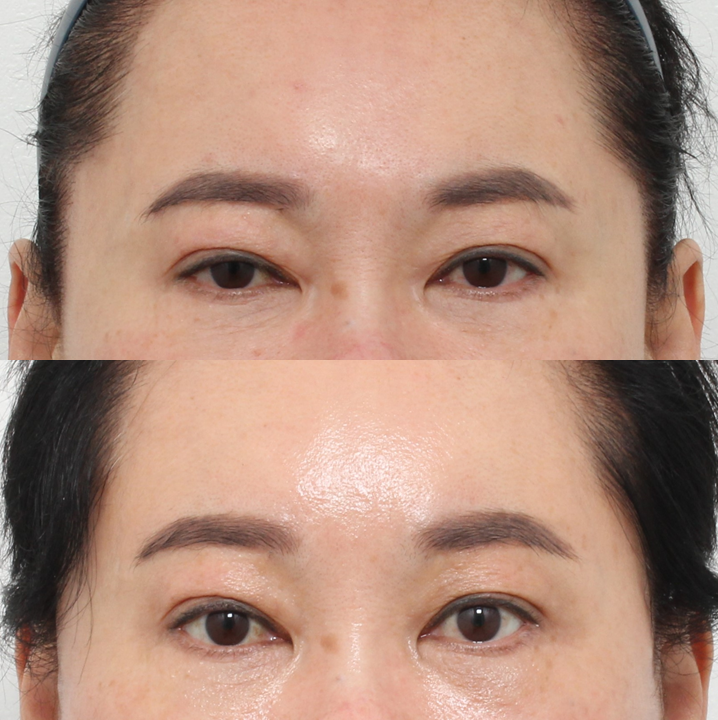
This woman in her late 50s had thick-looking eyelids and a heavy appearance before surgery.
After an endoscopic forehead lift, her eyebrows and forehead were naturally lifted, reducing the burden of the tissue that had been covering the eyelids,
and her overall appearance changed to make the eyelids look lighter.
Rather than making the eyes unnaturally larger, the procedure allowed her original eye shape to appear more comfortably and naturally.
An endoscopic forehead lift is performed through small incisions inside the scalp, so meticulous surgical technique is required.
It is not a procedure that requires shaving all the hair, and hair loss does not occur simply because an incision was made.
The direction of the incisions, methods for preserving the hair follicles, meticulous hemostasis to minimize heat damage caused by electrocautery,
and accurate suturing together can reduce the possibility of scarring and hair loss.
Endoscopic forehead lift review. Before and after an endoscopic forehead lift. Forehead lift results. Before and after a forehead lift. Forehead lift review. Partial model shown with consent.
What are the various fixation methods used for a forehead lift?
Learn about fixation methods such as bone tunneling, Endotine, and fascial fixation.