“Will the swelling and bruising be severe after a forehead lift?”
“Won’t I suffer from pain or discomfort after a forehead lift?”
These are among the questions we hear most often in the consultation room.
Because of the name “forehead lift,” many people think the surgical area is very extensive and that swelling and bruising will last a long time or that the pain will be severe even after surgery.
People also often worry, “Could my scalp remain numb for a long time if a nerve is affected?” or “Could I suffer from nausea or headaches?”
However, endoscopic forehead lifts performed today are considerably different from the techniques used in the past.
In particular, surgery using a Full HD endoscope offers an important advantage that can significantly affect the recovery process.
- Small Incisions, but a Much Wider Surgical View -
An endoscopic forehead lift is performed through small incisions inside the scalp.
Although the incisions are small, the surgeon operates while viewing an enlarged image on a Full HD endoscope screen, allowing them to examine areas deep inside that are difficult to see with the naked eye.
In other words, the internal structures can actually be seen more clearly without making large incisions.
This is the greatest advantage of endoscopic surgery.
- Why a High-Resolution Full HD Endoscope Matters -
The most important aspects of an endoscopic forehead lift are safe and sufficient dissection.
Because important blood vessels and sensory nerves pass through the forehead and temple areas, delicate dissection is essential.
A Full HD endoscope makes it possible to clearly identify these structures, greatly helping the surgeon perform the dissection while preserving the blood vessels and nerves as much as possible.
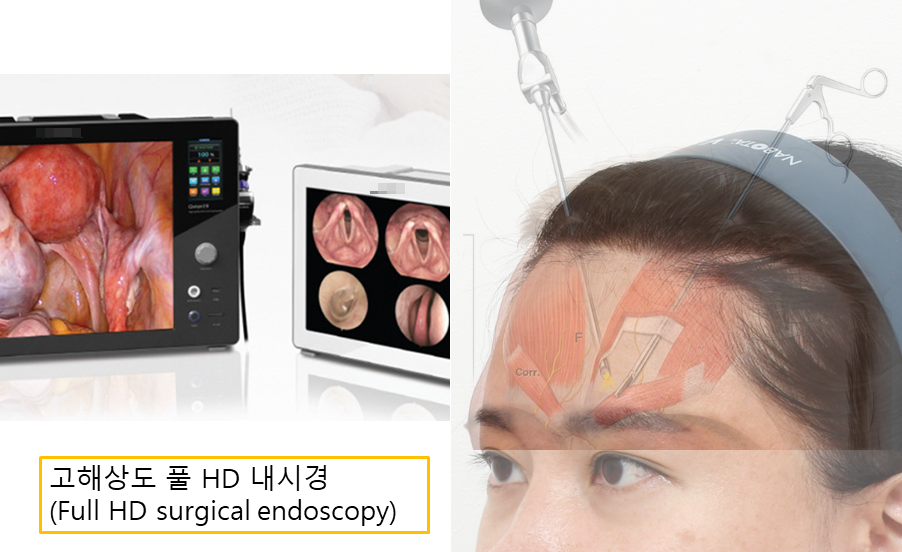
High-resolution surgical endoscope. Endoscopic forehead lift. Full HD endoscope. Full HD endoscope. Endoscopic forehead lift technique. Endoscopic forehead lift surgical method. This is a partial model whose image release was authorized.
- Minimizing Bruising and Swelling by Reducing Blood Vessel Damage
One of the main causes of bruising and swelling after surgery is blood vessel damage.
The most important vessel is called the sentinel vein, also known as the zygomaticotemporal vein in the temple area.
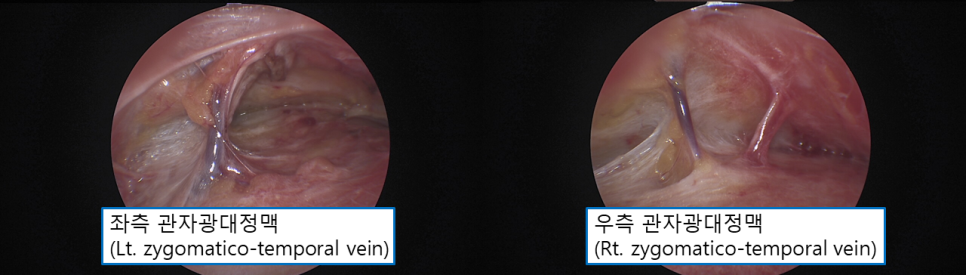
Sentinel vein. Sentinel vein. Zygomaticotemporal vein. Endoscopic forehead lift. Blood vessels in a forehead lift.
The location and number of these blood vessels vary slightly from person to person, and even the left and right sides can differ in the same person.
Because blood vessels are distributed in such varied anatomical patterns, surgery must be performed while accurately identifying their locations with an endoscope.
Maintaining a clear view with a Full HD endoscope and preserving the blood vessels can help reduce unnecessary bleeding, which often results in relatively less swelling and bruising after surgery.
This is why patients often say, “There is less swelling than I expected.”
- Preserving Sensory Nerves for a More Comfortable Recovery
Several nerves responsible for sensation pass through the forehead and temple areas.
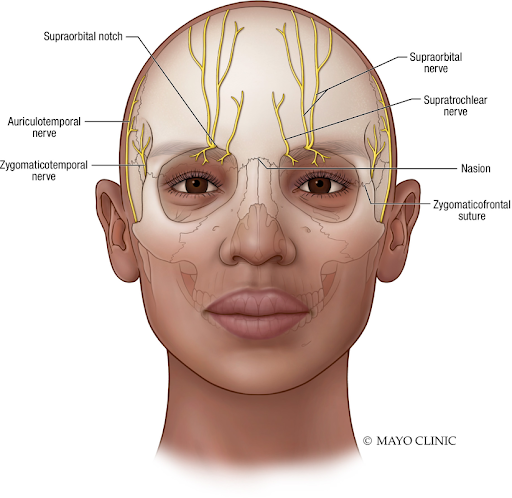
Sensory nerves of the forehead, temple, and scalp. Source: Mayo Clinic.
The supraorbital nerve, supratrochlear nerve, and zygomaticotemporal nerve run through these areas.
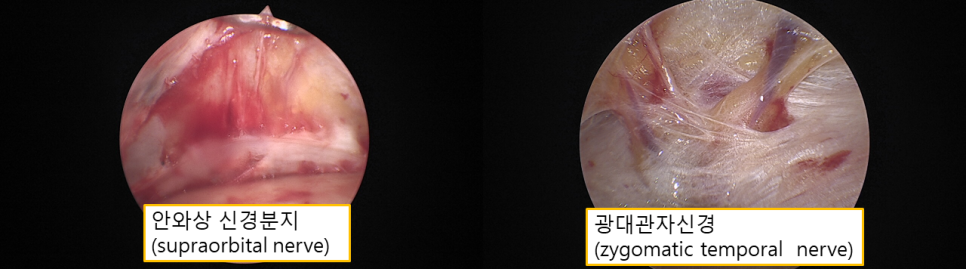
If these nerves are unnecessarily irritated or damaged, the following symptoms may persist for a long time:
-
Scalp numbness
-
Reduced sensation
-
Uncomfortable tightness
-
Abnormal sensations
Full HD endoscopy is advantageous for minimizing nerve damage because it allows these sensory nerves to be directly identified during surgery and enables the procedure to be performed using the Plane shifting technique.
For this reason, many patients say that their recovery was much more comfortable than they had expected.
- Recovery Period After an Endoscopic Forehead Lift -
This is the aspect that people considering an endoscopic forehead lift are most curious about.
Of course, every surgery involves individual differences.
However, many patients who undergo an endoscopic forehead lift say, when they return for a follow-up the next day:
“I’m doing much better than I expected.”
Rather than the severe pain or intense nausea they anticipated, many describe only a slight feeling of tightness in the scalp, and they generally return to their daily activities relatively quickly.
The before-and-after photographs were taken approximately 10 days after surgery.
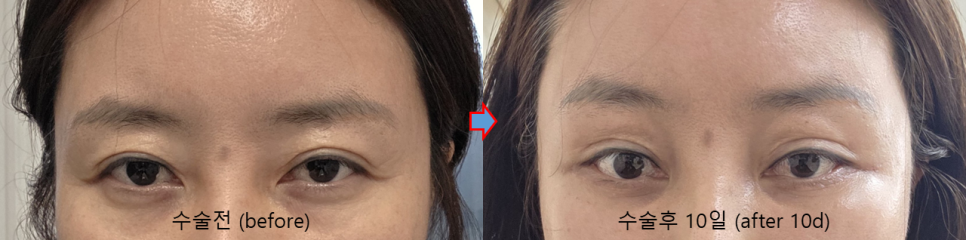
Forehead lift swelling. Forehead lift bruising. Forehead lift recovery period. Forehead lift downtime. Before and after a forehead lift. Forehead lift review. This is a partial model whose image release was authorized.
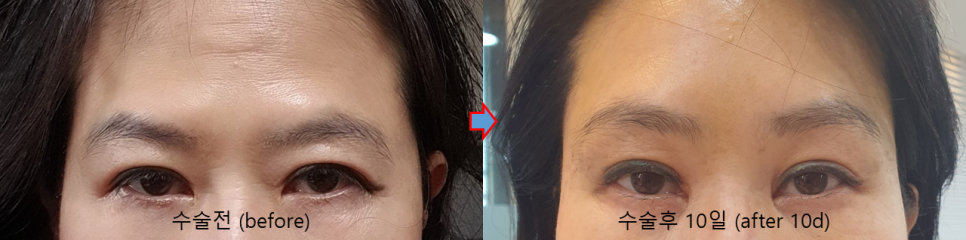
Forehead lift swelling. Forehead lift bruising. Forehead lift recovery period. Forehead lift downtime. Before and after a forehead lift. Forehead lift review. This is a partial model whose image release was authorized.
Looking at the photographs, you can see that most of the bruising is barely visible and that the swelling has also decreased considerably.
Of course, recovery speed varies from person to person, but many people experience a more natural recovery than they expected.
This recovery cannot be explained solely by differences in individual constitution; it is also closely related to the meticulous dissection performed during surgery while preserving the blood vessels and nerves as much as possible.
- Ultimately, a Good Recovery Begins with Good Surgery. -
Of course, there are several programs designed to help with postoperative recovery for those who are concerned.
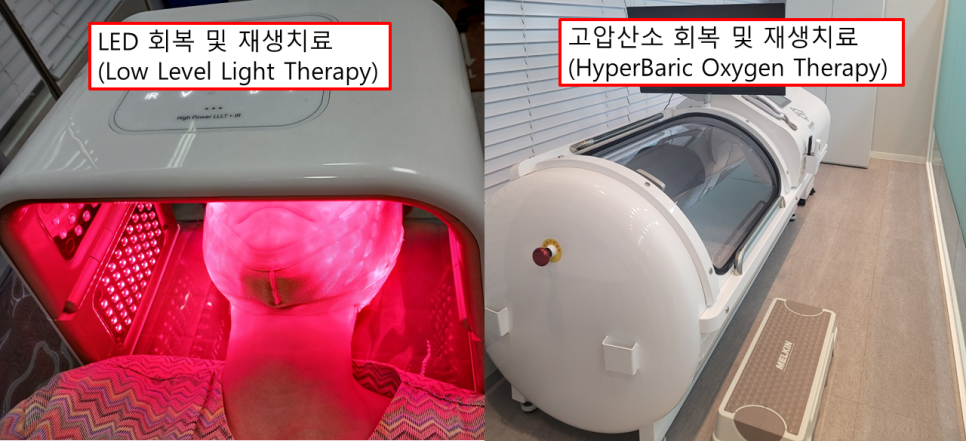
Postoperative recovery programs. LED regenerative treatment. Postoperative swelling management. Hyperbaric oxygen therapy. Hyperbaric oxygen treatment.
However, the most important factor in promoting a faster recovery after surgery is performing the procedure accurately while maintaining good visibility.
That is the greatest value of a Full HD endoscope.
When surgery is performed with a clear view while preserving important blood vessels and sensory nerves as much as possible, unnecessary tissue damage can be reduced.
This may lead to less bruising and swelling after surgery and a more comfortable recovery.
If you are considering a forehead lift, we recommend looking not only at “how small the incisions are,” but also at how precisely the surgery is performed.
Good surgery can make a difference not only in the results but also in the recovery process.
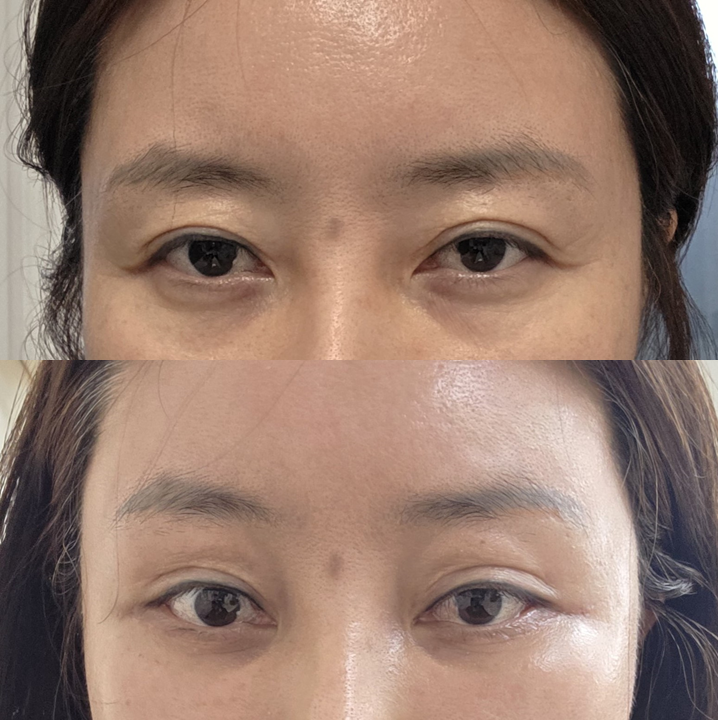
Before and after a forehead lift. Forehead lift review. Before and after an endoscopic forehead lift. Endoscopic forehead lift review. Forehead lift recovery period. Forehead lift swelling. Forehead lift bruising. This is a partial model whose image release was authorized.
If you have concerns related to hair, such as hair loss or scarring after a forehead lift, please refer to the blog post below.