“The area under my eyes looks dark.”
There are truly many people who visit clinics because of dark circles.
However, dark circles are not a single condition in which the skin under the eyes simply turns darker.
In reality, multiple causes work together, making the area under the eyes look dark and tired.
- Common Causes of Dark Circles -
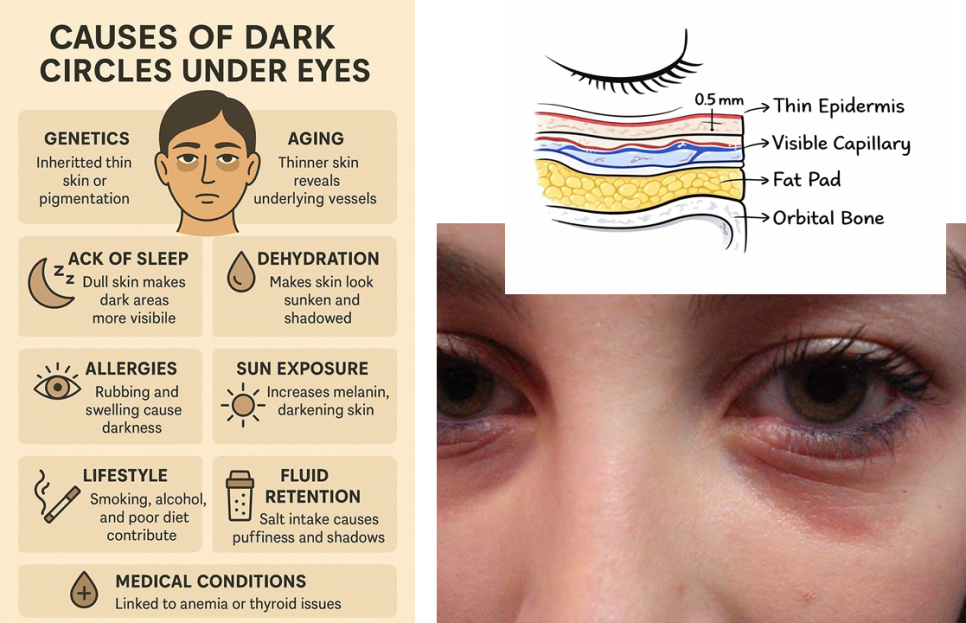
Causes of dark circles. Reasons for dark circles. Dark circles. Causes of dark circles. Source: Wikipedia
The main causes include the following:
-
Hyperpigmentation of the skin under the eyes
-
Visible blood vessels under the eyes
-
Bulging fat under the eyes
-
Hollowing of the tear troughs
-
Skin laxity that develops with age
Therefore, to improve dark circles, it is important to first identify what is causing your dark circles.
- How Much Can the Causes of Dark Circles Be Improved with Lower Eyelid Fat Repositioning? -
Lower eyelid fat repositioning is a surgery that releases the tear troughs under the eyes and moves the fat under the eyes downward,
improving both the bulging fat under the eyes and the hollowed tear troughs at the same time.
Among the various causes of dark circles, the effects of lower eyelid fat repositioning can be expected particularly in the following cases.
| Cause of dark circles | Improvement with lower eyelid fat repositioning | Expected effects |
|---|
| | |
| ① Bulging fat under the eyes | ◎ Direct improvement | Relocating the bulging fat softens the fullness under the eyes and improves dark circles caused by shadows |
| ② Hollowed tear troughs | ◎ Direct improvement | Moving the fat under the eyes into the hollowed areas reduces the hollowing and shadows of the tear troughs |
| ③ Vascular dark circles | ○ Partial improvement may be possible | When necessary, some blood vessels may be ligated during surgery to improve the dark appearance caused by the vessels to some extent |
| ④ Skin laxity and fine lines | ○ Partial improvement may be possible | Smoothing the contours under the eyes can partially improve shadows caused by skin laxity |
| ⑤ Hyperpigmentation | △ Difficult to improve through surgery | The skin’s own pigmentation may remain even after lower eyelid fat repositioning. If necessary, additional treatments such as laser therapy or nanofat grafting may be considered |
① When the fat under the eyes is bulging
When the fat under the eyes protrudes forward, a bulging area develops beneath the eyes.
This area can create shadows under the eyes, making them look darker than the actual skin tone.
By moving the bulging fat to an appropriate position through lower eyelid fat repositioning, the contours under the eyes become smoother,
which can improve dark circles caused by these shadows.
② When the tear troughs are hollowed
The deep groove that begins at the inner area beneath the eyes and extends toward the cheek is commonly called the tear trough.
When the tear troughs are deeply hollowed, shadows form and the area under the eyes looks even darker.
In this case as well, it is important not simply to remove the fat under the eyes, but to move it into the hollowed areas
so that the hollowing of the tear troughs can be improved at the same time.
This is why lower eyelid fat repositioning differs from simple fat-removal surgery.
③ Vascular dark circles can also be improved to some extent.
Some people have vascular dark circles, in which blood vessels show through because the skin under the eyes is thin.
The treatment approach in this case differs from that for hyperpigmentation or bulging fat.
Although it is difficult to completely eliminate vascular dark circles through lower eyelid fat repositioning alone,
identifying some of the blood vessels under the eyes during surgery and partially ligating them when necessary may
help improve the dark appearance caused by the vessels to some extent.
④ Skin laxity can also be improved to some extent.
In some cases, the area under the eyes looks dark because the skin has sagged and wrinkles have formed along the tear troughs.
When the bulging and hollowed areas under the eyes are addressed during lower eyelid fat repositioning,
the overall contours under the eyes become smoother, and the skin may appear somewhat more refined.
However, if reduced skin elasticity or significant skin laxity is the main cause,
it may be difficult to resolve every issue with lower eyelid fat repositioning alone, and lower blepharoplasty may be necessary.
- Conversely, Some Dark Circles Are Difficult to Resolve Through Surgery. -
The most typical example is hyperpigmentation.
People who have had allergic rhinitis since childhood or who frequently rub their eyes
often develop hyperpigmentation in the skin under the eyes, causing it to look dark.
This pigmentation does not disappear simply by repositioning the fat under the eyes.
Therefore, even if the fat under the eyes and tear troughs are successfully improved, the skin itself under the eyes may remain slightly dark.
If necessary, additional treatments such as pigment laser therapy may be considered to improve any remaining pigmentation or skin quality,
and nanofat grafting may also be considered as an adjunctive treatment when the skin is thin enough for the underlying muscle to show through.
In other words, what is important in treating dark circles is not
“eliminating all dark circles with a single surgery,”
but distinguishing which causes can be improved through surgery and which cannot.
- A Case of Dark Circle Treatment in a Woman in Her Late 20s -
This case involved a woman in her late 20s who visited the clinic with dark circles as her main concern.
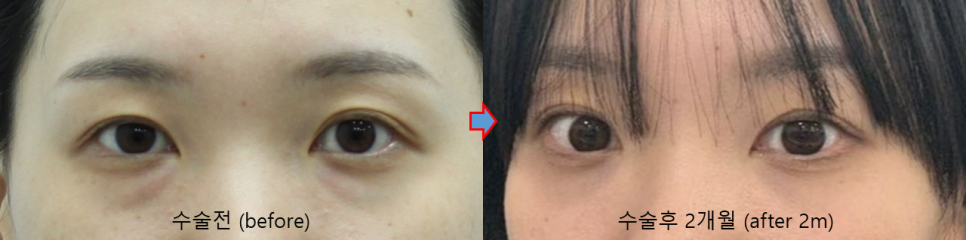
Dark circle lower eyelid fat repositioning. Dark circle treatment review. Before and after dark circle treatment. Before and after lower eyelid fat surgery. Lower eyelid fat surgery review. Before and after lower eyelid fat repositioning. Lower eyelid fat repositioning review. Model shown with consent for publication.
A close examination of the area under the eyes showed bulging fat, along with hollowing in the tear trough area.
Lower eyelid fat repositioning was therefore performed.
After surgery,
-
The previously bulging fat under the eyes was improved
-
The hollowing of the tear troughs was reduced
-
The overall contours under the eyes became much smoother
-
The dark circles that had appeared dark because of shadows were noticeably improved
However, some of the pre-existing skin hyperpigmentation remained visible.
This is a very important point in treating dark circles.
Although lower eyelid fat repositioning can substantially improve structural issues under the eyes,
surgery cannot remove the pigmentation of the skin itself.
- If You Had to Choose Just One Treatment or Surgery to Get Rid of Dark Circles, What Would It Be? -
In my experience providing consultations and performing surgery,
I feel that lower eyelid fat repositioning is a surgery that can improve multiple causes of dark circles at the same time through a single procedure.
Especially when bulging fat under the eyes + hollowed tear troughs + dark circles caused by shadows
are present together, lower eyelid fat repositioning can be a highly effective option.
Depending on the case, additional treatment for the blood vessels or the condition of the skin may also be performed.
Therefore, if I had to choose just one surgery for addressing dark circles,
I believe lower eyelid fat repositioning is one of the first procedures that can be considered.
Having dark circles does not automatically mean that the fat under the eyes should be removed or repositioned,
but lower eyelid fat repositioning is a surgery that can address many aspects of dark circles.
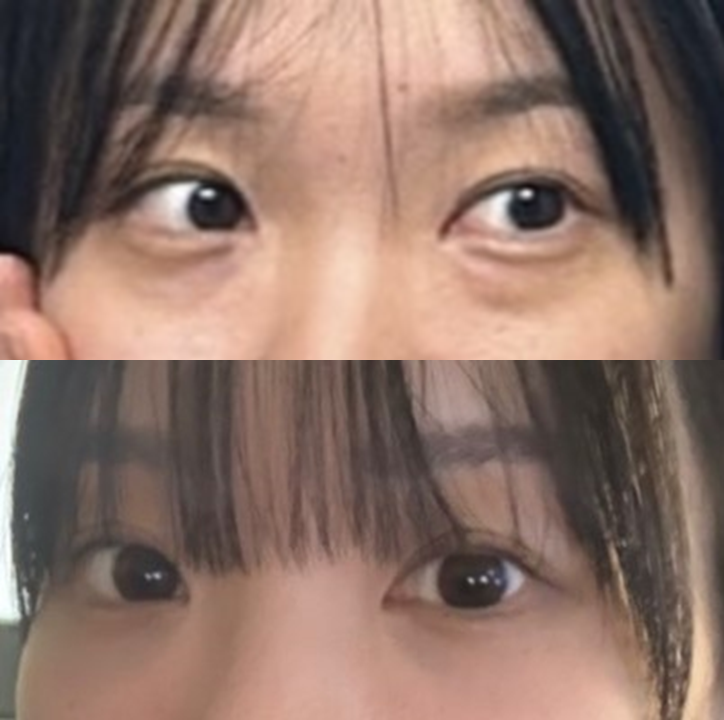
Before and after dark circle surgery. Dark circle surgery review. Before and after lower eyelid fat surgery. Lower eyelid fat surgery review. Before and after lower eyelid fat repositioning. Lower eyelid fat repositioning review. Model shown with consent for publication.
What kind of surgery is lower eyelid fat repositioning, and what is the recovery period like? Please refer to the blog post below.