There are more types of threads used for thread lifting than you might expect.
The effects and direction of lifting can vary depending not only on the thread’s material and shape, but also on the direction of the cogs, the fixation method,
and the location where the thread is applied.
Therefore, what is important in thread lifting is not simply “Which thread is the best?” but rather deciding which thread to use, where to use it, and how to use it based on the patient’s facial condition.
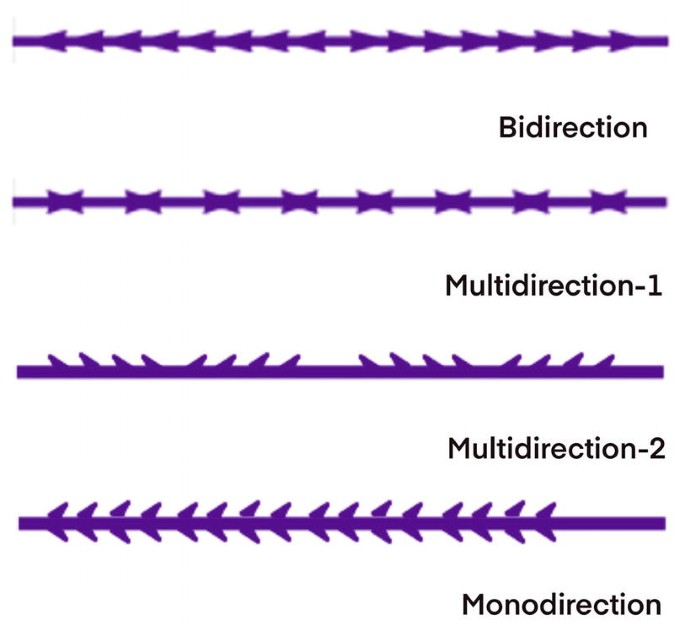
Types of threads for lifting. Thread lifting cog. Source: Understanding Lifting Threads
- The SMAS of the face is not a single tissue -
There is an important tissue layer beneath the skin of the face called the SMAS (superficial musculoaponeurotic system).
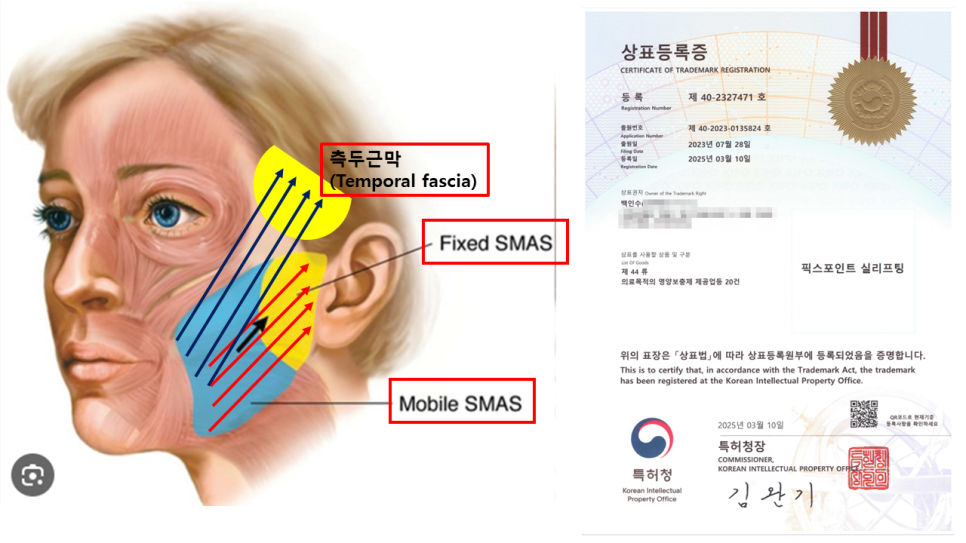
SMAS of the face. Thread lifting. Fixpoint thread lifting patent and trademark registration.
The SMAS helps support the skin and subcutaneous tissue while contributing to facial movement and expression.
When understanding thread lifting, the SMAS can be broadly considered as mobile SMAS, which can be moved to a significant extent, and fixed SMAS, which is relatively firmly anchored.
In thread lifting, simply pulling the tissue upward is important, but where a stable fixation point is created can also significantly affect the strength and durability of the lift.
In particular, it is advantageous to use the temporal fascia and fixed SMAS, which are relatively firm structures, as fixation points.
In other words, connecting → and fixing moving tissue to firm tissue is one of the important principles of thread lifting.
- A more powerful lift is possible when there is a fixation point -
It is easy to think of thread lifting simply as “a procedure in which threads pull sagging skin upward.”
In reality, however, it is important not only how strongly the threads pull the tissue, but also where that force is transferred and maintained.
When a firm fixation point is created, sagging tissue can be moved more stably in the desired direction.
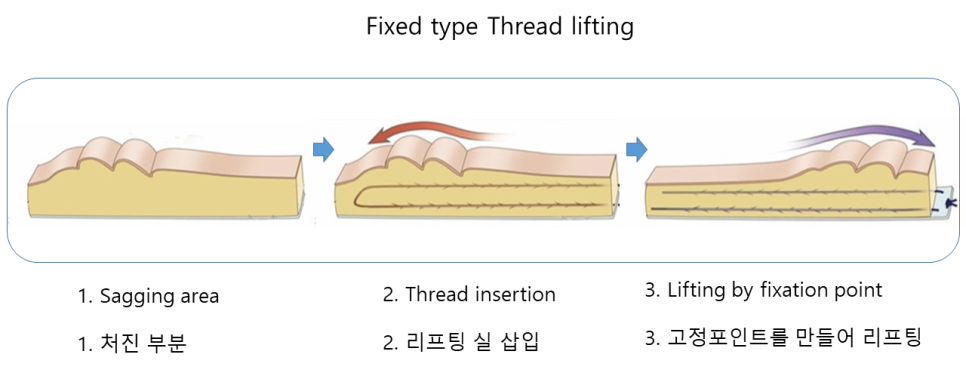
Principle of thread lifting. Thread lifting method. Fixpoint thread lifting. Source: EZ lift
- When lifting should also improve hollowed areas -
In faces in the 40s and 50s and beyond, decreased volume and hollowness in specific areas often occur along with sagging.
Hollowness or depressions in the lateral cheeks are common. In such cases, simply pulling the tissue upward can leave the hollow areas unchanged, making the face look peanut-shaped.
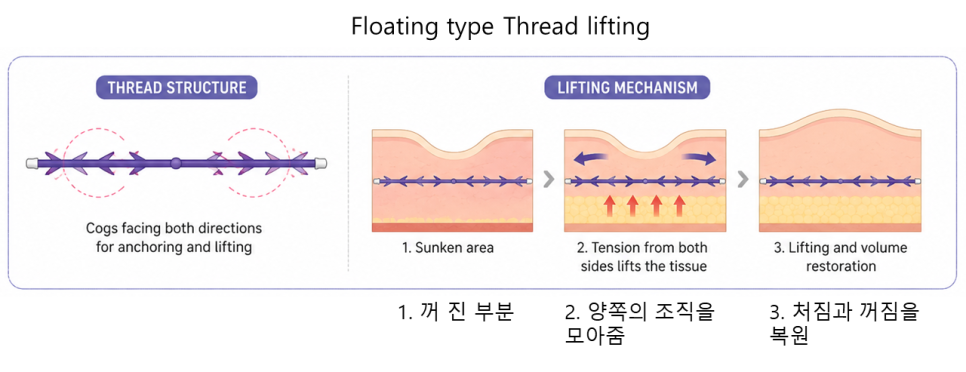
Thread lifting that fills and elevates hollowed areas. Thread lifting for lateral cheek depressions. Thread lifting for lateral cheek hollowness.
One method that can be used in this situation is to use a bidirectional cog thread with cogs on both sides as a floating type.
Because a thread with cogs in both directions can hold tissue from both sides, it can be used to gather and elevate hollowed tissue in the desired direction rather than fixing it to one specific point.
- An actual case of thread lifting in a woman in her 50s -
This patient was a woman in her 50s who showed overall facial sagging along with hollowness in the lateral cheeks.
During the procedure, fixation points were created near the temporal fascia to sufficiently lift the sagging areas of the face.
At the same time, a bidirectional cog was applied as a floating type to the hollowed lateral cheek area, moving the tissue upward while filling the hollow.
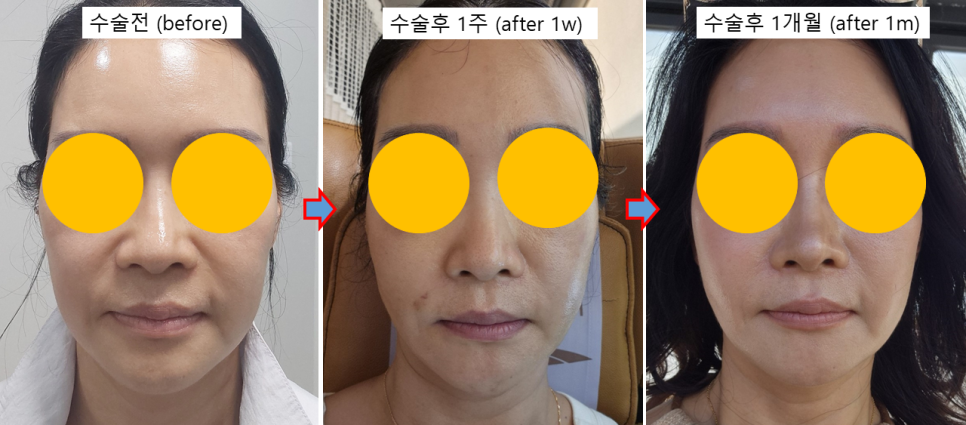
Thread lifting recovery process. Thread lifting recovery period. One week after thread lifting. Before and after thread lifting. Thread lifting review. This is a model whose consent for publication was obtained.
One week after the procedure
One week after the procedure, some swelling and bruising remained, as is characteristic of thread lifting procedures.
However, even with this swelling and bruising present, it can be seen that facial sagging had improved and the hollowed areas of the lateral cheeks had been elevated.
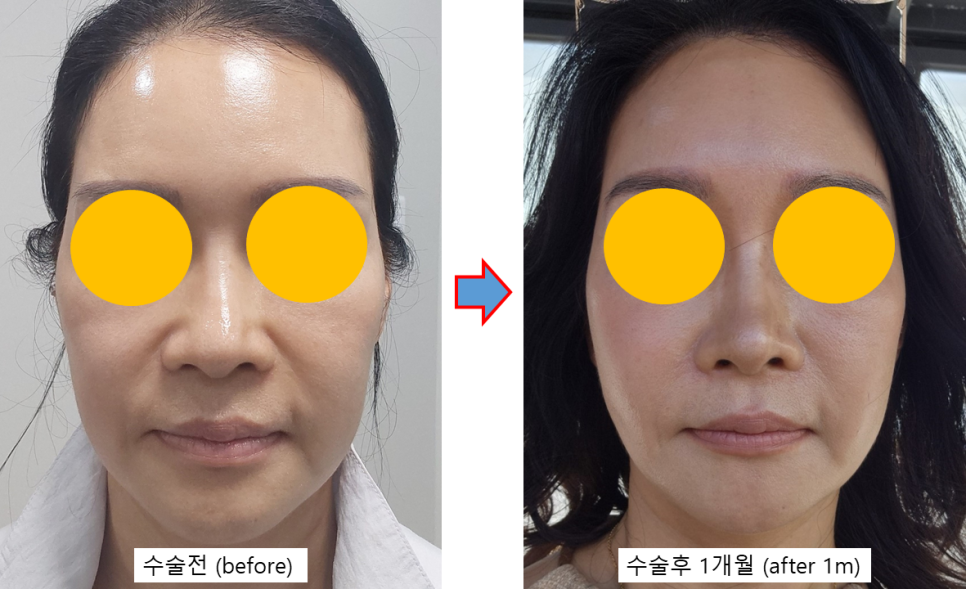
One month after the procedure
After one month, most of the swelling and bruising had disappeared, and a more natural facial contour could be seen.
In particular, the initial lifting effect did not significantly diminish over time,
and the lifted contour appeared to remain well maintained even after one month.
Ultimately, in thread lifting, what matters is not simply which thread is used,
but which thread is used in which area, in what direction, and how it is fixed.
Analyzing the patient’s sagging and hollowness together and selecting threads suited to each condition
is the key to natural-looking and effective thread lifting.
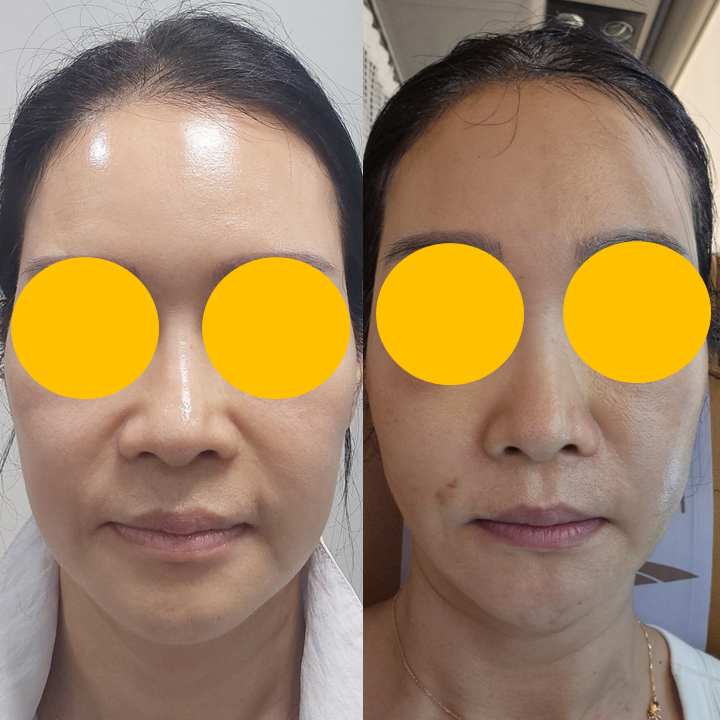
Thread lifting swelling. Thread lifting bruising. Thread lifting recovery period. Thread lifting recovery process. This is a model whose consent for publication was obtained.