How to Deal with Folliculitis After Hair Transplant Surgery
After hair transplant surgery
one of the most common
and seemingly minor
side effects is folliculitis.
Folliculitis refers to
a condition in which inflammation develops in the hair follicles due to
bacterial infection or chemical or physical irritation.
After hair transplant surgery,
many people may struggle with folliculitis.
Although it may seem mild,
if left untreated it can become more serious,
so it is important to know how to deal with it.

Today,
with Director Kim Narae of Dana Plastic Surgery,
we will take a look at how to deal with folliculitis after hair transplant surgery.

When people come for consultation before or after hair transplant surgery,
many ask about
side effects after hair transplant surgery.

One of the most common,
and in some ways seemingly mild,
side effects is folliculitis
in the transplanted area after surgery
or
folliculitis in the donor area.

First, in the case of folliculitis,
you may think of it as acne that appears on the scalp,
and when viewed with the naked eye,
there may be some redness,
or in severe cases,
pustules may form around the redness.
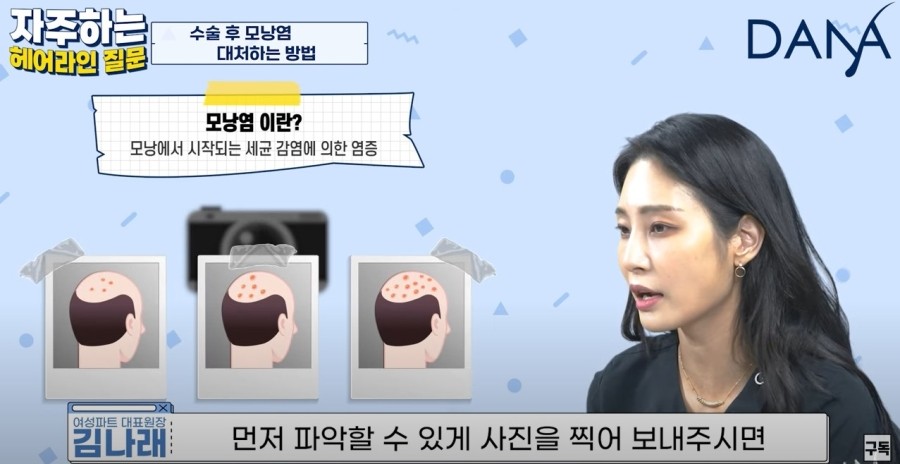
Once folliculitis appears, first take a photo
so that we can determine what condition it is in,
whether it is mild or somewhat severe.
If you send us a photo,
we can communicate with our clinic
to take appropriate action.

First of all,
looking at the causes of folliculitis:
- Resident skin bacteria on the scalp
Because resident skin bacteria exist on the scalp,
folliculitis can develop.
Resident bacteria
come in many types,
and vary depending on the environment,
lifestyle habits, and body part.

- Damage to sebaceous glands smaller than the magnifying lens can show
We wear magnifying lenses that enlarge the view more than five times
while harvesting and transplanting follicles,
but there may be partial damage to sebaceous glands
that are too small to be clearly seen even with this magnification.
In such cases,
because it affects sebum discharge,
folliculitis can develop as a result.

- Medications used in the transplanted area
Lastly,
among the injectable medications mixed and used together,
there are also medications used in the transplanted area
that may slightly increase the likelihood of causing folliculitis,
so folliculitis can occur.
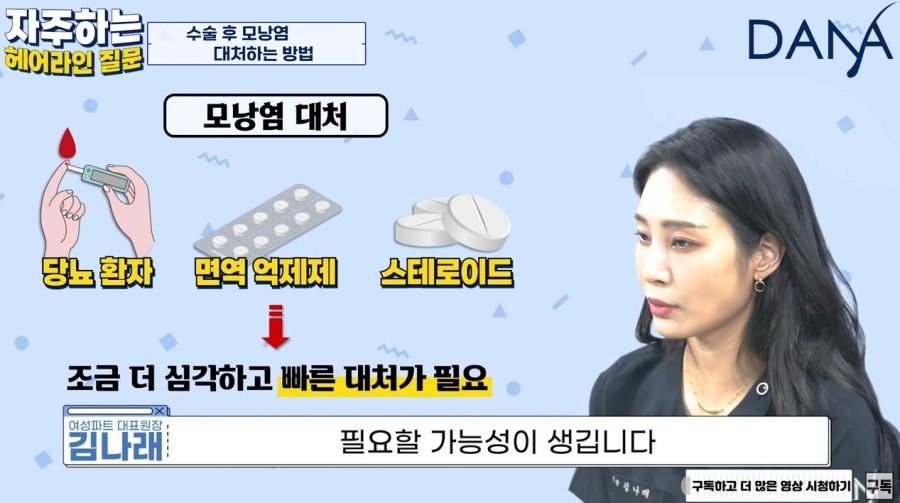 How to deal with folliculitis
In general, when folliculitis appears only occasionally,
you do not need to worry too much,
and simple measures are possible.
However, if the patient
has diabetes,
is taking immunosuppressants,
or is taking steroids,
more serious and faster action is needed.

First, if there is redness only
and no pustules,
apply povidone (disinfectant) around the folliculitis area.
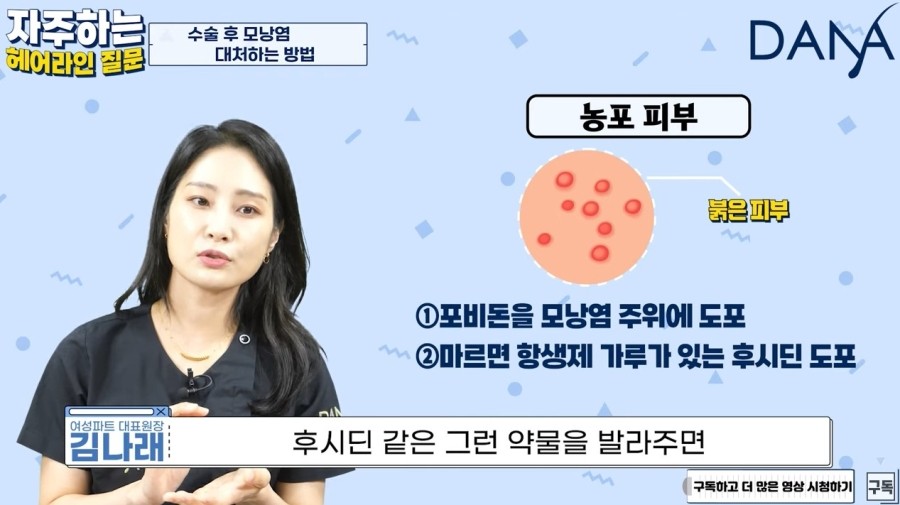
Because the disinfectant works by evaporating,
wait until it evaporates,
and once it dries completely,
apply a medication such as Fucidin,
which contains antibiotic powder,
to the area,
and you should see a quick improvement.
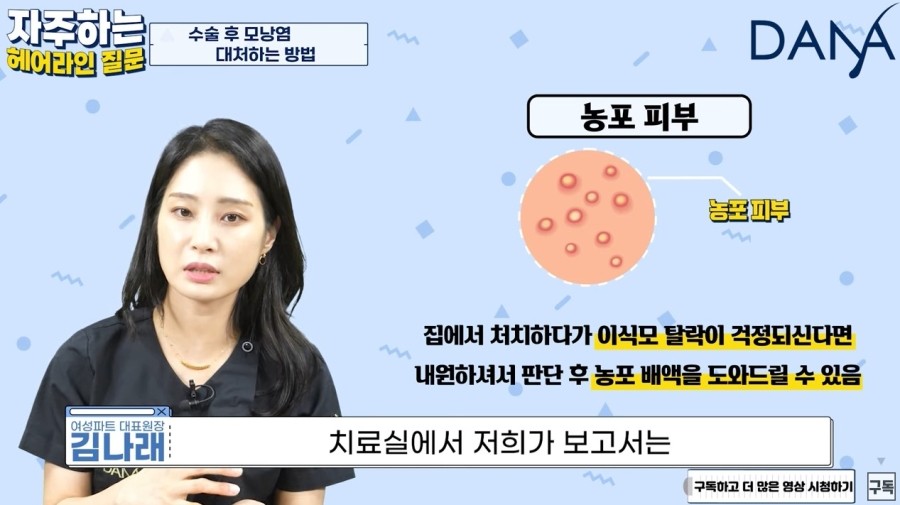
If there is a lot of pus,
drainage may be necessary.
If you are worried that the transplanted hairs might fall out while doing this kind of care,
or if you have other concerns,
we recommend visiting the clinic
and receiving treatment.

If folliculitis keeps recurring in the same area,
or if there is so much pus that it is difficult to manage at home,
we recommend visiting the clinic.
Video
Scalp acne? Redness? Pustule formation? 🌱How to deal with folliculitis after hair transplant📝ㅣDana Plastic Surgery (DA...
If you have any other questions, please apply for a consultation easily through the link below! 👉Location: 10th Floor, Samju Building, 606 Gangnam-daero, Gangnam-gu, Seoul, Dana Plastic Sur...
youtu.be
So far,
we have looked at how to deal with folliculitis after hair transplant surgery.
If you have any further questions or want more detailed information,
please visit Dana Plastic Surgery
and get answers about hair transplantation
through accurate consultation and diagnosis.