Hello. Today, let’s take some time to learn about how to handle delayed bleeding that can occur at the back of the head or the transplanted area.

First of all, among people who say they have bleeding after surgery,
in most cases, a small amount of pooled blood comes out later along with the medications used during the procedure.

If follicular unit extraction was performed from the back of the head, and you sleep with that area touching the pillow,
the medication pooled inside may come out.

In such cases, this may be accompanied by discharge, as when fluid oozes from a wound.
For an accurate assessment, you should take a photo and show it to the hospital where you had the surgery.

Next, in cases where surgery was performed using the strip method,
unlike the non-incision method, the wound is sutured, but together with a small amount of blood pooled inside,

anesthesia or various medications used during the procedure may also flow out.

First, the most effective way to stop bleeding from capillaries is “pressure.”

For pressure, if you have gauze at home,
you can make the gauze thicker, place it over the bleeding area,
and lie down so that the area is pressed.

You can also use a clean towel, but it needs to have some thickness for pressure to be applied,
so if you apply pressure for about 5 minutes, in most cases the bleeding will stop.

Very rarely, it may be important to return to the clinic for a more detailed observation
and to receive the appropriate treatment,
so if there is bleeding, do not leave it for several hours. Contact the hospital right away
and receive the proper treatment according to the situation.
💥Summary💥
Q. If bleeding occurs at the back-of-head donor area or the transplanted area after surgery
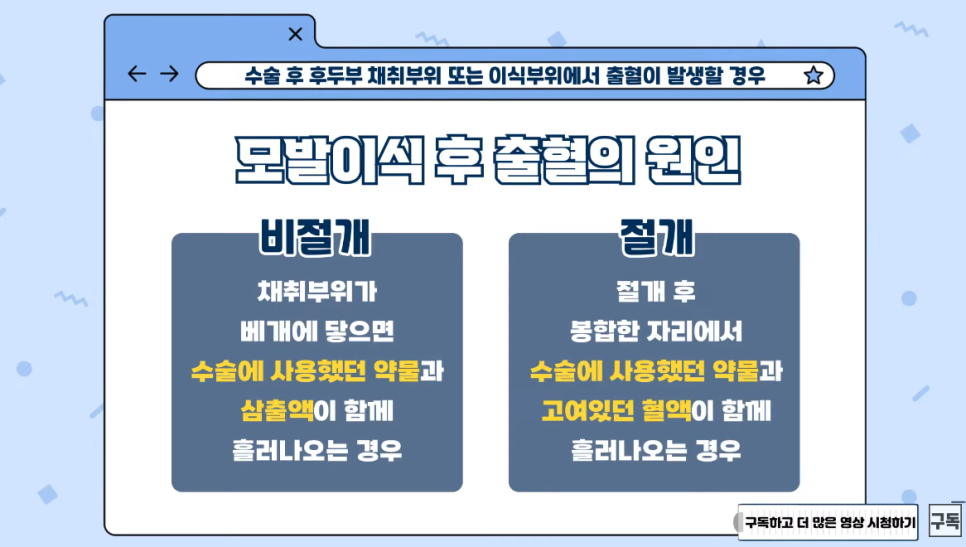
Non-incision method: If the donor area touches the pillow, the medications used during surgery and the exudate may flow out together.
Strip method: After the incision and suturing, the medications used during surgery and the pooled blood may flow out together from the sutured area.
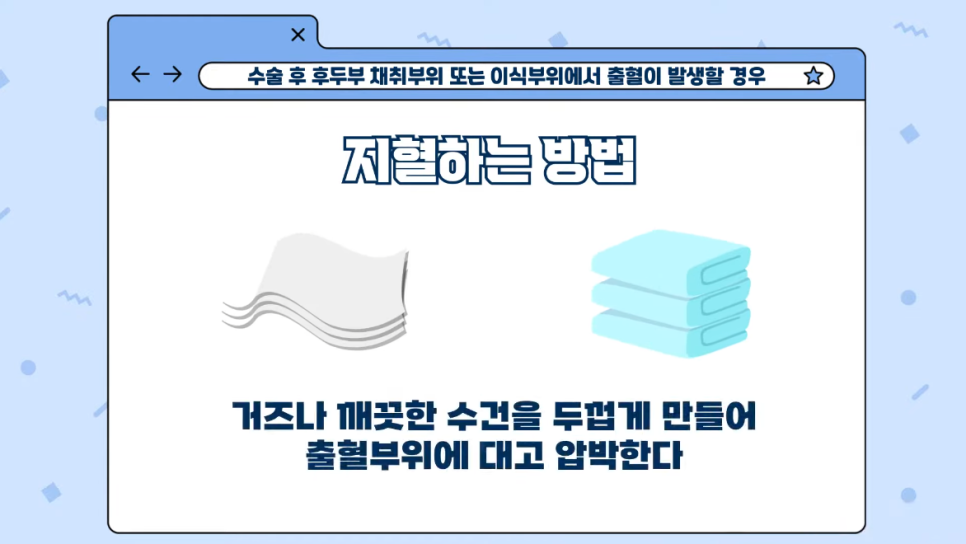
Q. How to stop the bleeding
Make gauze or a clean towel thick and press it against the bleeding area.
Although the pressure method described above can be used, in rare cases it may be important to visit the hospital
and receive the appropriate treatment, so if bleeding occurs at the back of the head, it is best to contact the hospital.
Today, we learned how to respond if bleeding occurs at the back-of-head donor area or the transplanted area after hair transplant surgery.
Please make sure you are familiar with the response methods explained above and handle the situation accordingly, or if you find it difficult to do so,
do not hesitate to visit the hospital where you had the surgery and receive appropriate treatment.
If you would like to know more, please check Danas Plastic Surgery’s YouTube channel.
https://www.youtube.com/watch?v=pik4q5tNlno