Hello, this is Dana Plastic Surgery.
Today, we would like to take some time to look into the relationship between cancer treatment and hair loss,
which many people are more interested in than you might expect and ask about frequently.
Hair loss related to cancer treatment includes hair loss that occurs during cancer treatment,
and hair loss that does not recover and remains after cancer treatment.
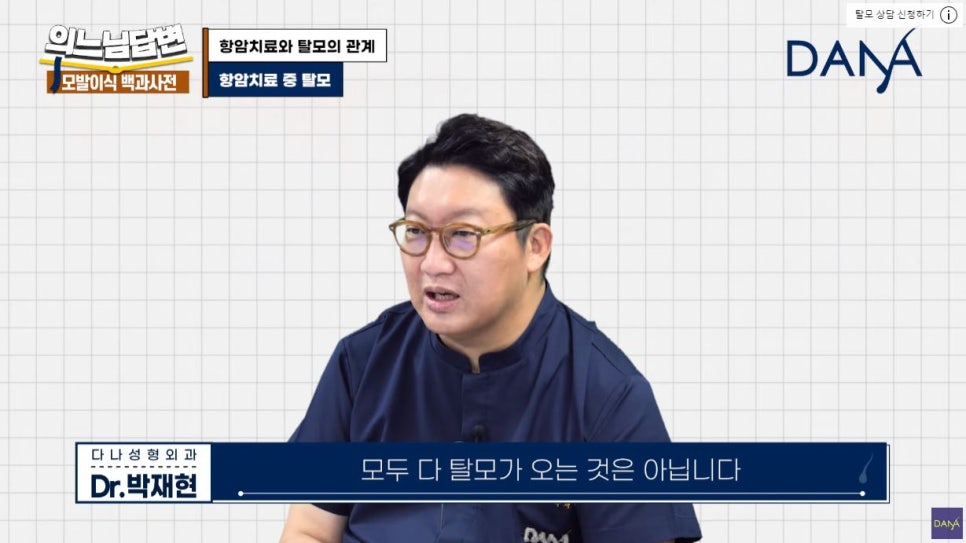
First of all, not every cancer treatment patient experiences hair loss.
Some patients do experience hair loss, and the pattern can vary slightly, such as hair falling out in certain areas or overall.

In statistical terms,
about 6–70% of cancer treatment patients reportedly experience hair loss.

To explain the typical course of hair loss after cancer treatment,
hair loss begins about 2 to 3 weeks after the administration of anticancer drugs.
A gradual recovery starts around 4 to 6 weeks later, which is the typical course of hair loss after cancer treatment.
Anticancer drugs can affect all cells in the body.
So, in addition to the hair on the head, hair loss can also occur in the eyebrows, abdominal hair, chest hair, underarm hair, beard, and perineal area.
Hair loss caused by chemotherapy begins to recover gradually
after treatment ends and about one to one and a half months have passed.
However, in some cases, it can become permanent hair loss.
Usually, it is left in a state where the hair volume has decreased significantly or the hair has become very thin.
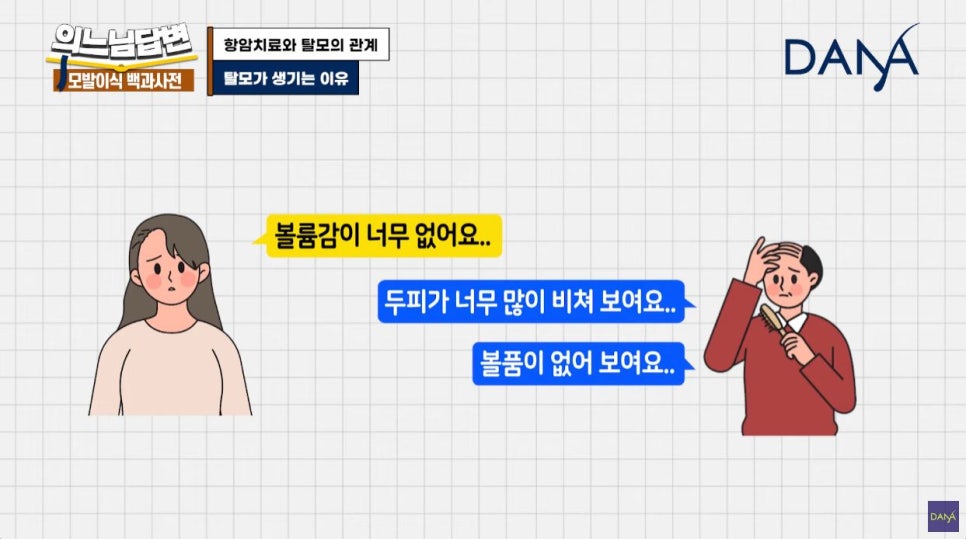
In most cases, when patients come to our clinic after cancer treatment, the things they mention are:
"There is so little volume."
"My scalp shows through too much."
"It looks unappealing."
Even though going through cancer treatment itself is difficult, they may also feel depressed because of their changed appearance,
feel that they have lost their attractiveness,
and be unable to accept how they look, leading to psychological inferiority or withdrawal.
What is the cause of hair loss that remains irreversibly after cancer treatment?
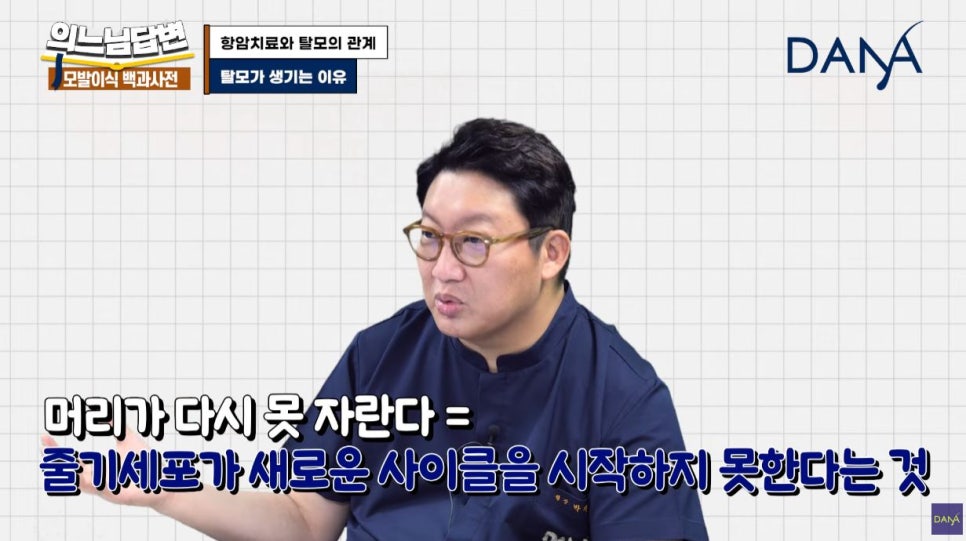
If the hair cannot grow back,
it means that the stem cells cannot begin a new cycle.
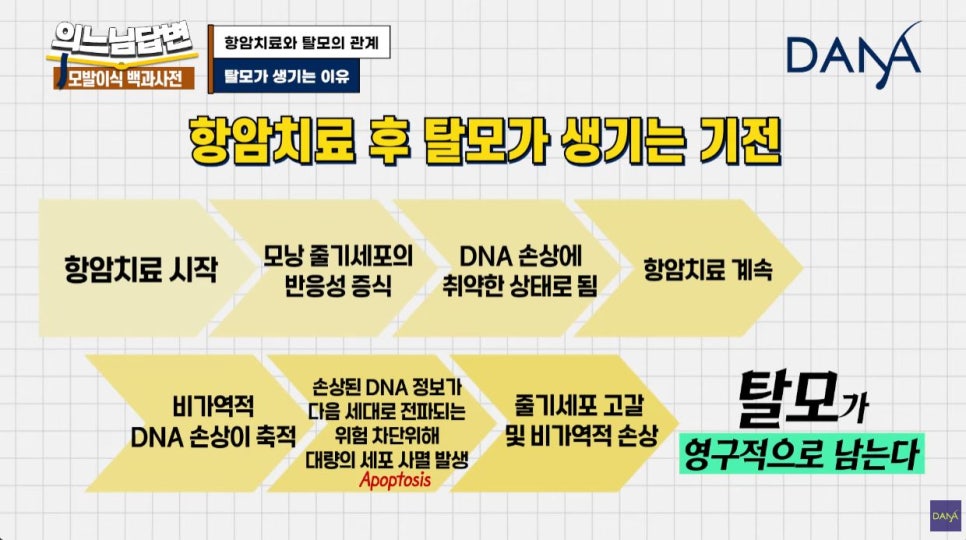
Looking at the mechanism of hair loss after cancer treatment,
when cancer treatment begins, tissues are damaged. To repair this, stem cells undergo reactive proliferation,
and at this time they become vulnerable to DNA damage. When cancer treatment is repeated, irreversible DNA damage accumulates,
and to prevent the risk of damaged DNA information being passed on to the next generation, a large number of cells undergo apoptosis on their own.
As stem cells are depleted and tissue regeneration does not occur, permanent hair loss develops.
Next time, we will take a look at hair care methods to help prevent hair loss during cancer treatment!
If you are more curious about the causes of hair loss after cancer treatment, please refer to the [Dana Plastic Surgery YouTube channel]!
https://www.youtube.com/watch?v=mb5H8_qS4TM