Hello,
This is Dana Plastic Surgery!
This time, we would like to share information about side effects that can appear after hair transplant surgery and how to handle them.
What side effects can occur after hair transplant surgery?
What side effects can occur after hair transplant surgery?
One of the side effects that can occur after hair transplant surgery is hair transplant donor-site shedding.
This refers to shedding in the donor area.
Then what exactly is hair transplant donor-site shedding?!
Hair transplant donor-site shedding
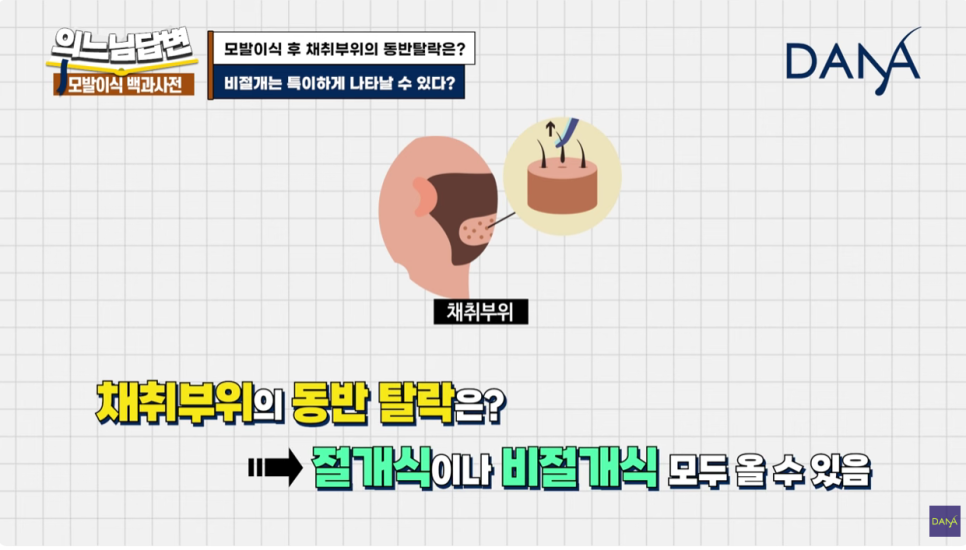
Hair transplant donor-site shedding does not occur in the transplanted area, but refers to shedding in the donor area.
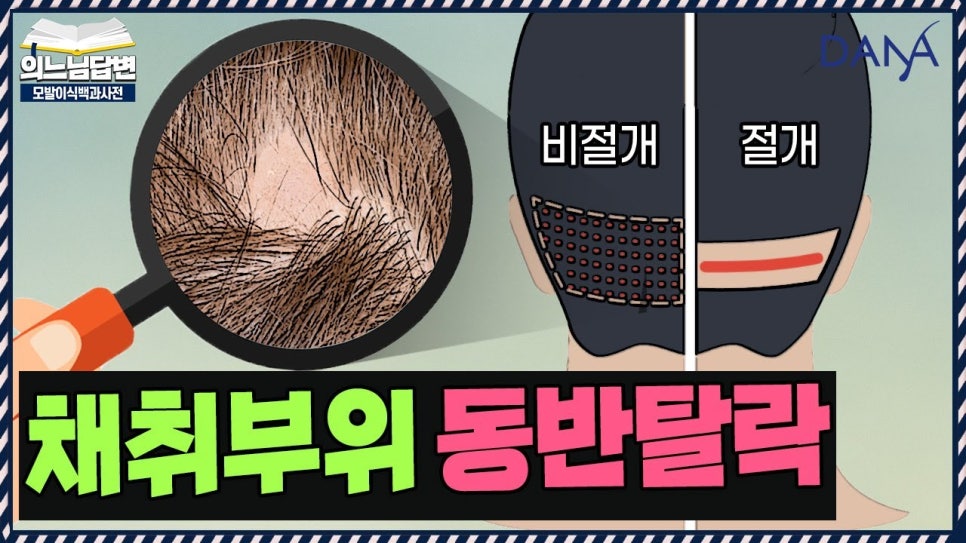
Donor-site shedding can happen with both strip and non-shaven methods,
and for the non-shaven method, the more grafts are harvested and the larger the punch size used, the more hair transplant donor-site shedding may occur.
However, this correlation has not been clearly proven.
Strip / non-shaven hair transplant donor-site shedding?

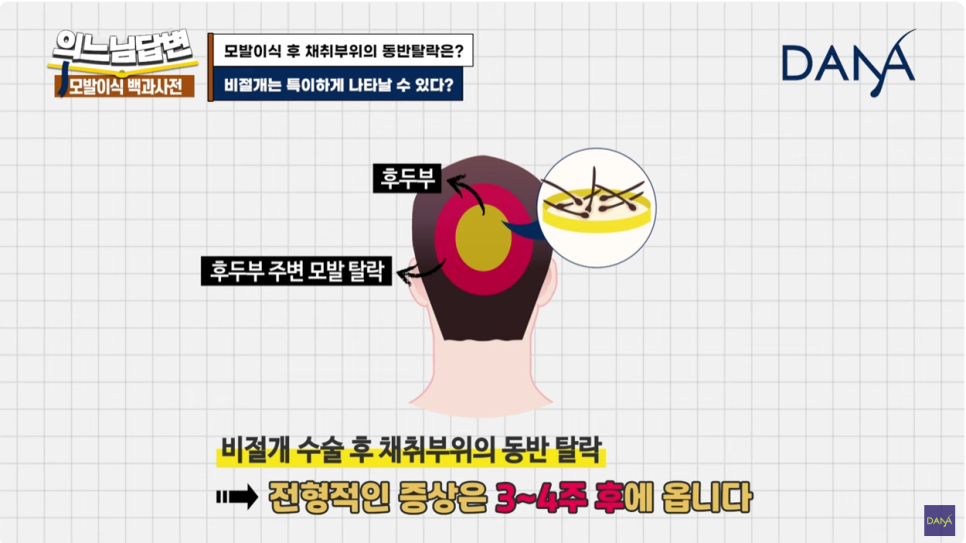
In addition, donor-site shedding that occurs in the occipital area after a non-shaven procedure shows a somewhat distinctive pattern.
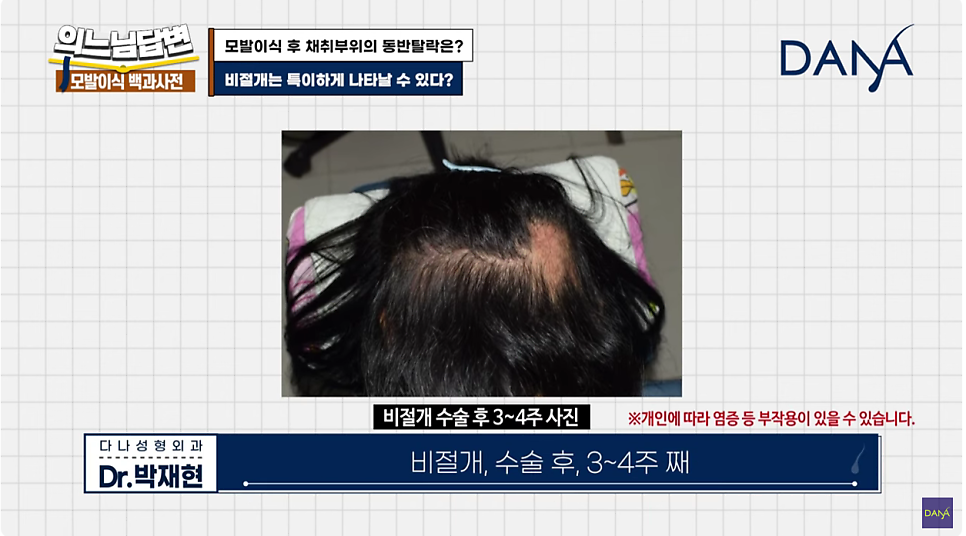
(The example photos above show hair transplant donor-site shedding.)
The typical symptom of donor-site shedding after a non-shaven procedure occurs 3 to 4 weeks later.
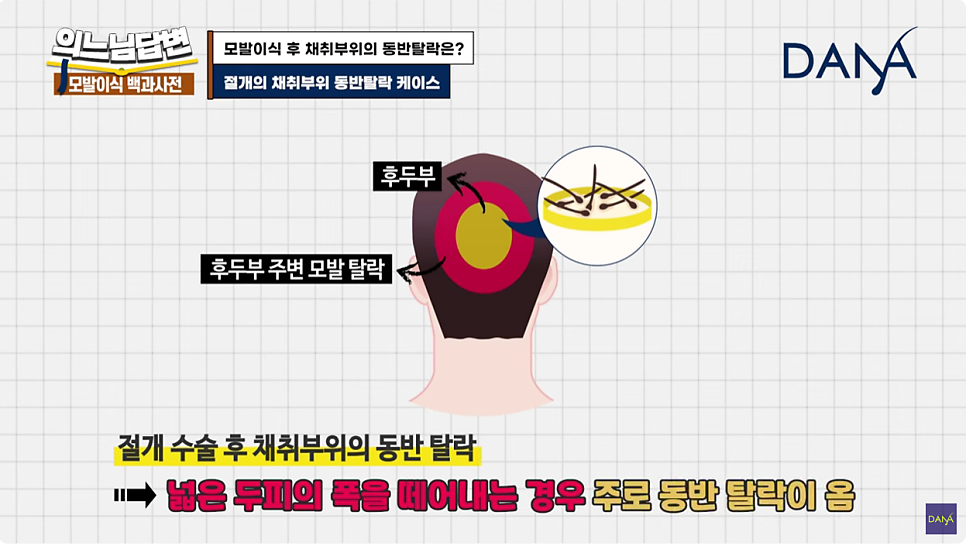
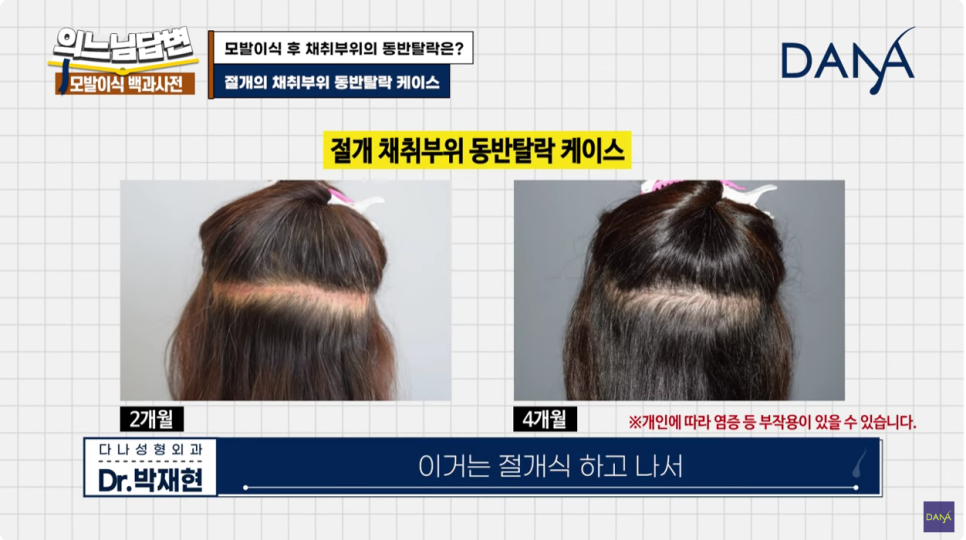
After strip surgery, donor-site shedding usually occurs when a wide strip of scalp is removed.
In the example photos of hair transplant donor-site shedding above, the left is from 2 months after surgery and the right is from 4 months after surgery.
Looking at the example photos, some patients may worry and think a large scar could remain.
However, unlike the appearance at 2 months, when donor-site shedding begins,
by 4 months, you can confirm that the donor-site shedding has been completely resolved, so there is no need to worry too much.

If you look at the example photos of donor-site shedding prepared by Dana Plastic Surgery,
you can see that the timing and pattern of donor-site shedding differ somewhat between the non-shaven and strip methods.
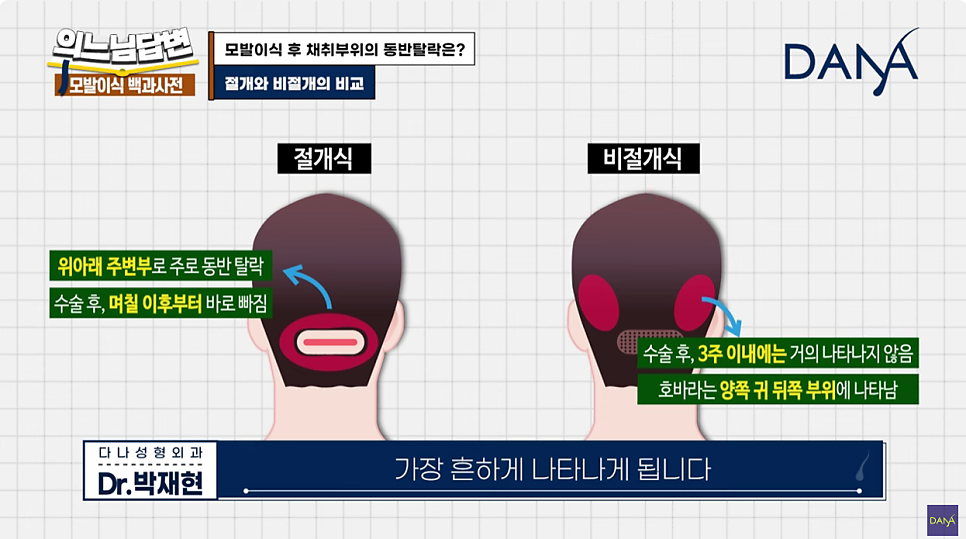
With the strip method, donor-site shedding mainly appears around the upper and lower areas near the incision.
If the shedding symptoms last a long time, they may continue for about 5 to 6 weeks.
With the non-shaven method, it rarely appears within 3 weeks after hair transplant surgery,
and typical donor-site shedding symptoms begin around 3 to 4 weeks later.
Shedding symptoms mainly appear in the Hoba area,
and the Hoba area is where donor-site shedding most commonly appears behind both ears.
Because the hair falls out in a somewhat round shape, people may mistake it for alopecia areata when they see the shedding,
so be careful not to misunderstand it!
Treatment for hair transplant donor-site shedding?

In conclusion, after hair transplant surgery using either the strip or non-shaven method,
many people worry that their hair may not grow back when donor-site shedding occurs,
but there is no need to worry about hair transplant donor-site shedding!!
More than 99% of hair transplant donor-site shedding grows back after about 4 months, so there is no need to worry,
and if you are especially concerned about donor-site shedding,
it is best to contact the hospital where the hair transplant surgery was performed and receive appropriate care.
However, since donor-site shedding usually recovers on its own, there is no need to worry too much!
Why does hair transplant donor-site shedding happen?

Sometimes, people wonder whether donor-site shedding is not actually donor-site shedding, but rather something caused by the hair growth cycle.
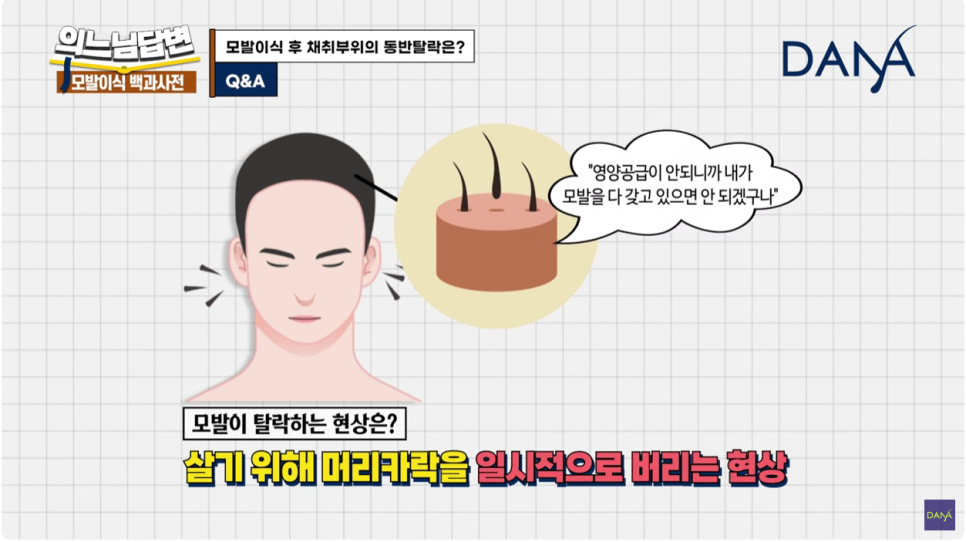
Hair shedding refers to the temporary release of hair to survive.
Using plants as an analogy, it is like leaves falling and then new shoots growing and flowers blooming again; it refers to hair temporarily shedding and then growing back.
For that reason, donor-site shedding can be understood as happening for this reason.

In most cases, transplanted hair also enters a resting phase first.
Once the resting phase ends and 3 to 4 months have passed after hair transplant surgery, you can see the hair starting to grow.
In this way, after 3 to 4 months have passed following hair transplant surgery, the donor-site shedding symptoms that occurred in the strip or non-shaven donor area also improve,
and as time passes, hair will begin to emerge in the areas where donor-site shedding occurred!
So, thinking that time heals all is the best approach, and if you wait with a relaxed mind,
you will see that donor-site shedding resolves on its own without major problems, so there is no need to worry👍🏻
We took some time to look at side effects that can occur after hair transplant surgery, which are concerns for people undergoing hair transplant surgery, and how to handle them. Was this helpful?!
On the [Dana Plastic Surgery YouTube] channel, there is a wide range of useful information related to hair transplant surgery in addition to donor-site shedding.
If you need various kinds of information besides donor-site shedding, please click the link below!!
👇🏻👇🏻
https://www.youtube.com/watch?v=V5ihWxIn3jI