Hello
This is Dana Plastic Surgery!
There is a question many people who have undergone hair transplant surgery often ask.
It is, “Do I really need to take medication after a hair transplant?”
Let’s take a detailed look at the need for medication to maintain transplanted hair in a healthy state, the reasons for taking it, and the problems that can arise if you do not take it.
Is Taking Hair Loss Medication Essential After Hair Transplant?

Many female patients also wonder
whether they need to take hair loss medication after hair transplant surgery.

Taking hair loss medication after hair transplant surgery is
something that applies only to male hair loss patients.
Female patients who undergo hairline surgery
do not need to take hair loss medication.

The reason male hair transplant patients still need to
take hair loss medication after surgery is due to something called the donor dominance principle.
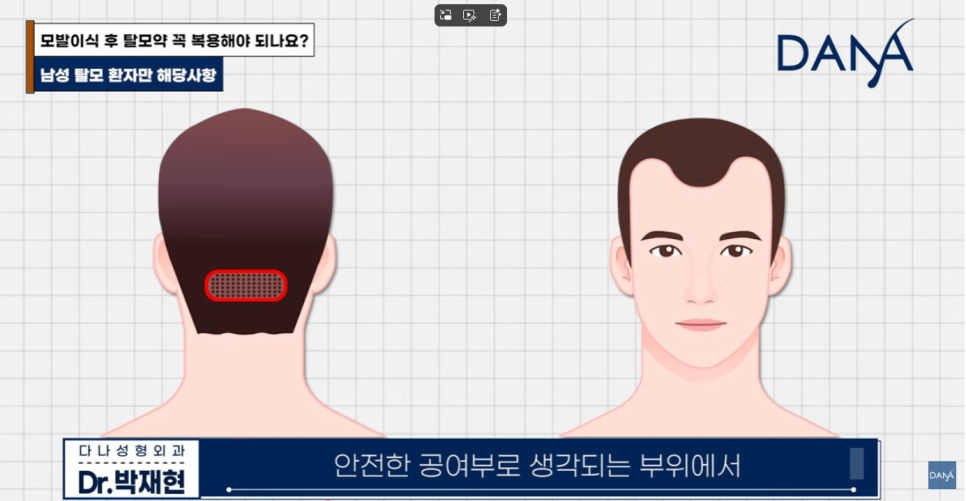
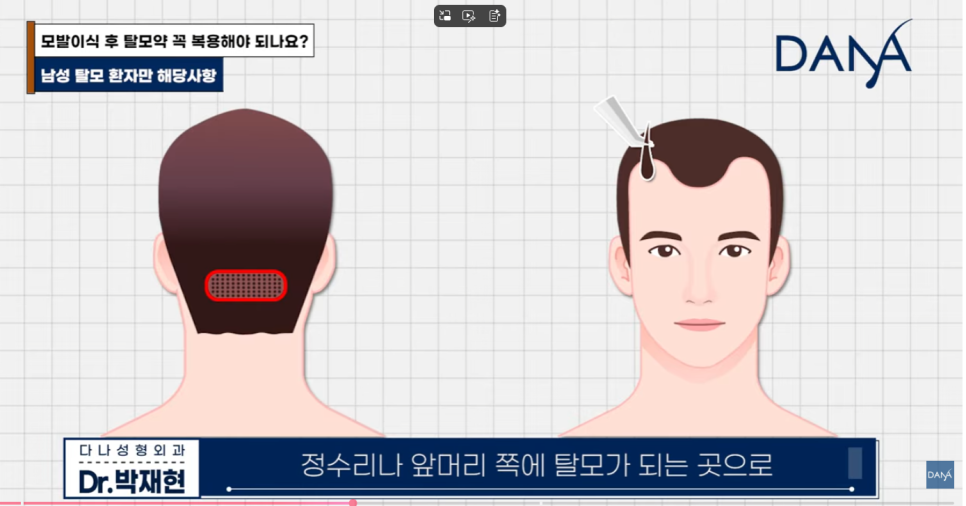
Hair transplant surgery
is a procedure that moves healthy follicles from the occipital area, where hair loss does not occur,
to the area affected by hair loss.

Hair transplanted from the back of the head retains the characteristics of the back of the head.
The transplanted follicles maintain their genetically hair-loss-resistant traits, so they are likely to continue growing for life.
However, the original hairs that were not transplanted are still affected by the hair loss gene.
Problems That Can Occur If You Don’t Take Hair Loss Medication After Hair Transplant
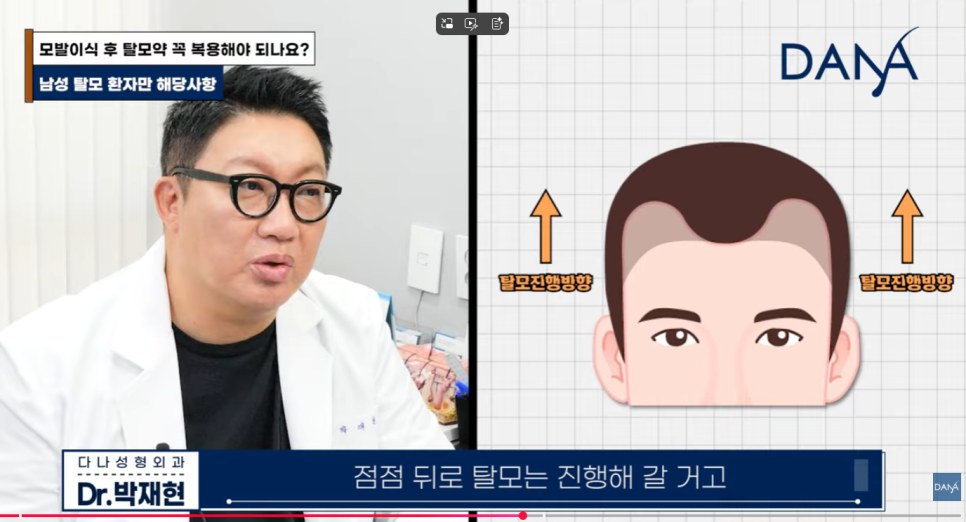
The original hairs remaining around the transplanted hair may continue to fall out.
This relatively reduces the effect of the transplant and lowers satisfaction with the final result.
For example, if you had a hairline correction procedure,
the existing hair around the transplanted area may continue to fall out,
causing the hairline to recede again.
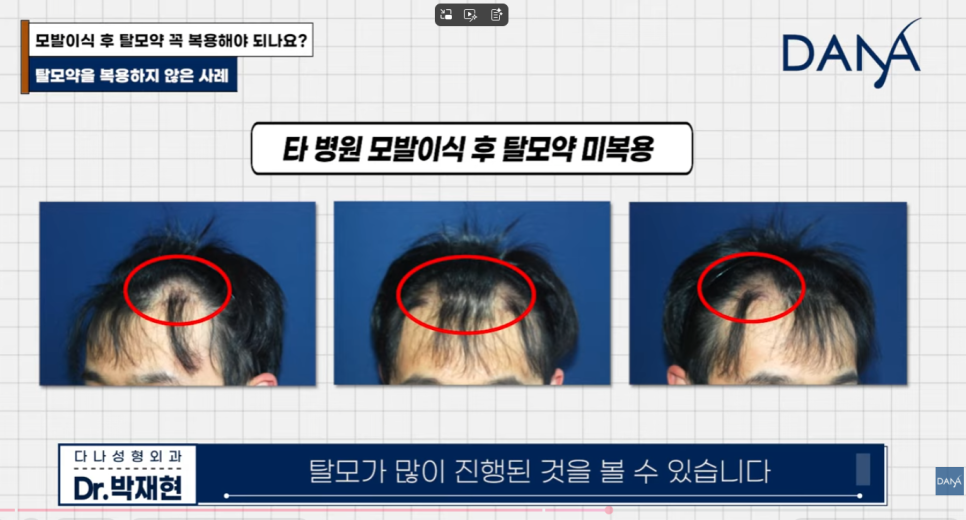
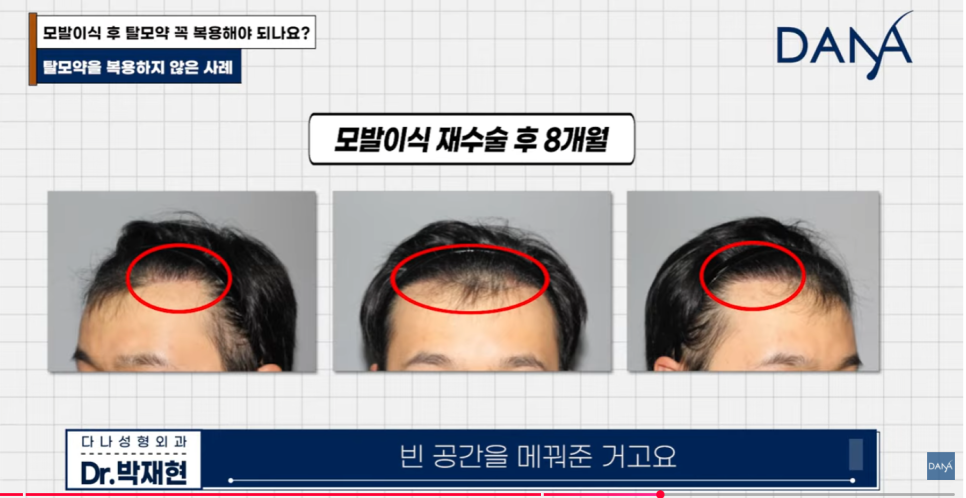
The patient in the photo above underwent a hair transplant a long time ago
and did not take hair loss medication.
As shown in the photo, the hair behind the M-shaped area
has progressed significantly in hair loss.
The likelihood of needing a repeat procedure increases due to further hair loss.
Hair transplant uses a limited resource (follicles from the occipital area), so unlimited repeat surgery is not possible.
Therefore, it is important to preserve the effect of the first surgery for as long as possible.
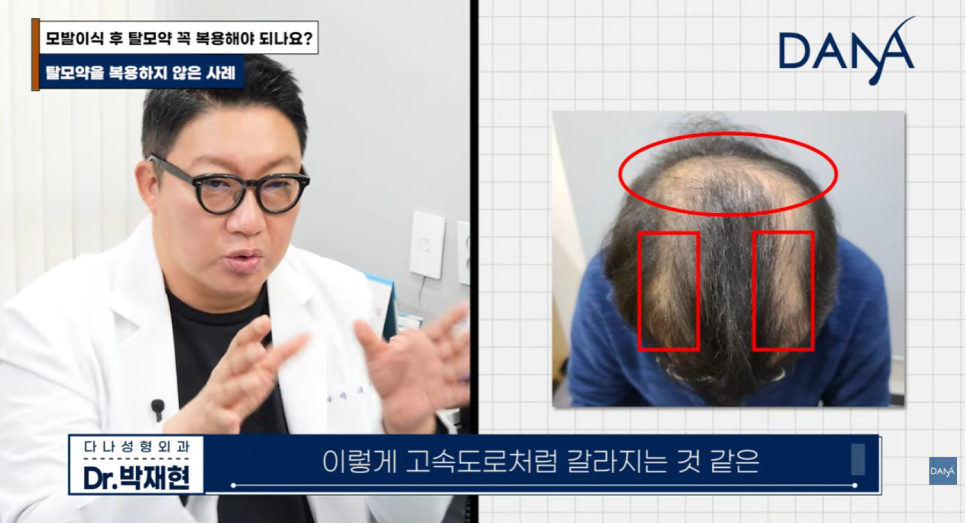
In the long term, the hair loss pattern may worsen.
Hair loss that progresses naturally without medication continues over time,
so eventually a larger additional procedure may be needed.
In this way, after hair transplant,
if you do not take hair loss medication,
additional hair loss other than the transplanted hair cannot be prevented.

Therefore, additional hair loss must be prevented through medication.
Why Taking Hair Loss Medication After Hair Transplant Is Important
Hair transplant is not something that ends with surgery alone.
After surgery, the survival of the transplanted hair and ongoing management are very important.
In particular, taking hair loss medication is essential for extending the life of transplanted hair,
and for preventing the remaining natural hair from falling out further.
Propecia (Finasteride) and Avodart (Dutasteride)
There are two medications most commonly prescribed after hair transplant.
They are Propecia and Avodart.
Propecia contains finasteride,
which inhibits the conversion of testosterone, the male hormone, into DHT (dihydrotestosterone).
DHT is the main cause of hair loss, and blocking it slows the progression of hair loss.
It is generally taken once a day at 1 mg,
and effects usually begin to appear 3 to 6 months after starting the medication.
Avodart contains dutasteride,
and provides a stronger DHT-suppressing effect than Propecia.
It is taken once a day at 0.5 mg and is prescribed for patients who do not respond to Propecia
or who want a stronger effect.
Duration of Hair Loss Medication After Hair Transplant
So how long should the medication be taken?
The general recommendation from medical professionals is
to take it for at least one year after hair transplant, and preferably for life.
The first year immediately after surgery is especially important.
During this period, taking hair loss medication helps stabilize the follicles and minimize additional hair loss.
Even after that, continued use can help maintain the transplant effect for as long as possible.
Because individual differences exist, it is important to discuss this thoroughly with the medical team in charge
and create a medication plan for hair loss that comprehensively considers your hair loss progression, family history, and current hair condition.
Precautions When Taking Hair Loss Medication
There are several things to keep in mind when taking Propecia and Avodart.
First, they must be taken only under a doctor’s prescription,
and the dosage should not be adjusted or discontinued arbitrarily.
Second, side effects such as decreased sexual function and breast tenderness may occur in some patients,
so if side effects are suspected, the medical team should be informed immediately.
Third, the effectiveness and side effects of the medication should be monitored through regular consultations with the medical team.
Aftercare Is the Key to Hair Transplant Success
The surgery itself is important, but post-operative care determines the final result.
Taking hair loss medication is an essential measure to protect transplanted hair and preserve the remaining natural hair.
If you are considering a hair transplant, please seek sufficient consultation not only on the surgical technique but also on the long-term post-operative care plan,
and make your decision accordingly.
If you have any questions, we recommend creating an optimized treatment plan for yourself
through an individual consultation with a specialist.
https://youtu.be/E40oyTYTx5o?si=t7C1ha9JNsfJHX2I