Hello!
This is Dana Plastic Surgery, a hospital specializing in hair transplant surgery!
Let’s talk about one of the most confusing parts for patients considering a hair transplant: the surgical method.
Why do hospitals recommend different surgical methods?

When you go in for consultations, some hospitals recommend the incision method,
while others recommend the non-incision method.
How can you find the surgical method that is right for you?
Let’s take a detailed look at why hospitals have different criteria for recommending incision and non-incision methods.
Characteristics and Advantages of Incision Hair Transplant
Among hair transplant surgeries,
the most traditional and proven method is the incision hair transplant.
Incision hair transplant is a procedure in which a section of the back of the head is cut to collect skin tissue,
and individual follicles are then separated under a microscope and transplanted to the hair-loss area.
The biggest advantage of the incision method is its high graft survival rate.
Because the harvested tissue is less likely to be damaged, and because precise handling is possible during the follicle separation process,
the survival rate of the incision method generally reaches 95% or higher.
In addition, the surgery cost is lower than the non-incision method, and the surgery time is shorter.
Another benefit is that a larger number of follicles can be harvested,
making it suitable for patients with extensive hair loss who need a large-volume transplant.
Characteristics and Advantages of Non-Incision Hair Transplant
Non-incision hair transplant does not cut the back of the head
and uses a special punch tool
to harvest individual follicles.
The biggest advantage of the non-incision method is that no linear scar remains on the back of the head.
This makes it suitable for patients who are concerned about scarring or who often wear short hairstyles.
In addition, compared with the incision method, the non-incision method causes less pain and allows faster recovery, so patients can return to daily life more quickly.
Daily activities are possible about 2 to 3 days after surgery, and vigorous exercise is possible about a week later.
What are the criteria for choosing a hair transplant method?
First, the recommended method varies depending on the patient’s degree and extent of hair loss.
Because the incision method can harvest enough follicles at once,
it is more efficient for patients with extensive hair loss (hair loss stages 5 to 7).
On the other hand, the non-incision method can be said to be a better option for patients with mild to moderate hair loss (hair loss stages 2 to 4).
Second, the recommended method varies depending on the patient’s scalp characteristics.
For patients with a strong and healthy scalp, the incision method can be performed without problems,
but for patients whose back-of-head scalp is thin or sensitive, or for those whose constitution has weaker scar-healing ability,
the non-incision method is safer.
Third, it may vary depending on the patient’s occupation and lifestyle.
If a patient wears long or medium-length hair, the scar can be sufficiently hidden even with the incision method.
On the other hand, for soldiers, athletes, or people who frequently engage in intense activity and for whom short hair is required for work,
the non-incision method may be more advantageous.
The fourth is budget.
Because the incision method is 30 to 40% cheaper than the non-incision method,
it may be recommended for patients with a limited budget.
Reasons Why Different Hospitals Recommend Different Methods
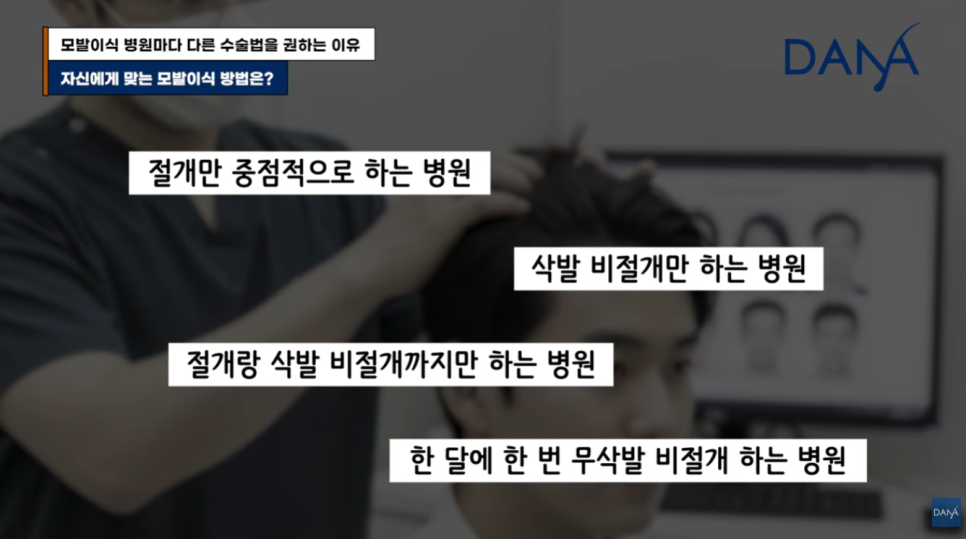
Then why do the recommended surgical methods differ from hospital to hospital?
This may be influenced by the hospital’s technology and experience.
Hospitals that have focused on the incision method for a long time tend to recommend the incision method.
On the other hand, hospitals specialized in the non-incision method may emphasize its advantages and recommend it.

At Dana Plastic Surgery, we are proficient in all techniques in the hair transplant field,
so we can recommend the surgical method that is truly appropriate for the patient.

Neither the incision method nor the non-incision method is absolutely better.
Each simply has its own advantages and disadvantages depending on the patient’s situation.
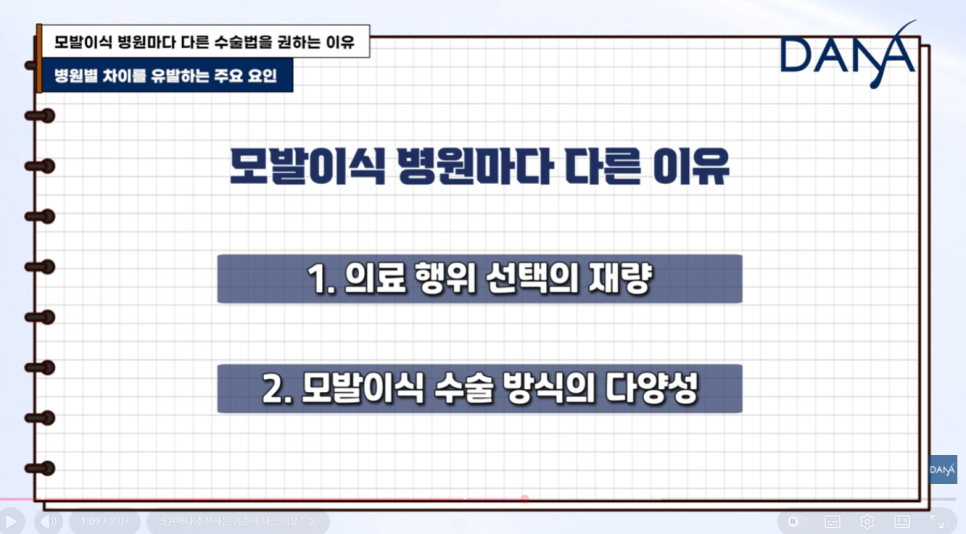
The reason recommendations differ from hospital to hospital is
that multiple factors work together, including available technology, the patient’s condition, and the hospital’s philosophy.
It is important to visit a medical team with abundant surgical experience and a high level of understanding of the patient’s various situations.
Also, patients should not simply follow cost or a hospital’s recommendation,
but should make a decision based on objective evidence and sufficient consultation.
You should accurately understand the degree and extent of your hair loss,
and choose the optimal method for yourself according to your scalp and physical characteristics,
your occupation, and your lifestyle.
If you consult at least 2 to 3 hospitals and gather their opinions, you can make an objective judgment.
If every hospital recommends the same method for the same patient,
that is likely to be the correct answer.
Since hair transplantation is an important decision that you may only make a few times in your life,
I hope you make a careful and rational choice with no regrets!
https://youtu.be/p98-2-ApK8I?si=tsshvdp_OJJ7JOq9