Hello!
This is Dana Plastic Surgery, a hospital specializing in hair transplant surgery!
Today, I’d like to talk about treatment for female pattern hair loss!
What is female hair loss?

Female hair loss is, of course, the most common type of hair loss in women.
Female hair loss is a non-scarring alopecia, specifically androgenetic alopecia.
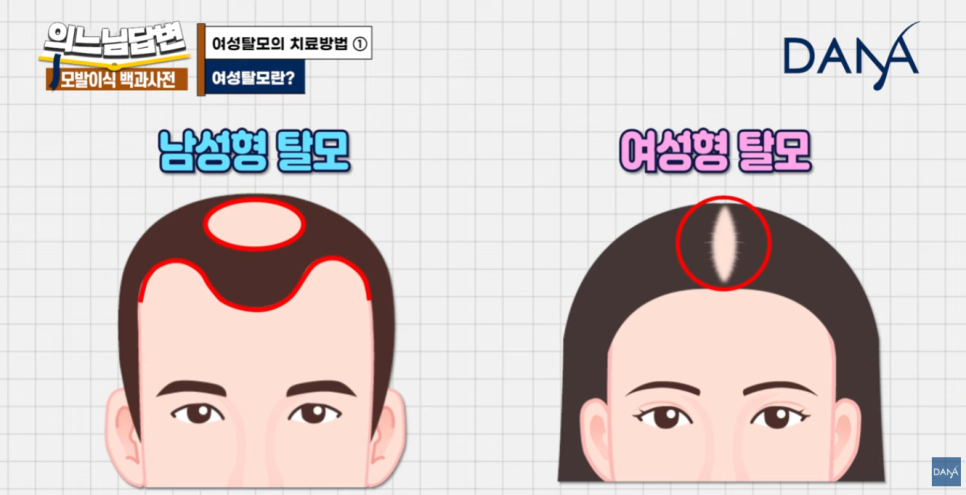
Androgenetic alopecia
causes both male pattern hair loss and female pattern hair loss,
but the pattern is different in male pattern hair loss.
In male pattern hair loss, it progresses into an M-shaped hairline and appears at the crown,
but in female pattern hair loss, it does not extend 3 to 4 cm in front of the hairline,
and instead appears in a pattern of overall decreased hair thickness and density.
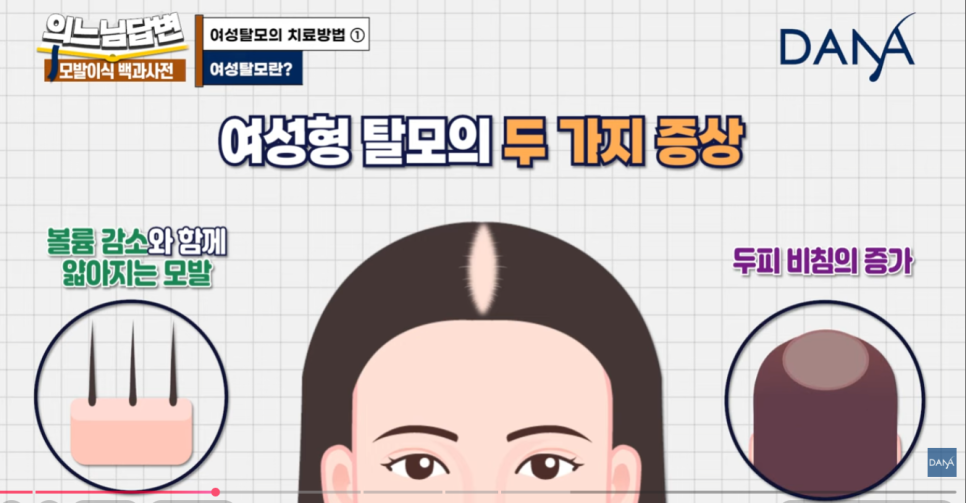
People with female pattern hair loss mainly show two symptoms.
The first is thinning hair along with reduced volume,
and the second is increased scalp visibility.
What is scalp visibility?

Scalp visibility occurs
because of the contrast between the color of the hair and the scalp.
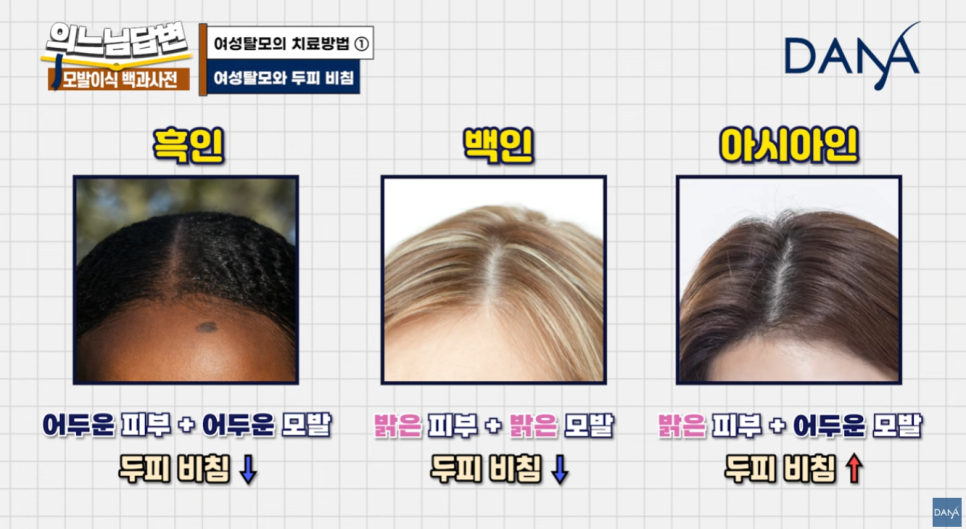
Scalp visibility varies by race.
Black people have darker scalp color and darker hair, so scalp visibility is less noticeable.
Caucasians also have lighter scalp and hair, so the visibility effect is less pronounced.
On the other hand, Asians, especially Koreans, have dark hair against lighter skin,
so the contrast is stronger and scalp visibility can be the most noticeable.

For example, a condition like vitiligo, in which the skin turns white,
is not a major issue for Caucasians.

However, for Black people or Asians,
when vitiligo occurs, people with darker skin tones become white in those areas,
so it can be stressful.

In the same way, scalp visibility is perceived more seriously by Asians
because of the color contrast,
and when scalp visibility is severe, there is a strong perception that hair loss is severe.
The cause of scalp visibility can be seen as a decrease in hair density or volume.
What is the target of female hair loss treatment?

The target of female pattern hair loss treatment
is the battle against scalp visibility,
and reducing scalp visibility
is the main goal of treatment.
Scalp Micropigmentation vs. Hair Transplant
There are two ways to treat female pattern hair loss:
scalp micropigmentation and hair transplantation.
Which one should you choose?
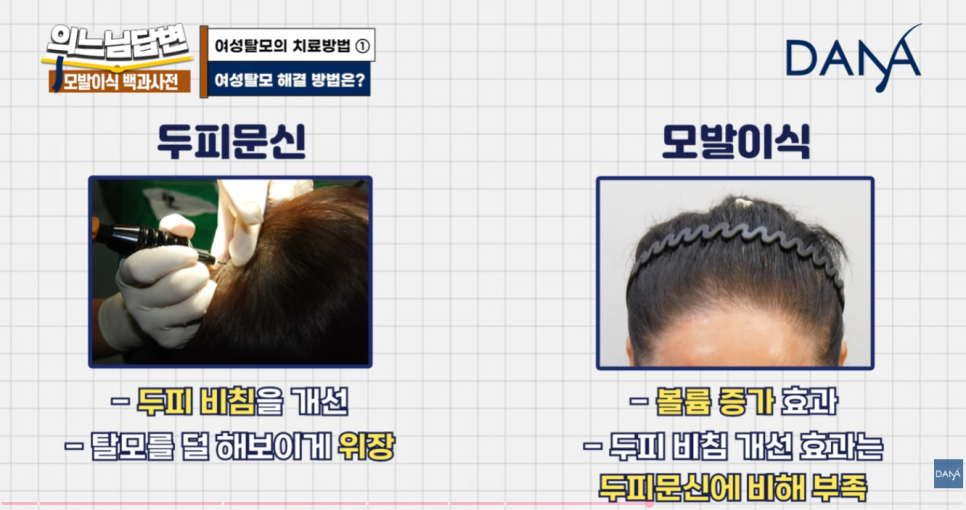
Scalp micropigmentation
improves scalp visibility
and has a camouflage effect
that makes the degree of hair loss look less severe.
A hair transplant
plants the hair itself,
so it has a volume-increasing effect.
However, its effect on improving scalp visibility
is less than that of scalp micropigmentation.

When examining the hair under magnification,
if a decrease in density is the main cause,
then hair transplantation will be the main choice.
If density has not decreased but only thickness has become thinner,
then scalp micropigmentation would be the choice.
This is because hair can only be transplanted into empty areas when density has decreased.

Hair loss
starts with a decrease in thickness and then a decrease in density.

So in the early stages, if density has not yet dropped
but the hair has become thin,
treatments that increase thickness
and scalp micropigmentation
would be good treatment options.
If the hair is thin and density is also low,
a hair transplant and scalp micropigmentation,
or combining them with hair loss treatment,
is a good approach.

You can think of density loss as hair transplantation
and thickness loss as scalp micropigmentation.
And if a hair transplant is chosen,
depending on whether shaving is possible and the elasticity of the scalp,
you can consider incisional or non-incisional methods,
shaved, unshaved, or partially shaved approaches,
and choose the surgical method that suits you.
Today, we looked at female pattern hair loss and its treatments.
Treatment for female hair loss is not simply about which is better, hair transplantation or scalp micropigmentation,
but about getting an accurate diagnosis of your scalp condition
and choosing the method that fits it.
After 충분한 consultation with experienced medical staff,
I hope you find the treatment that suits you
and move beyond your concerns about female hair loss!
https://www.youtube.com/watch?v=vcu8anAiRaE