Hello. I’m Director Moon Seong-hoon of Lifton Dermatology.
One of the questions I get a lot after opening the clinic is about InMode.
I think that’s because it continues to be popular, and it’s also a good combination to use together with Ulthera.
However, we intentionally did not bring in InMode and instead introduced a device called ONDA.
It was a decision made after carefully considering the principles and effects.
The combination of Ulthera and InMode is certainly very good, but in comparison, TION lifting (Titanium + ONDA), which we often perform at our dermatology clinic, is also producing quite good results.
So today, I’d like to talk about TION lifting.
Titanium Lifting: Treating Very Deep and Shallow Areas!
Titanium is a device that has become very well known,
and it emits three wavelengths (755 nm, 810 nm, and 1064 nm), so the depth of penetration varies depending on the wavelength, making it useful for treating multiple layers.
There are two treatment modes:
There is a stack mode, in which the laser is emitted in succession as it is accumulated,
and a SHR mode, in which it is delivered one time at a time so that it reaches only the superficial layer of the skin.
stack mode
It provides deep thermal energy and helps lift the retaining ligaments located deep within the skin.
For example, if you fire 5 stacks, the three wavelengths of laser are emitted very quickly five times in a row.
That allows it to penetrate deeper and create a lifting effect.
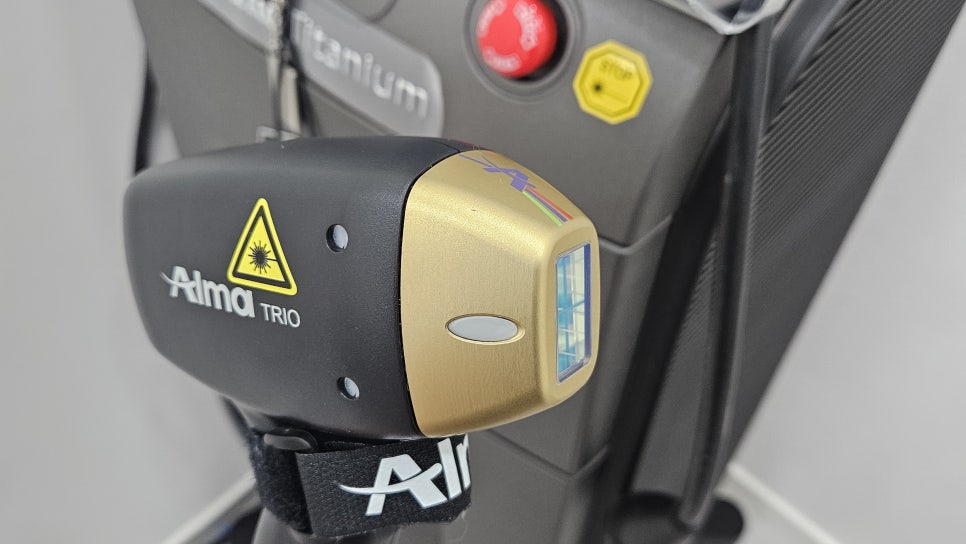 Do you see it? The three wavelengths are marked in different colors on the handpiece~ㅎㅎ
Because the heat is layered and can feel quite hot, skilled handling by a doctor is necessary, and if it is not done properly, there is a risk of burns, so this is very important.
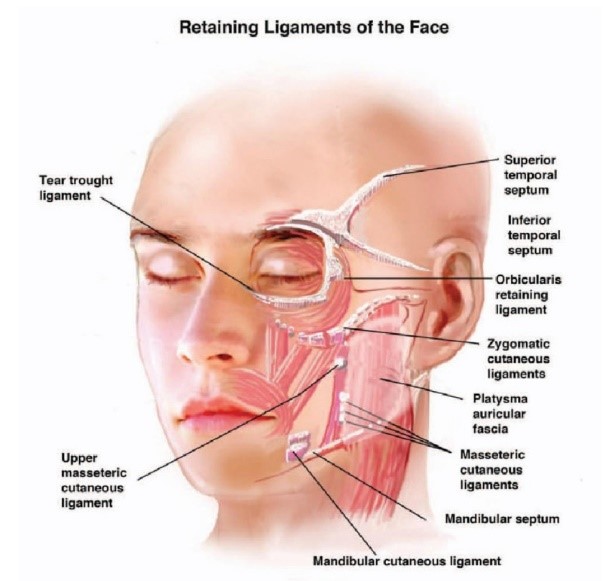 The part marked in white is the retaining ligament, and this is the target of stack mode.
shr mode
This is a treatment method in which the laser is continuously rubbed over the skin so that it is evenly delivered across the surface.
The laser reaches only as far as the dermis, inducing firmness and a brighter tone.
After the treatment, you may feel warm and tightened, with a brighter appearance.
If you’ve had the treatment, you’ll know that gel is applied and the clinician keeps rubbing across the face, double chin, and neck, and heat builds up in an instant, making the handpiece feel warm tooㅎㅎ.
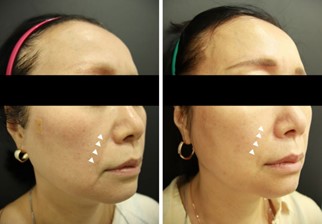 Lifting of the sagging nasolabial folds after treatment (Source: Lasers in Medical Science (2023) 38:272)
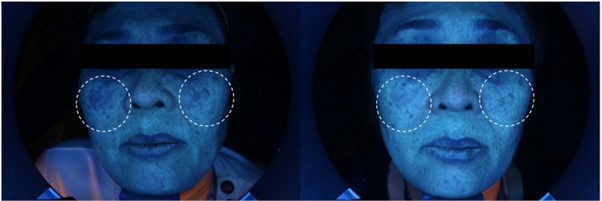 Reduced pigmentation (Source: Lasers in Medical Science (2023) 38:272)
Next, you can refer to my previous post about ONDA lifting.
In short, ONDA is a treatment that destroys the fat layer and stimulates firmness in the dermal layer.
Then what kind of principles and effects do you get when Titanium and ONDA are used together?
Titanium lifting provides heat to very deep and superficial areas,
and ONDA lifting provides heat to the middle layer and destroys fat.
To summarize it that way, I think it makes sense.
Recently, Titanium laser has received a lot of positive response because it provides an immediate lifting effect.
In contrast, ONDA lifting shows a more gradual lifting effect, so combining the two treatments can help maintain the lifting effect for longer.
Especially in areas with thicker fat layers, such as the buccal area, double chin, and lateral cheekbone area,
the fat-reducing effect of ONDA lifting is very helpful in refining the facial shape.
Above all, a major advantage is that both devices require no downtime.
If you have any further questions, I’ll answer them in the comments. Thank you^^