Hello, this is Lepton Dermatology at Sinsa Station. In the previous post, I briefly introduced Radiesse, a collagen-stimulating injection.
Today, I’ll explain how Radiesse works and what effects it produces.
In tissue, Radiesse promotes the production of type 1 and type 3 collagen, elastin, and proteoglycans (PG). As a result, elasticity and wrinkles improve, and moisture also increases as aged skin is replaced by new tissue. In other words, it can be described as an injection that promotes the transformation of aging-looking skin into younger-looking skin.
In addition, the injected Radiesse itself naturally breaks down in the human body after 30 months. In the previous article, I mentioned that Radiesse is composed of CMC gel and calcium particles.
Simply put, CMC is a medium that helps distribute the calcium particles evenly. CMC gel also has antibacterial properties, providing safety against bacterial infections such as Escherichia coli and Staphylococcus aureus. With existing hyaluronic acid fillers, there are cases where, several years later, a bacterial infection develops in the capsule surrounding the injected filler, causing swelling and pain and making it necessary to dissolve the filler. In that sense, being free from this seems to be an advantage of Radiesse.
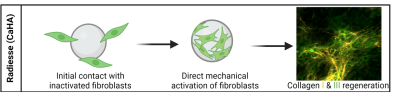
The process of type 1 and type 3 collagen formation around Radiesse particles
When Radiesse is injected into the human body, the CMC gel breaks down over 6 to 8 weeks. After that, the synthesis of new tissue is promoted by the remaining particles (CaHA). Radiesse (CaHA) particles injected into the body increase the production of collagen, elastin, and PG through interactions with fibroblasts. As shown in the figure, fibroblasts first gather around the calcium particles, and as fibroblasts are activated near the surrounding tissue, collagen is produced.
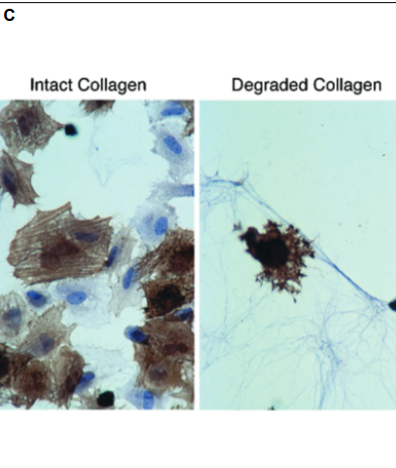
Fragmented and broken collagen bundles as aging progresses
More than 90 percent of the collagen that makes up the skin consists of type 1 and type 3 collagen, and collagen forms bundles that support the tissues of our body. In the figure, when collagen is degraded, it becomes fragmented and broken, and no longer forms bundle structures, appearing contracted.
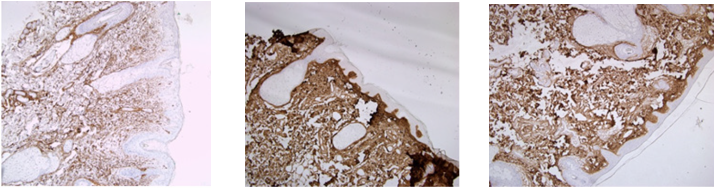
Collagen type III expression at baseline, 4 months, and 7 months (magnification x400
Radiesse particles help generate new collagen tissue (types 1 and 3), increase elastin fibers, improve skin elasticity and flexibility, and increase skin thickness, while also helping to form new blood vessels around the particles. In the figure above, you can see that the newly formed collagen tissue (stained brown) remains well preserved even after 7 months.