Last time, I briefly looked at the structure and effects of Silhouette Soft thread lifting.
I wrote this post to talk a little more about some of the advantages of Silhouette Soft threads.
In fact, one of the advantages I have felt after doing Silhouette Soft thread lifting consistently for many years for many patients is that
it allows for very diverse designs depending on the patient’s face.
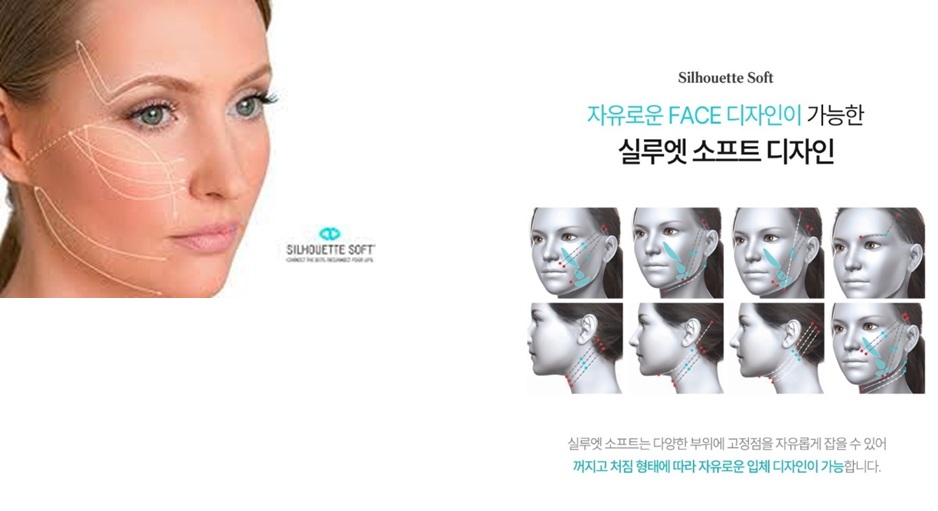
If conventional PDO threads are straight, they can only be used with limited patterns to create vectors (the direction of lifting) for the procedure,
in the case of Silhouette Soft, because needles are attached in both directions,
it is possible to effectively lift the areas that need to be treated most for each individual, depending on the design, such as
straight patterns, V-shaped patterns, U-shaped patterns, and L-shaped patterns.
Also, in terms of duration, while PDO threads usually last about 6 months,
Silhouette Soft threads are made of PLLA, so the lifting effect tends to last more than 1 year after a single treatment.
It seems I have talked only about the advantages so far, so I will also mention points to be careful about.
First, compared with conventional thread lifting, it is more expensive, so using a large number of threads can be a burden.
Personally, I think using around 10 threads for both cheeks is sufficient, and that gives the best results and longevity.
However, in reality, it is difficult to perform 10 threads for everyone. (The cost can be higher than surgery for lifting ㅠㅠ)
Therefore, it is often done by combining Silhouette Soft with conventional PDO cog threads (such as Mint threads).
Also, unlike existing threads, which use a blunt cannula method, Silhouette Soft has needles attached in both directions, so the possibility of tissue damage or vascular injury is higher.
Therefore, more skill and experience from the practitioner will be needed.
And the recovery period is also somewhat longer.
Because it has a cone structure that moves within the skin,
and because PLLA itself causes a strong tissue reaction,
ordinary thread lifting recovers within a few days to at most one week, whereas
with Silhouette Soft, patients’ irritation symptoms may, in some cases, last up to one month, with tingling or a foreign-body sensation persisting.
(Of course, this varies from person to person.)
Before receiving the procedure, please be sure to confirm the number of threads needed and the design, and I hope you can undergo it safely and effectively.