Liphon Dermatology.
What is the biggest reason acne scar treatment fails?
When people who are worried about acne scars visit the clinic, the most common thing they say is:
“I’ve tried Pico Fraxel, radiofrequency, Juvelook, and everything else, but nothing works, and my face just gets red and sensitive.”
The procedures used for acne scar treatment generally involve devices or agents that lightly abrade the skin,
and compared with pigment treatments or lifting treatments, the downtime is also relatively long.
I think acne scar treatment is one of the more difficult areas.
Even now, various methods and devices are being introduced to try to treat acne scars with new approaches,
but many of them have not been verified for effectiveness over enough time,
so rather than helping, the flood of information seems to make patients even more confused about which treatment is right for them.
So, based on the consensus that has been established to some degree among doctors,
I would like to briefly introduce how acne scars are classified by shape and which treatments are appropriate for each type.
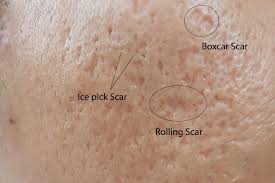
These days, this is something that patients with even a little interest in acne treatment already know,
but the standard approach is to classify scars by shape and treat them accordingly.
They are broadly divided into keloid-type and atrophic scars.
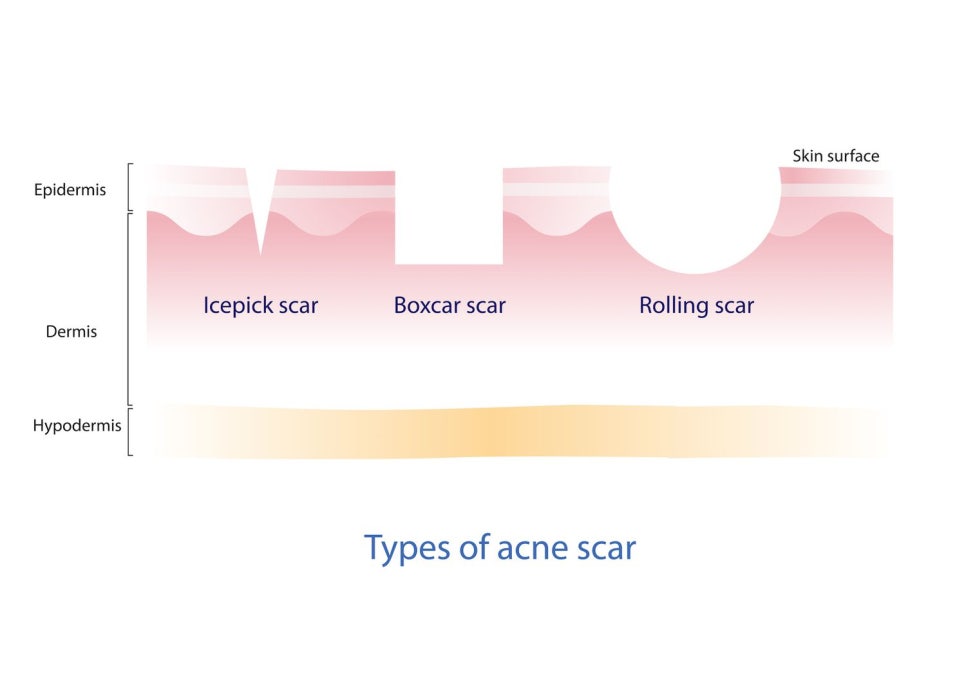
In the case of acne scars, most are atrophic, so within atrophic acne scars,
they are further divided into three types: ice pick, box, and rolling.
Then the treatment appropriate for each scar type is performed.
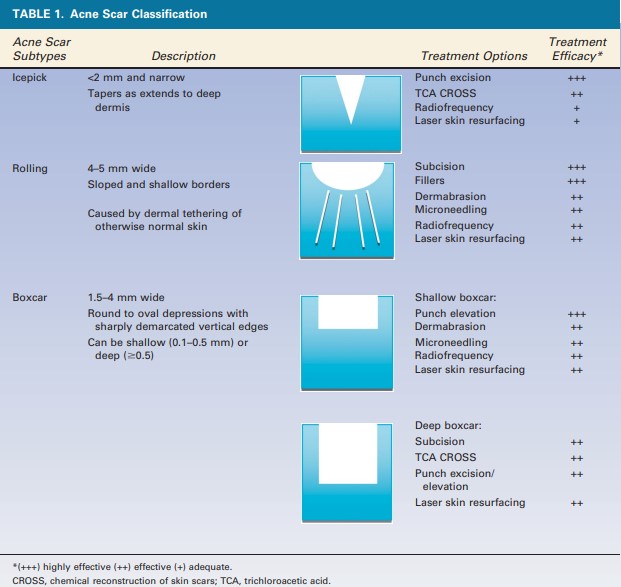
This is taken from a review paper published in 2019.
To summarize the most effective treatments by scar shape:
For ice pick scars: punch excision, TCA cross (dot peel)
For rolling scars: subcision, filler
For box scars: punch elevation, subcision, TCA cross
Among the treatments above, punch refers to using a pen-shaped knife(?) to perform
excision (cutting out the skin) or elevation (lifting the skin without removing it).
Because these treatments have long downtime, most people who need to maintain social life do not prefer them,
so they are not performed very often.
So the table above is not wrong,
but if everything could be treated successfully just by doing that, there would be no one in the world with acne scarsㅠ
What I’ve learned while treating acne scars is that,
for example, even if a scar is box-shaped,
it does not mean that simply doing CO2 pinhole, shouldering, dot peels, and subcision will automatically make it better.
The shape-based treatment is correct,
but in reality, each patient differs in skin thickness, elasticity, regenerative ability, underlying conditions, and more,
and there are even cases where the scar shape is difficult to classify into just one category...
Therefore, in scar treatment, it is important to carefully observe the response to each previous session every time.
Even if the same treatment is performed, the skin’s response differs from person to person,
and even in the same person, there are cases where previously treated areas must be skipped depending on the area.
If strong treatment is repeated forcefully before the skin has fully regenerated,
symptoms such as sensitivity or redness may occur.
One somewhat unfortunate thing is that there are many people in the acne scar area in particular who change hospitals because they do not see results quickly or develop side effects,
and in such cases, the doctor does not have enough time to accumulate proper data on the patient’s skin characteristics.
As the number of treatment sessions increases, we can better understand the patient’s skin characteristics and response to treatment,
and scar treatment is an area where the process of adjusting to a more suitable plan is especially important.
Personally, I think receiving consistent treatment at a trustworthy clinic is the most important factor in scar treatment.
That is why I always set aside time to speak with the patient before treating acne scars.
Through this process, we can gather information about how the previous treatment responded and understand the progress of each scar area.
That’s all for today^^