Hello. This is Lifton Dermatology.
Ulthera and Thermage are both widely known as lifting devices, so many people come in thinking of the two procedures in a similar way.
But in actual practice, Ulthera and Thermage are not devices that look at the same problem,
and it is better to understand them as a process of examining deep-layer sagging and reduced skin elasticity separately and designing the direction that is needed.
In the end, what should be looked at first is not the combination of devices, but the condition of the face,
and the starting point for a natural lifting result is the process of distinguishing which layer has collapsed first, where deep sagging needs to be addressed,
and where skin elasticity needs to be strengthened.
Why the Jawline Becomes Blurry
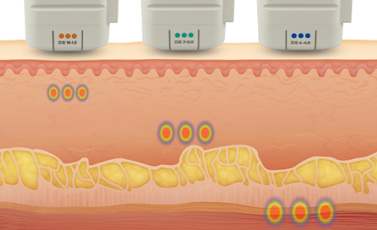
There are people whose jawline becomes blurred and whose cheeks sag downward, making the face look heavier than before.
If this is viewed simply as reduced skin elasticity, the lifting direction may be off,
and what should be checked before the outer skin is the changes in the deep layer that supported the face.
When the strength of this layer drops, the center of gravity of the face shifts downward, and the jawline becomes blurred or cheek sagging becomes more noticeable.
So in cases like this, it is necessary to first check which area has dropped and in which direction that sagging should be addressed for a natural appearance,
and Ulthera can be understood as a procedure that looks at this point and organizes the collapsed facial line based on sagging in the deeper layer rather than the skin surface.
When Skin Elasticity Becomes Loose
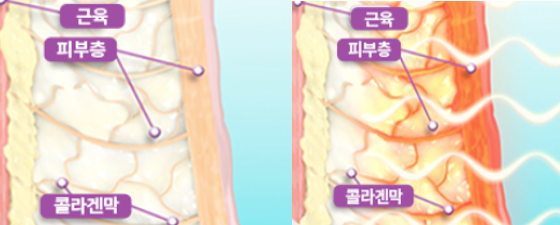
On the other hand, there are cases where the facial line has not collapsed much, but the skin looks thinner and fine wrinkles appear more prominent,
and some people say that pores look more noticeable or the skin texture appears loose.
In such cases, rather than pulling the deep layer unconditionally, it is better to first look at the direction in which the skin itself can become firmer again,
and when the collagen response in the dermis is activated, the skin can become a little denser and the visible sense of elasticity on the surface can also be naturally improved.
Thermage is a procedure that looks at this part.
If Ulthera plays the role of addressing the collapsed structure from below, Thermage is closer to the process of strengthening the skin above it again.
Conditions for a Face That Needs Ultraformer Thermage
The actual aging of the face does not appear in just one form.
It is common for the lines to become blurred while the skin becomes thinner, and for cheek sagging to appear together with fine wrinkles or reduced pore elasticity.
If only Ulthera is performed on such a face, the lines may be organized, but the skin may still feel lacking in firmness,
whereas if only Thermage is performed, the skin texture and elasticity may improve, but the lowered contour may still remain visible.
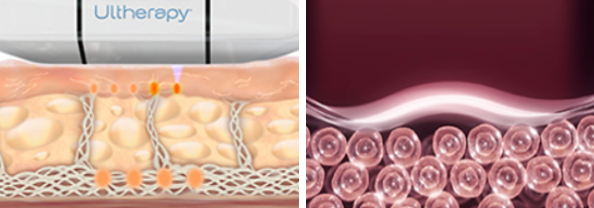
So Ultraformer Thermage should not be understood simply as using two devices together,
but as a design that separately approaches the different problems on the face,
with deep-layer sagging addressed by Ulthera and reduced skin density and elasticity strengthened by Thermage.
The Lifting Direction That Determines the Result
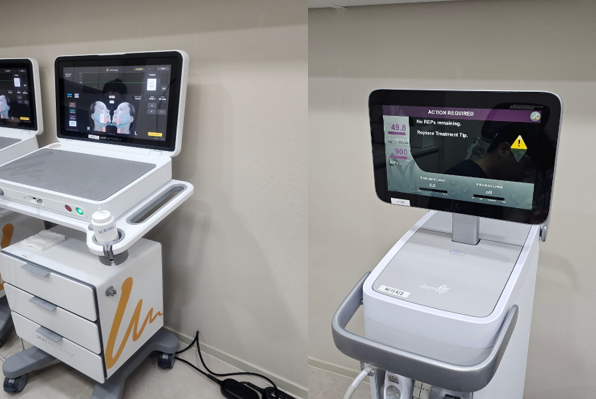
What matters in Ultraformer Thermage is not the fact that both devices were used,
but the process of looking at the depth and direction where sagging began, the skin thickness, and the amount of fat together, and then deciding how much force to apply and how far to pull.
If you only pull upward without sufficiently considering the direction of sagging and the amount of fat, the cheekbones may look more prominent or the face may look even more tired,
and the midface should be viewed with the upward flow in mind while the jawline should also be considered in relation to the backward direction;
the double chin should be approached step by step from the deep layer so that the facial line connects naturally.

The same applies to Thermage, and the energy delivery method should vary depending on skin thickness and the degree of reduced elasticity;
even when the same device is used, the results can differ depending on which layer is examined and how it is treated.
The Standard for Natural Lifting
If you are considering Ultraformer Thermage,
rather than performing the two procedures together, it is important to first check whether changes in two layers are appearing on your face at the same time;
if deep-layer sagging is the main issue, an approach centered on Ulthera may be appropriate,
and if reduced skin texture and elasticity are the bigger problem, it may be more natural to consider Thermage first.
However, if the jawline and cheek sagging are visible while the skin is becoming thinner and fine wrinkles and reduced pore elasticity are also present,
more balanced changes can be expected when Ulthera and Thermage are designed separately.

Lifton Dermatology does not view lifting as a single method,
and as a Thermage key doctor and an Ulthera key doctor, based on the characteristics and application criteria of both devices,
we examine the facial structure, skin thickness, the degree of reduced elasticity, and the direction of sagging together,
and carefully design the location and range where Ultraformer Thermage is needed, as well as the intensity and order.
Thank you.