Gangseo-gu Implant Dentistry, Until an Implant Bone Graft Takes Hold
Hello.
I am Kim Geun-il,
Director of 365서울원탑치과.
Today, I would like to talk about
one of the questions
patients ask most frequently
when they come in for an implant consultation:
implant bone grafting.
“If bone graft material is placed in my gums,
does it immediately become my own bone?”
“After bone grafting,
how long do I have to wait
until the implant tooth is completed?”
These are questions I often hear
during implant consultations.
To give you the conclusion first,
the bone graft material placed by the dentist
does not immediately become your own bone
on its own.
The grafted bone material
merely serves as a kind of scaffold.
Our body’s cells need to enter along that scaffold
and go through the process of forming
truly solid alveolar bone of your own.
Today, I will explain in an easy-to-understand way
the physiological process by which bone graft material
hardens into your own bone,
as well as how long it takes.
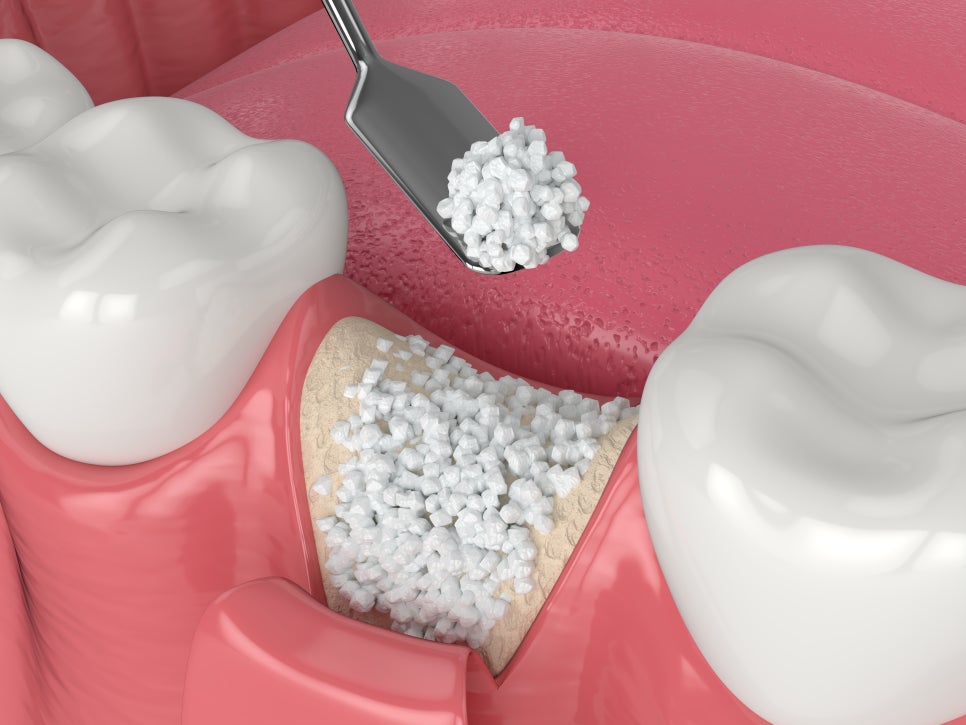
The 4-stage process by which implant bone graft material becomes “truly yours”
Bones in our bodies are living tissue.
For bone graft material to fuse with your alveolar bone,
the following precise stages take place.
Stage 1
Blood clot formation and blood vessel development
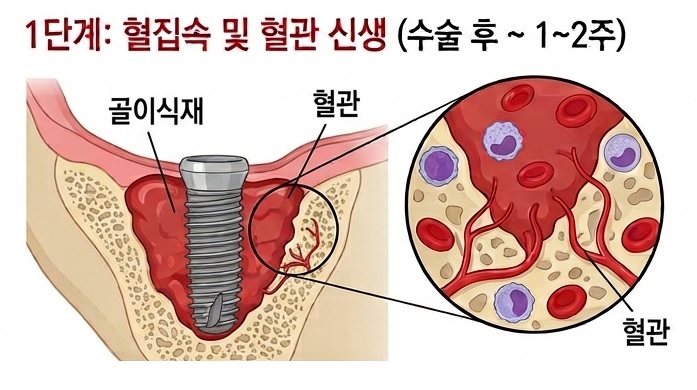
Once the bone graft material has been placed,
blood from the surrounding area
first seeps between the graft particles
and forms a blood clot.
This blood is filled with nutrients and stem cells
that can create new cells.
Over the one to two weeks after surgery,
new microscopic blood vessels begin to grow
into the graft material.
Stage 2
The activity of osteoclasts and osteoblasts
(1–2 months)
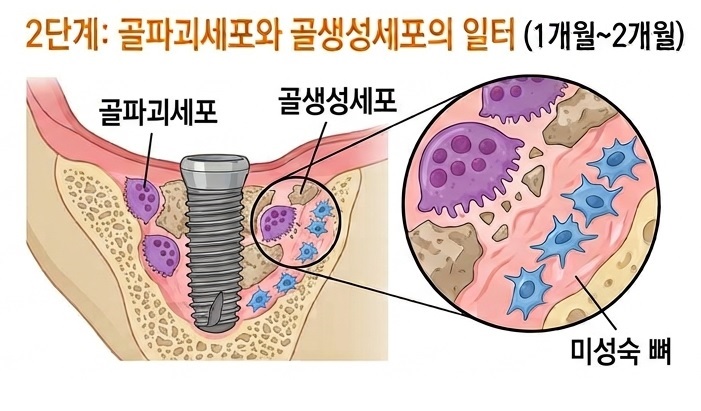
Osteoclasts that enter along the blood vessels
absorb and remove the rough areas
of the grafted bone material.
Then, osteoblasts that follow
begin secreting new bone proteins,
such as collagen.
The bone formed at this stage
is still immature and soft
(unmature bone).
Stage 3
Calcium and phosphorus deposition, and calcification
(2–4 months)
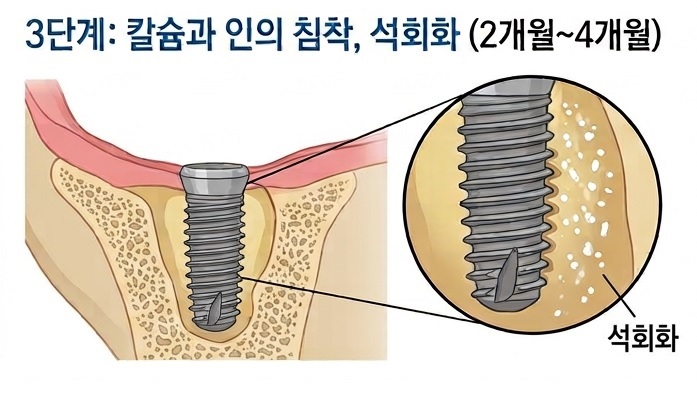
As calcium and phosphorus from the blood
are gradually deposited in the previously soft
immature bone tissue,
the bone gradually becomes harder. (Calcification)
From this stage, the implant fixture
begins to form a firm physical and biological bond
with the alveolar bone.
Stage 4
Bone remodeling and completion
(3–6 months or longer)
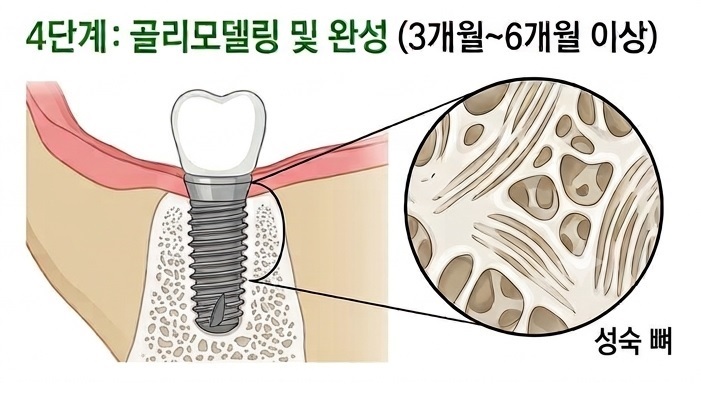
As the hardened bone receives stimulation and pressure
from chewing food,
its density becomes even greater.
It completely transforms into
“truly solid alveolar bone of your own”
(mature bone with sufficient bone density)
that can firmly hold the tooth root.
How long does it take to become your own bone?
Individual differences exist depending on
the patient’s alveolar bone condition
and the amount of bone grafted.
• Standard bone grafting (favorable conditions)
Usually, after about 3–4 months,
the graft becomes stable and strong enough
for an implant to be placed and used for chewing.
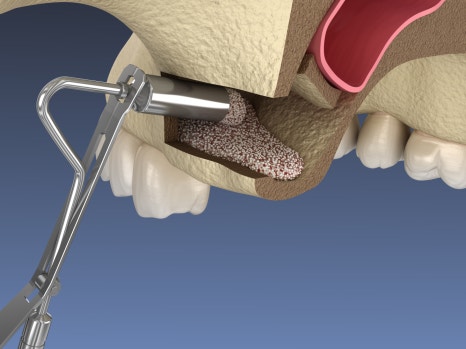
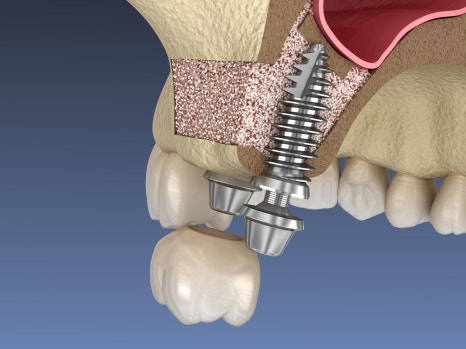
• Complex bone grafting
(When the alveolar bone has been significantly resorbed / procedures such as sinus lift surgery)
If a large amount of bone needs to be grafted,
at least six months is needed
for it to be replaced by your own bone.
There is no need to become impatient
just because the process takes a long time.
If a tooth is placed forcefully
before sufficient strength has been secured,
the implant may become loose or fail.
Postoperative precautions for stable osseointegration
No matter how well the surgery is performed,
it will not be effective if your body cannot form bone properly.
For stable bone integration,
the following three points must be followed.
1. Absolutely no smoking (most important!)
Nicotine and harmful substances in cigarettes
constrict blood vessels and block
blood flow to the bone graft site.
If you do not quit smoking,
not only the bone grafting,
but also the success rate of the implant
will drop sharply.
2. Avoid actions that interfere with bleeding control
Actions that increase negative pressure in the mouth,
such as spitting or using a straw,
can cause bleeding
and interfere with blood clot formation.
3. Manage chronic conditions (diabetes)
For patients with diabetes,
blood sugar must be well controlled
for blood vessel formation to proceed smoothly
and for the bone to harden properly.
Implant bone grafting
is not simply a matter of filling a space with material.
It is a complex procedure that must be performed
after accurately analyzing the patient’s bone metabolism
and the three-dimensional structure of the gums.
Before implant surgery,
precise diagnosis using equipment such as a 3D CT
is essential in order to carefully measure
each patient’s alveolar bone density and shape.
If the alveolar bone is significantly deficient,
the difficulty of implant surgery will be even greater.
However, rather than giving up immediately,
I believe a dentist’s role is to work with the patient
to find the best treatment method for their individual needs.
For my patients to enjoy healthy meals,
I, dentist Kim Geun-il,
will always do my best.
Thank you.
📍 365서울원탑치과
179 Gangseo-ro, Gangseo-gu, Seoul, 4th Floor, Dongmyeong M Building
Balsan-dong Dentistry / Gangseo-gu Dentistry / Hwagok-dong Dentistry
A 1-minute walk from Exit 8 of Hwagok Station