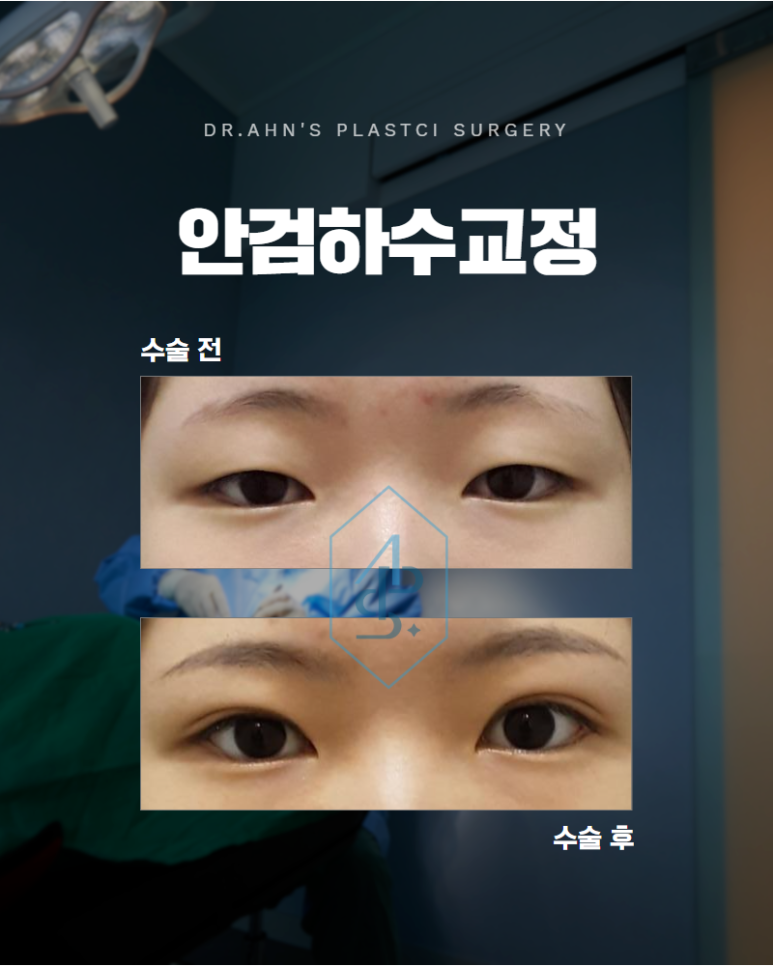
Hello, this is Director Ahn Byung-jun of Ahn Byung-jun Plastic Surgery.
Today, I’d like to talk about ptosis correction, a condition that many people think is simply caused by ‘small eyes’ or ‘sagging skin,’
but in reality, it is caused by weak muscles that open the eyes.
If your eyelids feel heavy and you find yourself using your forehead to help open your eyes, it may be worth considering ptosis.
Why your eyes feel heavy and tired starts with a muscle problem
Not everyone who has difficulty opening their eyes has ptosis.
This is because several factors work together, including sagging skin, the position of fat, and the elasticity of the muscles.
However, many of the patients we see in the clinic have weakened function of the muscle that lifts the eyelid, known as the levator palpebrae superioris.
When this muscle does not do its job properly, the force needed to open the eyes becomes insufficient, and you end up lifting your eyebrows or tensing your forehead to widen your field of vision.
If this habit continues for a long time, forehead wrinkles become deeper and the face can look constantly tired.
Ptosis correction is a surgery that improves this underlying problem.
It is better understood not as a cosmetic procedure simply to create double eyelids, but as a process that restores the function of opening the eyes.
The eyes become more visible, while the motion of opening them becomes more comfortable.
 Ptosis correction surgery methods are designed differently depending on the condition
Not all ptosis is corrected in the same way.
Ptosis correction surgery methods are designed differently depending on the condition
Not all ptosis is corrected in the same way.
Depending on how weak the muscle strength is, an incision method or a non-incision method may be used.
In mild cases, non-incision ptosis correction may be performed by tying the muscle inside the eyelid with sutures.
In such cases, the chance of scarring is low, and recovery tends to be relatively quick.
However, for moderate to severe ptosis, the levator muscle must be directly exposed through an incision so that its length can be adjusted or advanced to strengthen its power.
If needed during this process, the double eyelid line is also designed together so that both eye-opening function and appearance are balanced.
The key to ptosis correction is how naturally the muscle works.
Even when the eyes open wider, they should not look awkward, and when the tension is relaxed, they should remain comfortable. Finding that balance is important.
 After surgery, the face becomes softer and the eyes feel lighter
A change many people mention after ptosis correction is that their eyes feel more comfortable.
After surgery, the face becomes softer and the eyes feel lighter
A change many people mention after ptosis correction is that their eyes feel more comfortable.
Before surgery, the eyes would not open well unless they used the forehead or eyebrows, but now they open naturally without any special effort.
As the field of vision widens, the expression also feels brighter and softer.
Right after surgery, there may be some swelling and tightness, but stitches are usually removed after about a week, and daily life is not greatly affected after 2 to 3 weeks.
And after a month, the muscle used to open the eyes stabilizes, and we often hear that tired eyes have become lighter.
Best of all, there is no artificial feeling left behind over time.
People around them often say, “Your face looks brighter,” or “You don’t look tired.”
The subtle difference created by experience
Ptosis correction is not simply a surgery to make the eyes look bigger.
Because it deals with both eye function and appearance, it is important to understand the movement of the muscles and the anatomical structure.
The more surgical experience one has, the better one can read subtle muscle responses and tiny differences in the angle at which the eyes open.
By carefully analyzing each person’s unique eye structure and features, we create eyes that are comfortable and harmonious rather than overcorrected.
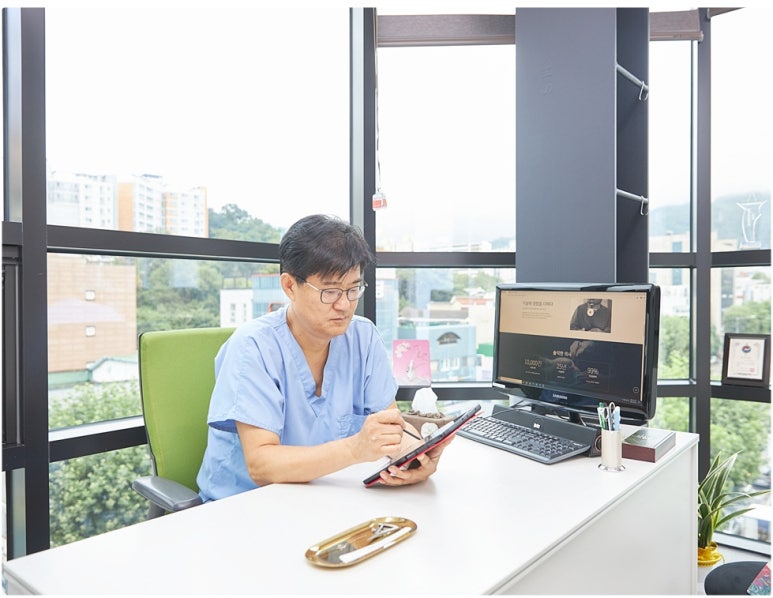 Natural changes, long-lasting comfort
The eyes are an important area that determines the overall impression of the face.
Natural changes, long-lasting comfort
The eyes are an important area that determines the overall impression of the face.
Rather than eyes that are unnaturally large or overly defined, eyes that open naturally without strain provide satisfaction for much longer.
Ptosis correction is a surgery that prioritizes restoring function over external change.
The eyes become more comfortable, the expression becomes brighter, and in the end, it leads to a more confident impression.
Naturally clear eyes begin with balanced muscle function.
If you suspect ptosis, we recommend checking the strength used to open your eyes through a careful evaluation.





Previous image
Next image