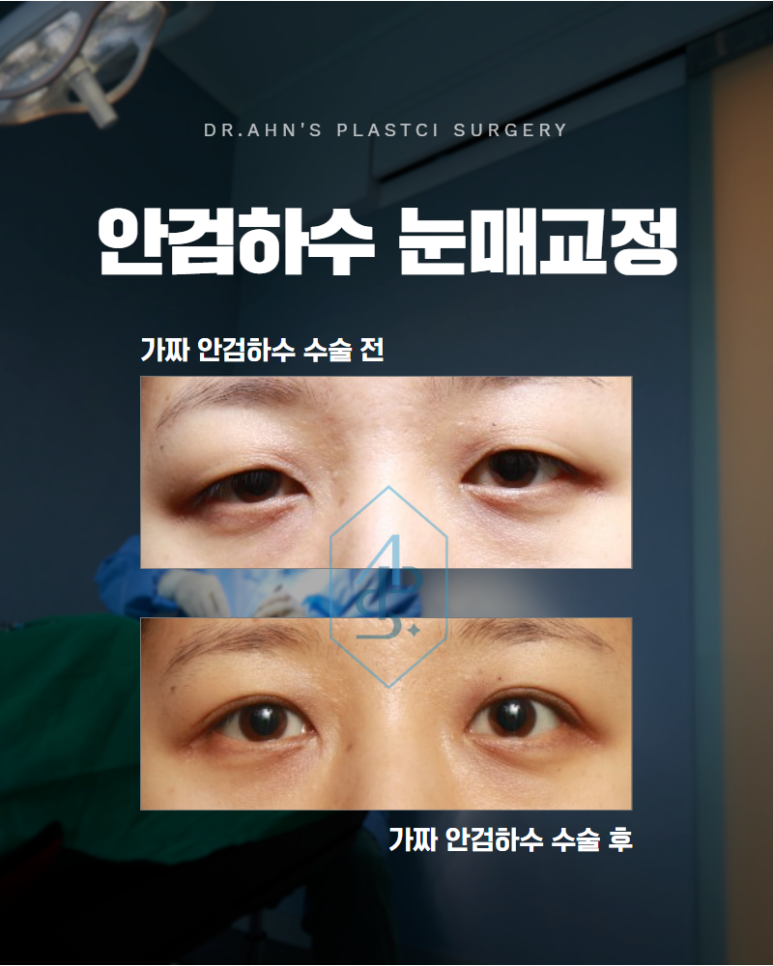
“Doctor, do I really have ptosis?”
During consultations, I often hear questions like this.
People say their eyes look a little sleepy and worry that photos make them look dull and unfocused.
It is also common for people to assume they have ptosis because they use their forehead muscles when opening their eyes and their eyebrows lift along with them.
However, not all sleepy-looking eyes are ptosis.
It is important to distinguish between cases where ptosis eyelid correction is truly necessary and cases where it is not.
That is because once the diagnosis changes, the surgical approach also changes completely.
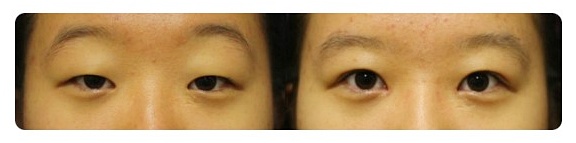
Before surgery / 2 months after surgery in a true ptosis case
What is different about true ptosis?
A normal eye has the upper eyelid covering about 1 to 2 mm of the black part of the eye.
If it covers more than 2 mm beyond that range, it is classified as ptosis.
It can appear congenitally because the muscle that opens the eyes is weak, or it can develop later in life as an acquired condition.
Depending on how much of the eye is covered, it is divided into mild, moderate, and severe cases, and the strength and method of correction also differ.
In such cases, simply removing sagging skin is not enough.
Structural correction that adjusts the muscle responsible for opening the eye is necessary.
So if it is true ptosis, ptosis eyelid correction should be performed with the goal of functional improvement.
The important thing is to create eyes that look clear and open comfortably without strain.

How is fake ptosis different?
On the other hand, fake ptosis is often a problem of the skin rather than the muscles.
Especially in people in their 50s and older, the eyelid skin loosens and begins to cover the eye.
As they use the forehead muscles to open their eyes wider, wrinkles become deeper, and at first glance it can look like ptosis.
However, if you gently lift the sagging skin by hand, the amount covering the eye is often 2 mm or less.
This is called fake ptosis.
Because the muscle strength is normal, many cases improve sufficiently with double eyelid surgery and skin refinement alone.
If the muscle is unnecessarily overcorrected at this point, the eyes may actually look unnatural.
That is why it is important to properly assess the structure before deciding on ptosis eyelid correction.
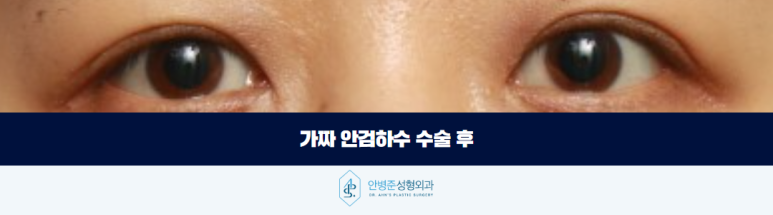
Using the eyebrows does not always mean ptosis
Asian eyes have a different structure from Western eyes.
The skin is relatively thicker, and sagging often appears earlier.
Even women in their 20s sometimes use both their eyebrows and forehead muscles when opening their eyes.
But you cannot conclude that it is ptosis just because the eyebrows are being used.
If, after holding the eyebrow movement down with one hand and creating a crease, the amount covering the eye is not large, it is more likely to be fake ptosis.
In such cases, double eyelid surgery alone can create a clearer impression.
However, if it is ptosis, muscle correction is necessary.
This is why we say that diagnosis is half of ptosis eyelid correction.
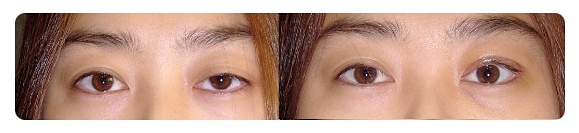
4 days after ptosis surgery on the left eye only
Careful judgment is ultimately important
During consultations, I often hear people say they feel confused because the opinions vary from place to place.
That is because there are many cases where the condition of the eyes falls into a borderline range.
There are also intermediate stages that are neither clearly fake nor clearly real.
In such cases, it is necessary to look at the strength of eye opening, the degree of skin sagging, and the habit of using the forehead together.
Excessive correction can cause unnatural results, while insufficient correction may not lead to proper improvement.
That is why the judgment of a board-certified plastic surgeon with extensive clinical experience is especially important.
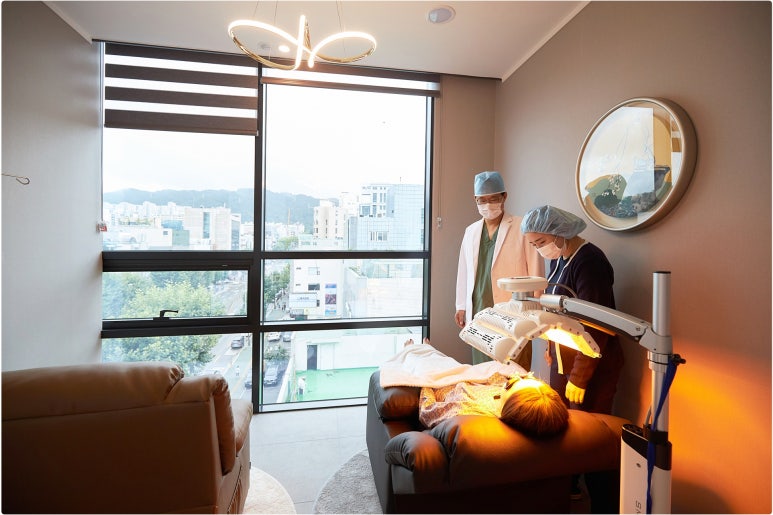
Not all sleepy-looking eyes are ptosis.
Only by distinguishing between fake and real can unnecessary surgery be avoided.
It is important to find the method that suits your own eyes.
I will help create a natural and comfortable eye shape.






Previous image
Next image