Hello. I’m Ahn Byung-jun, CEO and head surgeon of Ahn Byung-jun Plastic Surgery.
"I was told I have ptosis because my eyes sag a lot."
"My eyelids cover my pupils, which is uncomfortable."
These are things some patients say during consultations.
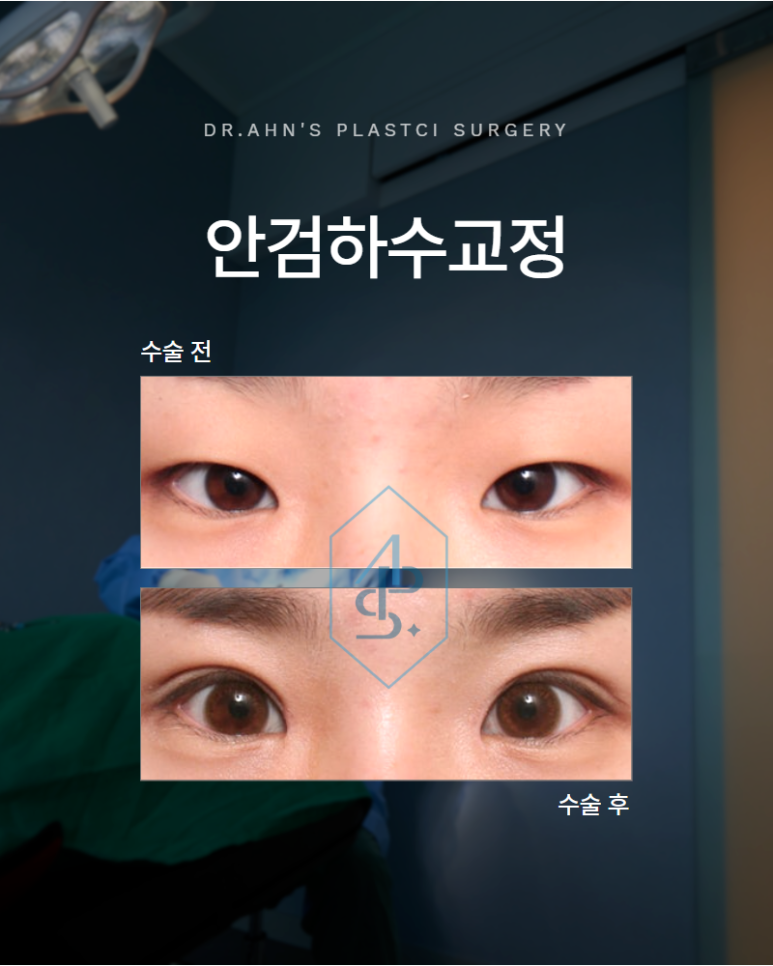
In some cases, just from the photos, it clearly looks like moderate to severe ptosis.
However, when we actually examine the eyes closely, there are more cases than you might expect in which sagging skin, rather than muscle weakness, is the main cause.
When planning ptosis correction, carefully analyzing this point first is part of the know-how of a board-certified plastic surgeon in deciding the surgical approach.
 How are ptosis and skin sagging different?
Ptosis is a condition in which the eyelid cannot rise sufficiently because the levator muscle or Müller muscle, which opens the eyes, has weakened.
By contrast, skin sagging is when the muscles themselves are normal, but the skin of the upper eyelid loosens and covers the pupil.
Because both conditions make the eyes appear less open, they are not easy to tell apart from the outside.
In particular, East Asians often have thicker eyelid skin and accompanying sagging, so pseudoptosis that looks like ptosis occurs commonly.
What is important is that while each condition can exist on its own, there are also many cases in which sagging skin and mild ptosis are present together.
That is why, during diagnosis, it is necessary to determine which is the main cause and whether both need to be corrected.
 There are cases where treating the skin alone is enough
If sagging skin is the main cause, a complex approach like ptosis correction may not be necessary.
That is because removing the loosened skin appropriately often allows the eyes to open much more comfortably.
When this skin sagging is resolved, the force placed on the eyebrows and forehead muscles naturally decreases, and you may also notice improvement in forehead wrinkles.
On the other hand, if muscle-strengthening surgery is done first too aggressively, the skin sagging problem may remain and the results may not be satisfactory.
That is why it is better to check how much skin sagging is present and then assess the muscle condition afterward.
 When skin sagging and mild ptosis coexist
Even if preoperative photos make the condition look like moderate to severe ptosis, there are cases where sagging skin and mild ptosis coexist.
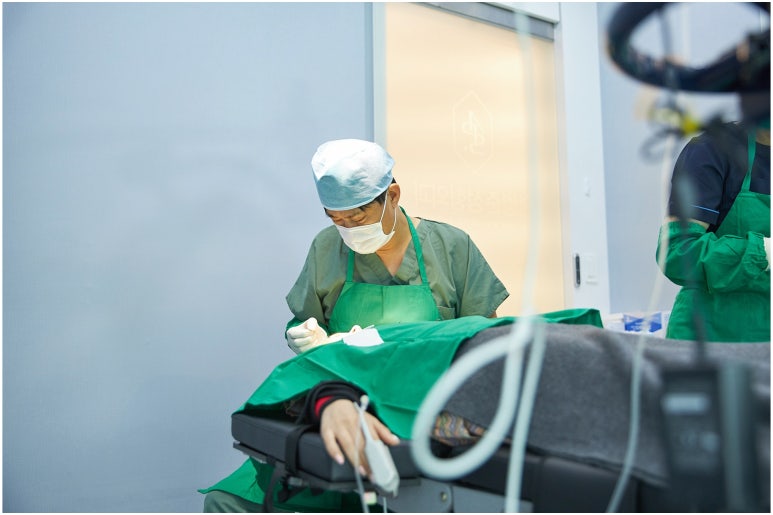
In such cases, the approach is to remove the sagging skin while also performing eyelid correction surgery at the same time.
After cleaning up the skin, if the eyes still do not open fully, muscle strength is reinforced only as much as is lacking.
This step-by-step approach helps prevent overcorrection.
If overcorrection occurs, the eyes may look excessively pulled, or there may be lingering discomfort because the eyelids do not come down sufficiently when closing the eyes.
That is why I consider it important to avoid being overly aggressive in ptosis correction.
Do you have concerns that drooping eyelids make you feel uncomfortable or that you do not like the way you look?
Ptosis correction is not only about strengthening the muscles.
It is important to identify what the main cause is in your current eye condition and to design how to address skin sagging and muscle issues separately.
I recommend starting by carefully examining the overall eye area with a board-certified plastic surgeon who has extensive clinical experience.




Previous image
Next image