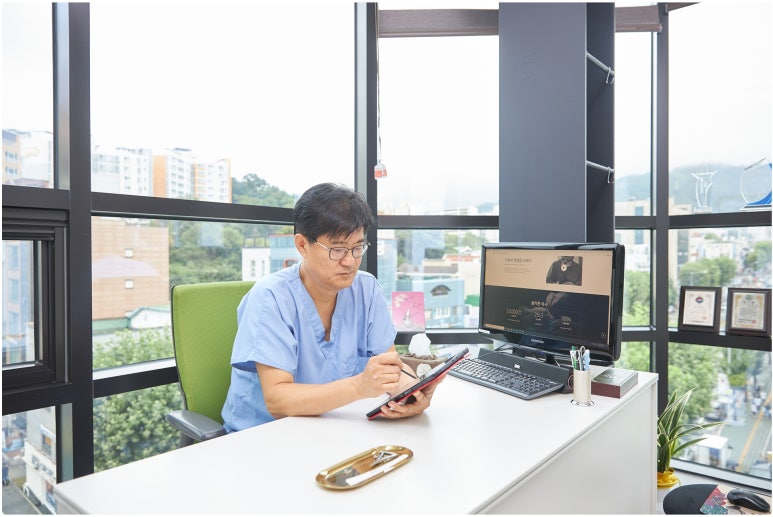
Hello. I am An Byung-jun, the director of 안병준성형외과.
After the age of 50, signs of aging are often first noticed around the eyes.
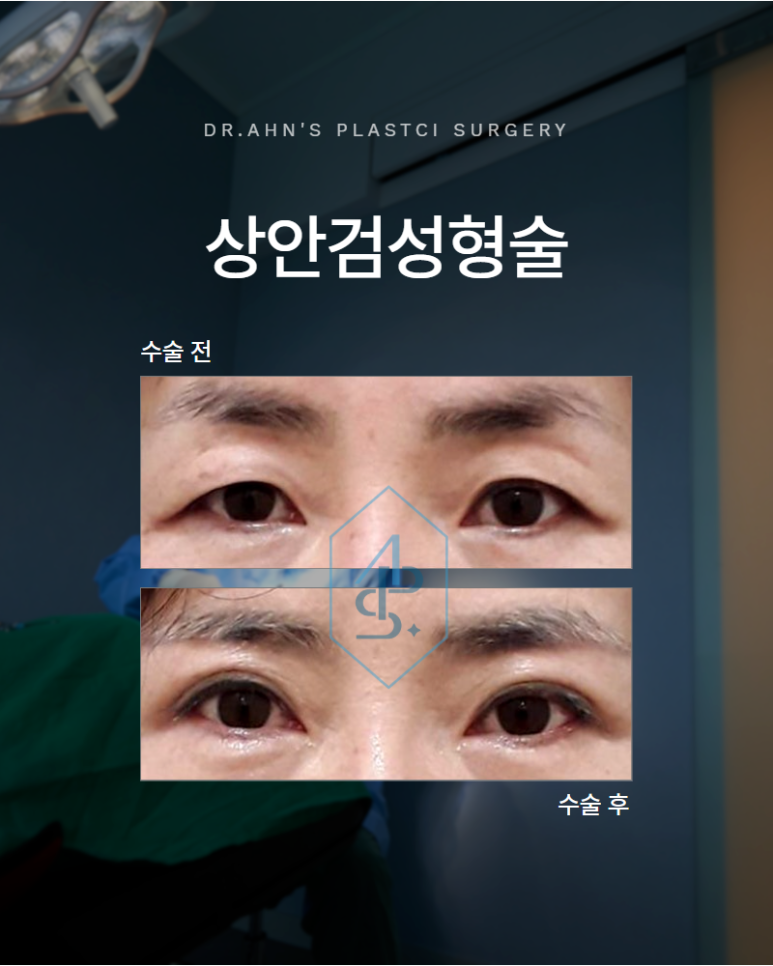
The eyelids may droop and make your vision feel obstructed, or the skin may sag toward the outer corners of the eyes, making your expression look heavy and tired.
Many people who visit for a consultation about these changes are considering upper blepharoplasty.
However, depending on the degree and location of the drooping, upper blepharoplasty alone may not be sufficient.
That is what I would like to discuss today.

What Is Upper Blepharoplasty?
Upper blepharoplasty is a procedure that removes sagging skin, stretched muscle, and excess fat from the upper eyelid.
Rather than simply removing skin, the structures inside the eyelid must also be addressed to achieve a natural result.
Unlike double-eyelid surgery in your 20s, after middle age we avoid methods that fix the eyelid crease too firmly.
This is because strong fixation on skin that has lost its elasticity can leave an awkward and unnatural appearance.
The basic approach to upper blepharoplasty after middle age is to sufficiently remove the drooping tissue while guiding the crease to settle softly and naturally.

When There Is Significant Drooping, Upper Blepharoplasty Alone May Not Be Enough
For people over 50 with severe eyelid drooping or significant skin sagging toward the outer corners of the eyes, it may be difficult to remove enough sagging skin through upper blepharoplasty alone.
This is because there is a limit to the amount of skin that can be removed from the inner side of the eyelid.
In such cases, combining the procedure with a sub-brow incision can produce a more natural and satisfactory result.
A sub-brow incision involves making an incision along the lower border of the eyebrow and also removing the sagging skin from above.
Because the scar is located beneath the eyebrow, it is often naturally concealed by the eyebrow line over time.
Combining upper blepharoplasty with a sub-brow incision allows drooping in the direction of both the eyelids and outer corners of the eyes to be addressed simultaneously from above and below, resulting in a more balanced contour.
When Is It Necessary to Combine the Two Procedures?
That does not mean that both procedures are performed together for everyone.
If the degree of drooping is not significant, or if drooping in the central eyelid area is the main concern rather than sagging toward the outer corners, upper blepharoplasty alone may be sufficient.
On the other hand, if the skin has sagged significantly all the way to the outer corners and it is determined that upper blepharoplasty alone would not adequately resolve the drooping, a sub-brow incision may also be considered.
The approach is determined after carefully examining the range and degree of drooping before surgery.
Only after examining the condition of your eyes directly can I explain which approach is appropriate.
There is initial swelling after upper blepharoplasty, and it takes time for the incision area to settle.
Immediately after surgery, the eyes may look pulled or feel awkward.
In most cases, this naturally improves and stabilizes during the recovery process.
As time passes, you can see the crease settle softly and the area around the eyes take on a more relaxed appearance.
If drooping eyelids make your expression look heavy or make your vision feel obstructed, we recommend starting by carefully assessing the extent of the drooping.


Previous image
Next image