Hello. I am Dr. An Byeong-jun, director of 안병준성형외과.
Some people have unusually raised eyebrows when they look in the mirror, or appear to be straining their foreheads when they have their picture taken.
They may think this is simply their normal expression.
In such cases, they may be using their eyebrows to lift their eyes because they lack sufficient strength to open them.
This is a situation that should be evaluated to determine whether ptosis correction surgery is necessary.

Lowering the eyebrows changes the overall impression
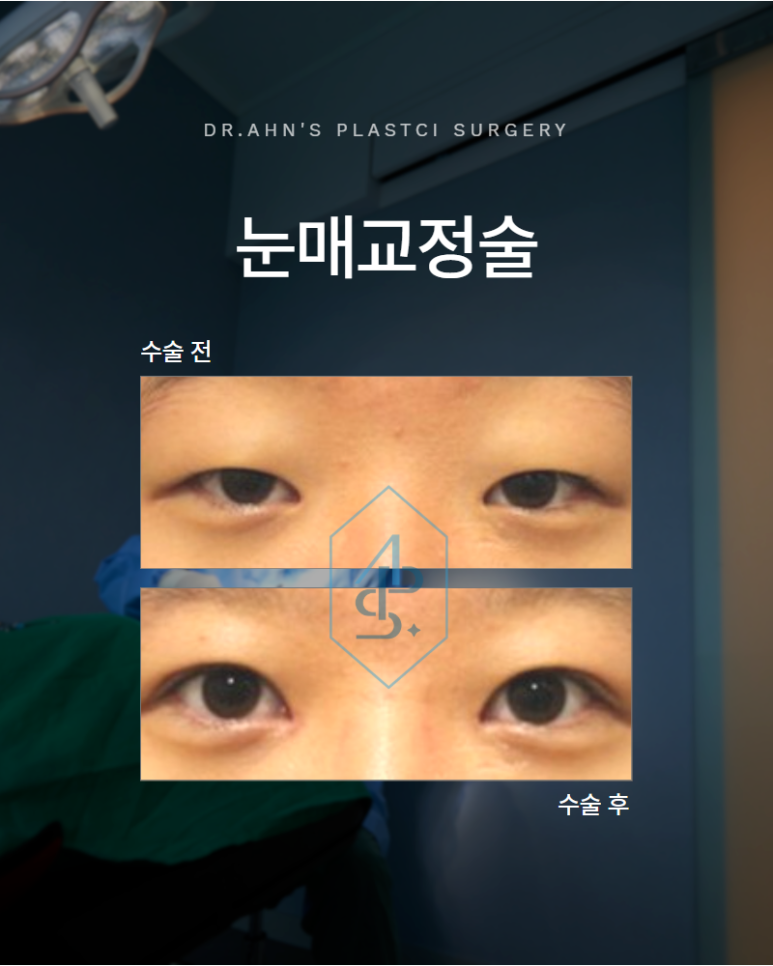
A case observed three months after ptosis correction surgery shows an interesting change.
The height of the eyes was similar before and after surgery, but the position of the eyebrows had noticeably lowered.
This is because, once opening the eyes becomes more comfortable, there is no need to strain the eyebrows.
When the eyebrows move down to a natural position, forehead wrinkles decrease, and the tense muscles throughout the face relax as well, creating a much softer appearance.
This is why ptosis correction surgery is not simply a procedure to make the eyes look larger.
The process of restoring the function of opening the eyes changes the expression of the entire face.

What is the principle behind ptosis correction surgery?
The muscles involved in opening the eyes include the levator muscle and Müller’s muscle.
When these two muscles are congenitally weak or lose strength later in life, the eyelids may not lift sufficiently.
Ptosis correction surgery reinforces the strength used to open the eyes by pulling these muscles forward and securing them.
Advancing the levator muscle and Müller’s muscle by 4 mm results in the eye opening approximately 1 mm more.
However, the presence of this ratio does not make the surgery simple.
Because the two eyes affect each other like a seesaw, correcting one side can also change how much the opposite eye opens.
This is why the balance must be checked and adjusted in real time during surgery.
Not every sleepy-looking eye is a candidate for ptosis correction surgery
Not everyone whose eyes appear less open needs ptosis correction surgery.
In many East Asian patients, the eyelid skin sags and covers the pupils, so the eyes may open much more comfortably simply by removing the excess skin.
If sagging skin is the main cause but muscle reinforcement is performed first, it can lead to overcorrection or an unnatural result.
In fact, a substantial portion of revision-surgery consultations stems from this type of misjudgment.
Therefore, when planning ptosis correction surgery, it is important to first determine whether the muscles are genuinely weak and whether sagging skin is the actual cause.
Postoperative changes should be assessed over time
Immediately after ptosis correction surgery, some people may feel that their eyes are excessively open or that closing them feels awkward.
This is because the tissues have not yet stabilized.
In most cases, they recover naturally as time passes.
After three months, the eyelids stabilize and the intended result begins to emerge.
When opening the eyes becomes more comfortable, tension in the forehead muscles is relieved and the entire expression becomes softer. In many cases, people around the patient notice this change first.
If your eyebrows are always raised or your eyes feel heavy to open,
we recommend consulting an experienced board-certified plastic surgeon to have the condition of the muscles used to open your eyes evaluated.




Previous image
Next image