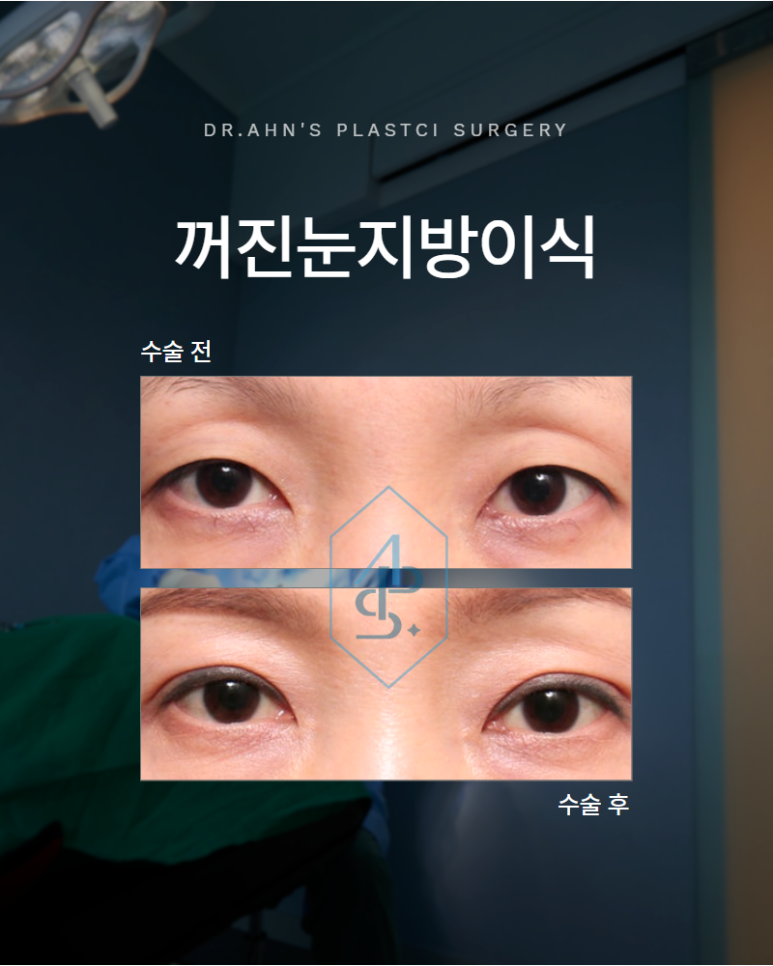
Hello. I am An Byeong-jun, the medical director of An Byeong-jun Plastic Surgery.
Some people start taking a closer look in the mirror after hearing that they “look older.”
When analyzing the issue, many discover that the area above their eyes looks particularly hollow and that their eyelids appear heavy.
This feels different from simply having small-looking eyes.
The sense of emptiness caused by lost volume itself can have a significant effect on making the overall impression look tired and older.
When consulting with people in this situation, we naturally discuss fat grafting for sunken eyes as a possible solution.

Why does the area above the eyes look hollow?
There is naturally fat inside the eyelids.
This fat gently supports the eyelids and provides an appropriate amount of volume around the eyes.
As we age, this fat may gradually decrease or move downward, creating an empty space above the eyes.
As a result, the eyelids may feel as though they are sinking inward, and the upper and lower contours may also begin to look blurred.
People who are born with relatively little fat distributed around the eyelids may develop this condition at a comparatively young age as well.
This is also referred to as sunken eyes.
Because the eyes themselves lack volume, it is difficult to create a natural-looking eye shape simply by modifying the eyelid crease.
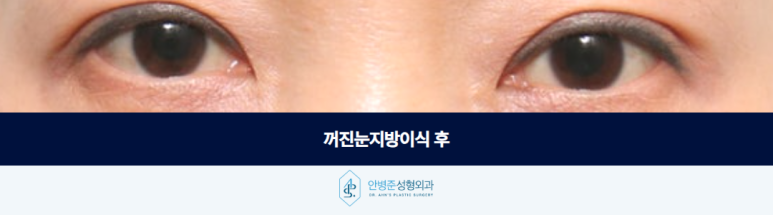
How is fat grafting for sunken eyes performed?
Fat grafting involves harvesting your own fat and transplanting it into hollow areas.
Because your own tissue is used instead of artificial materials, it does not generally create a foreign-body sensation and often maintains a natural appearance over time.
Since the grafting area is inside the eyelid, the incision is not large, and the recovery period is relatively short compared with other surgeries.
However, the amount of fat that survives after grafting varies from person to person, and the results may differ depending on the condition of the harvested fat and the grafting technique.
Therefore, it is more accurate to understand the procedure not simply as filling the area with fat, but as a process of carefully adjusting the distribution and density of volume.
When should ptosis correction also be considered?
There is an important factor to examine when planning fat grafting for sunken eyes.
That is the strength used to open the eyes.
Some people have hollow areas above the eyes as well as weak muscles that lift the eyelids.
In these cases, filling the area with fat alone may leave the eyelids looking heavy and droopy.
Combining fat grafting with ptosis correction can add volume while also improving the function involved in opening the eyes.
The eyes may open more comfortably, and the balance between the upper and lower eyelids may also become more natural.
It is important to examine both the structure and function of the eyes before deciding which procedures to combine.
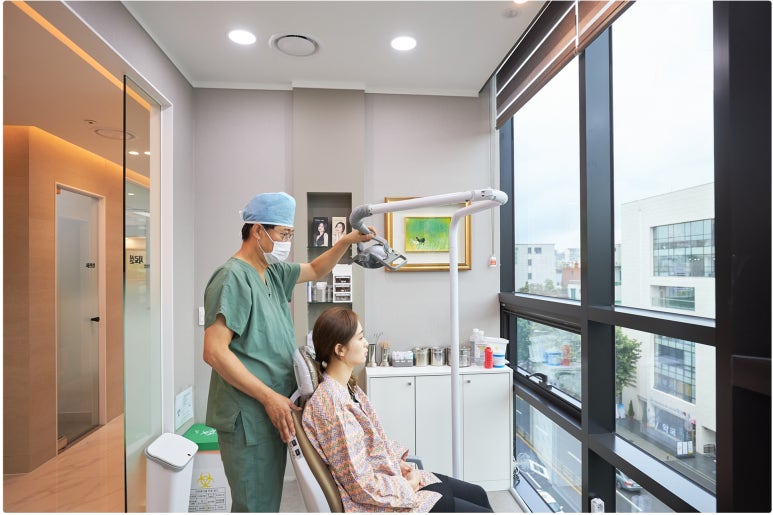
What changes can be expected after surgery?
After fat grafting for sunken eyes, there is initially swelling, and there may be a period when the eyes appear overly filled.
This swelling generally begins to subside gradually over the course of two to three weeks.
Around three months, when the grafted fat has stabilized, the contours around the eyes begin to settle into a natural shape.
After this period, many people feel that their overall impression has become much softer as the empty space in the eyelids is filled.
Some also hear that their previously tired-looking eyes appear more lively or that the shadows around their eyes have become less noticeable.
Creating natural-looking eyes
When people want to improve their eye shape, it is easy to think that changing the eyelid crease alone will be enough. However, when the eyes have lost volume, changing the crease may not significantly alter the overall impression.
The overall appearance of the eyes can change only when the areas that are structurally empty are filled.
In cases where the eyelids look hollow or the area above the eyes feels as though it is folding inward, it is advisable to first restore the volume through fat grafting.
After examining each person’s eye structure and the distribution of fat, we will work together to find the most suitable approach.



Previous image
Next image