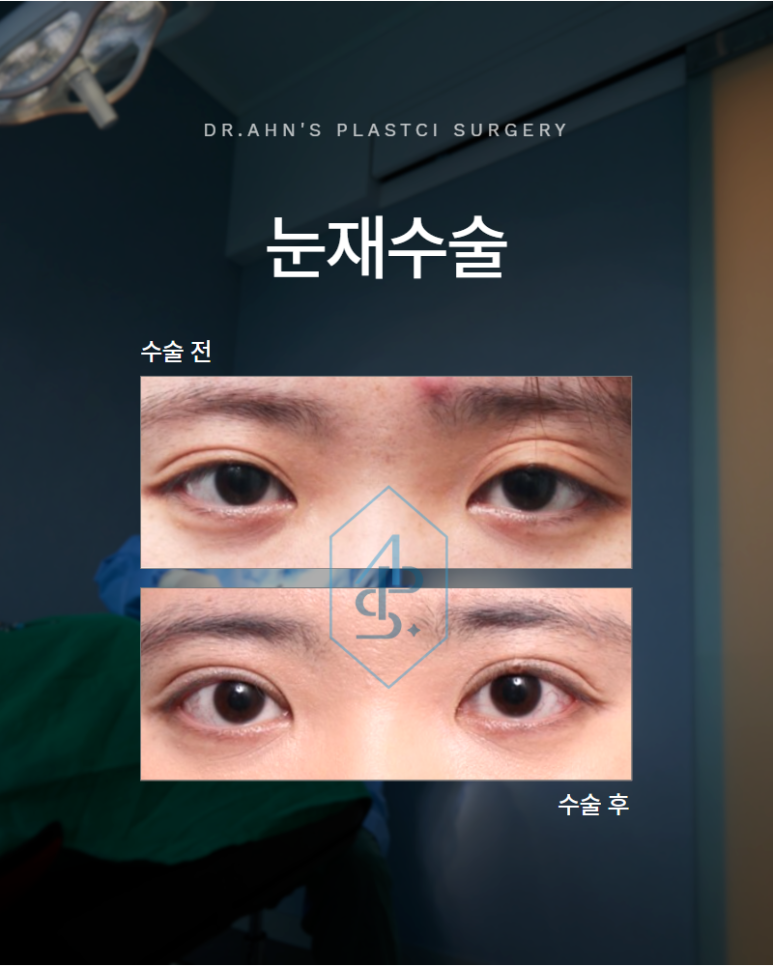
Hello. I am Ahn Byung-jun, director of Ahn Byung-jun Plastic Surgery.
Some people come to the consultation room saying that, even after having the same area operated on twice, the result is still far from what they wanted.
These are cases in which they were unable to achieve a satisfactory change even after one revision surgery and have gone from clinic to clinic looking for another revision eye surgery clinic.
I often hear that the creases appear doubled even when the eyes are closed, and that the eyes still leave a slightly sleepy-looking impression whenever they are opened.
In many cases, this condition cannot be improved simply by readjusting the position of the crease.
The more surgery is repeated, the more the tissue has already been stimulated, so in some cases the approach needs to be reconsidered from the beginning.
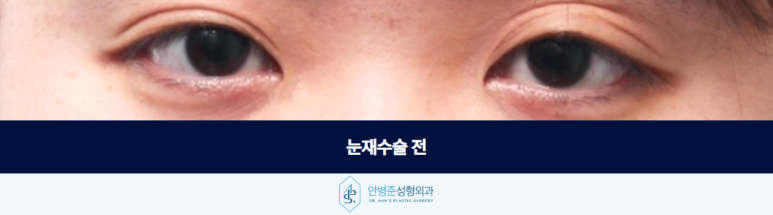
Double creases and a sleepy-looking impression may have different causes
The appearance of overlapping creases and a sleepy-looking appearance can stem from different problems.
Double creases are usually caused by an imbalance between the fixation position of the crease and the amount of excess skin.
When a new crease is added above the existing crease, the two lines appear to overlap.
A sleepy-looking appearance, on the other hand, is often related to the strength used to open the eyes—in other words, the function of the levator muscle of the upper eyelid.
Simply recreating the crease does not necessarily improve the strength used to open the eyes, so each of the two causes needs to be examined separately.
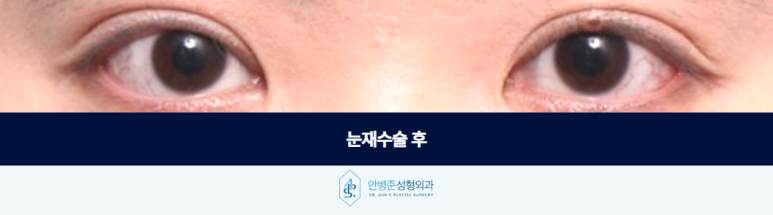
Why consider ptosis correction at a revision eye surgery clinic?
If the previous surgery adjusted only the crease issue, the reduced strength used to open the eyes may still remain.
In such cases, combining crease revision surgery with ptosis correction may help address the sleepy-looking appearance as well.
Ptosis correction is a process of adjusting the attachment between the levator muscle of the upper eyelid and the conjunctiva to restore the strength used to open the eyes.
If only crease revision surgery is performed and ptosis correction is omitted, the appearance may change while the discomfort related to opening the eyes remains.
Therefore, at a revision eye surgery clinic, the process should begin by diagnosing both the double creases and the discomfort when opening the eyes.
We carefully examine the condition of the tissue first
In eyes that have undergone surgery two or more times, adhesions or scar tissue have often already formed.
If surgery is performed in this condition as though a new crease were simply being added, the double creases may become even more pronounced.
For this reason, the existing tissue is first整理ed and adhesions are released, after which the crease is redesigned according to the structure of the eyes.
The direction of treatment can be determined only by considering the position of the eyeballs, skin thickness, and the levator muscle of the upper eyelid together.
If this process is skipped, the same concerns may recur even after the next surgery.
Care afterward
Immediately after surgery at a revision eye surgery clinic, the crease may look somewhat darker or more pronounced because of swelling and tightness.
During this period, it is better to wait for the swelling to subside rather than try to determine whether the double crease remains.
After about a month, the crease usually begins to settle, and many people say that the feeling when opening their eyes has also changed.
When there is a history of previous surgery, recovery time may vary from person to person, so it is necessary to monitor the progress and manage the condition accordingly.
If double creases or a sleepy-looking appearance remain even after multiple surgeries, the priority is to analyze and identify the cause before rushing into another procedure.
This is because the solution differs depending on whether the issue is with the crease or with the strength used to open the eyes.
Examining the condition of the existing tissue together with the function of the eyes may be the first step toward ending recurring concerns.





Previous image
Next image